Part 10 of 27 in Homo Conspirans: The Humans Who Come After Us
Homo Conspirans · Musk’s dream: “robots, not prisons, to stop crime” → a gentler humanity
In a world where AI mediates our quarrels and robots stop violence, humanity domesticates itself once more. Hotheads win fewer jobs and fewer partners, and the temperament fades over the generations. People drift away from who they are now, the way dogs drifted away from wolves.
In 1959 the Soviet geneticist Dmitry Belyaev, working in Novosibirsk, brought 30 male and 100 female silver foxes from a fur farm in Estonia. He had one rule: only the foxes that were less afraid and less aggressive when a person came near would be allowed to breed. He paid no attention to coat color or size. Within 10 generations, 18 percent of the pups had become the “elite,” foxes that came up to people on their own, wagging their tails and whimpering. By the 20th generation it was 35 percent, and by 1999 it was 70 to 80 percent.[1]
The surprise was the changes nobody chose. Ears drooped, tails curled up, white patches appeared in the fur and snouts grew shorter. It was the same “domesticated face” seen in dogs, pigs and cattle. Belyaev selected only for tameness, and the whole body came along.
In this story
Humans are the animal that tamed itself
The Harvard primatologist Richard Wrangham argues that humans walked the same road. In a chimpanzee group, fights over rank break out almost every day, but humans are remarkably calm inside their own group. Wrangham traces the reason to “executions” hundreds of thousands of years ago. Once men had language, they joined forces to kill the bullies who terrorized the group, and the hot temper was weeded out generation after generation.[2]
The bones kept a record. In 2014, researchers from Duke University and the University of Utah compared more than 1,400 skulls, from ones older than 80,000 years to those of 20th-century people. Over time the brow ridges got lower and the upper face got shorter. The researchers read this as a sign of weaker male hormone effects and growing tolerance for one another.[3] It points the same way as the silver fox’s shorter snout.
Also read: AI Will Reverse Human Aging, Even If Musk Says We Need Death: Reverse Aging
This time AI does the filtering
In the past, weeding out the violent took fights that put the whole group’s lives at risk. In the AI age the job becomes cheap and quiet. At Tesla’s shareholder meeting in November 2025, Musk suggested that instead of locking criminals in prison, an Optimus robot could follow them around and stop them from committing crimes again. He called it “a more humane form of containment of future crime.”[4]
AI has also started handling the quarrels that come before the fists. In October 2024, Google DeepMind published an AI mediator called the “Habermas Machine” in Science. When 5,734 people in Britain debated touchy subjects like immigration and climate, participants rated the joint statements written by the AI above the summaries written by human mediators. After AI mediation, the share of people who landed on the same position rose by an average of 8 percentage points.[5]

How anger leaves the gene pool
The taming happens through selection, not execution. In a world where AI analyzes the tone of job interviews, dating apps read aggression in chats and robots record violence, hotheads get fewer chances. A temperament that wins fewer jobs and fewer partners leaves less of itself in the next generation. Society as a whole does to people what Belyaev did to his foxes, this time without anyone meaning to choose.
And as with the silver foxes, tameness does not come alone. Faces grow more youthful, the playful years last longer, and more people smile easily at strangers. An AI brain update that makes a person kinder will one day be sold as a monthly subscription, but that changes one person’s character. This is about a species’ temperament shifting over dozens of generations.

March 2059: the year the school violence committee never met
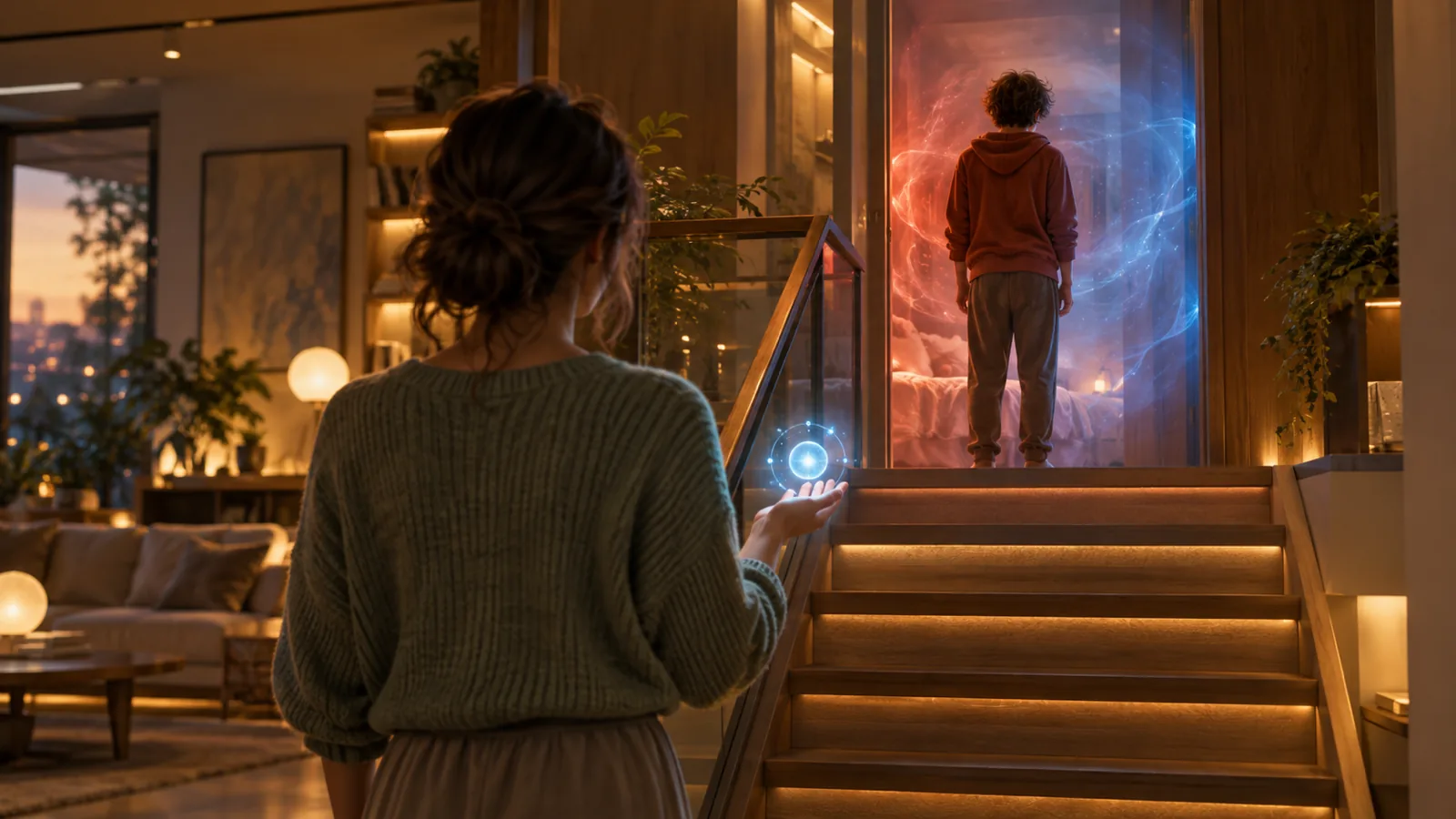
March 2059, a high school in Busan, South Korea. Mr. Park, a teacher for 30 years, is writing his annual report for the education office. In the past year, the school violence committee did not meet once. The last fistfight at this school was eight years ago. When a dispute breaks out, the students talk to the classroom’s AI mediator first.
That afternoon, in a video class, Mr. Park plays a news clip from the 2020s of two subway passengers screaming at each other. The kids do not laugh. A few cover their eyes, and one asks why those people did not just call the AI. Mr. Park remembers the swearing he heard several times a day when he was their age.

AI mediation by 2030, younger faces by 2150
This is the order in which humanity tames itself once more.
- 2030: Half of South Korea’s noise disputes between apartment neighbors go through AI mediation before they reach a human counselor.
- 2036: Several U.S. states begin assigning a security robot or an AI monitoring bracelet, instead of prison, to people with minor violent records.
- 2045: Violent crime in rich countries falls to half its 2025 level.
- 2060: Studies pile up showing that the “anger risk” dating apps and hiring AI read from speech makes a real difference in who finds partners and jobs.
- 2090: The generation raised with AI mediation scores markedly lower on aggression tests than their grandparents did.
- 2150: Facial measurement studies first detect, statistically, brow ridges and jaws smaller than in the 20th century.
Belyaev’s foxes still crowd toward the cage door in Novosibirsk when a person walks by. What the experiment, now more than 60 years old, left behind is not only tame foxes. It is the fact that when you select for tameness, the body follows. And the hand making that selection is passing to AI.
Next in the series · Musk’s AI Space Reactors Will Take Humanity to the Brink of Nuclear War: Nuclear Reactors in Space
In 1962 a nuclear bomb detonated 400 kilometers up in space set off alarms in Hawaii, 1,400 kilometers away. Now the U.S. and China are racing to put the first reactor on the Moon.
Homo Conspirans: The Humans Who Come After Us · Part 10 of 27
Part 11 arrives Nov. 6.
Read next
 Humans With Musk's AI Brain Chips Will Evolve to See Infrared: Neuralink Blindsight
 When Artificial Wombs and AI Take Over Birth, Human Evolution Will Start With the Pelvis: Artificial Wombs
 Humans Who Hand Their Thinking to AI Will See Their Brains Shrink Again, Like 3,000 Years Ago: Is AI Making Us Dumber
Trending on Seol Notes
- Kim You-jung Cracked Japan Despite the 'Anti-Japan Drama' Label
- The Emperor of K-pop Came Back, and Korea Flipped
- Ae-sun Left the Baeksang Empty-Handed. Then She Spoke: IU
- The No. 1 Korea Doesn't Want to Believe: Why Fans Doubt A2O
- Teachers Get Reported for It. Korean Folk Village Ghosts Get Cheered.
Sources
- Lyudmila N. Trut, “Early Canid Domestication: The Farm-Fox Experiment,” American Scientist 87(2), 160–169, 1999 (see also PBS NewsHour, “Domesticated foxes are genetically fascinating, but terrible pets”). https://www.pbs.org/newshour/science/domesticated-foxes-genetically-fascinating-terrible-pets
- Richard Wrangham, The Goodness Paradox: The Strange Relationship Between Virtue and Violence in Human Evolution, Pantheon, 2019 (Harvard Gazette, January 2019). https://news.harvard.edu/gazette/story/2019/01/author-examines-the-strange-relationship-between-good-and-evil
- Robert L. Cieri, Steven E. Churchill, Robert G. Franciscus, Jingzhi Tan & Brian Hare, “Craniofacial Feminization, Social Tolerance, and the Origins of Behavioral Modernity,” Current Anthropology 55(4), 419–443, 2014. https://doi.org/10.1086/677209
- Electrek, “Elon Musk says let criminals out of prison and give them a robot stalker instead,” November 6, 2025. https://electrek.co/2025/11/06/elon-musk-says-let-criminals-out-of-prison-and-give-them-a-robot-stalker-instead
- Michael Henry Tessler et al., “AI can help humans find common ground in democratic deliberation,” Science 386, eadq2852, October 18, 2024. https://doi.org/10.1126/science.adq2852
Discover more from Seol Notes
Subscribe to get the latest posts sent to your email.