Part 8 of 27 in Homo Conspirans: The Humans Who Come After Us
Homo Conspirans · Musk’s dream: “eyes that see infrared and even radar” → a humanity with a longer list of senses
Musk’s brain chip will not stop at giving sight back to the blind. It will add senses no human has ever had. Humans who see infrared will arrive within a single generation, without waiting tens of millions of years for evolution.
April 12, 2011, a rehabilitation facility in Massachusetts. Cathy Hutchinson, 58, sits in her wheelchair looking at a bottle of coffee on the table. Fifteen years earlier a brainstem stroke had paralyzed her from the neck down and taken her speech. An electrode chip the size of an aspirin tablet had been implanted in her motor cortex. When she thought about reaching out, the robotic arm beside her grasped the bottle and brought it to her lips, and she drank coffee through a straw. It was the first coffee she had drunk on her own in 15 years. The scene was published in Nature the following year.[1]
On September 17, 2024, the U.S. Food and Drug Administration designated Neuralink’s vision chip, Blindsight, a breakthrough device. That day Musk wrote on X that it would start out low resolution, like old Atari graphics, but could eventually be better than natural vision and let people see in infrared, ultraviolet or even radar wavelengths. He pointed to Geordi La Forge of Star Trek, who sees the world through a visor instead of eyes.[2]
In this story
We see with the brain, not the eyes
Musk’s words sound like bluster, but neuroscience is on his side. In 1969 the American rehabilitation physician Paul Bach-y-Rita fitted 400 vibrating pins into the back of a dentist’s chair and hooked them up to a camera. Blind people sat in the chair and trained by feeling the vibrations on their backs, and before long they could tell a telephone from a cup and make out the outline of a face.[3] He said the same thing his whole life: we see with the brain, not with the eyes.
The brain does not care where a signal comes from. It finds useful patterns in whatever comes in and rewires itself to fit those patterns. That turned a bold idea into an experiment anyone could run: feed the brain a signal the eyes could never receive, and watch what it does with it.
Also read: AI Will Reverse Human Aging, Even If Musk Says We Need Death: Reverse Aging
Rats touched infrared, and monkeys saw a new color
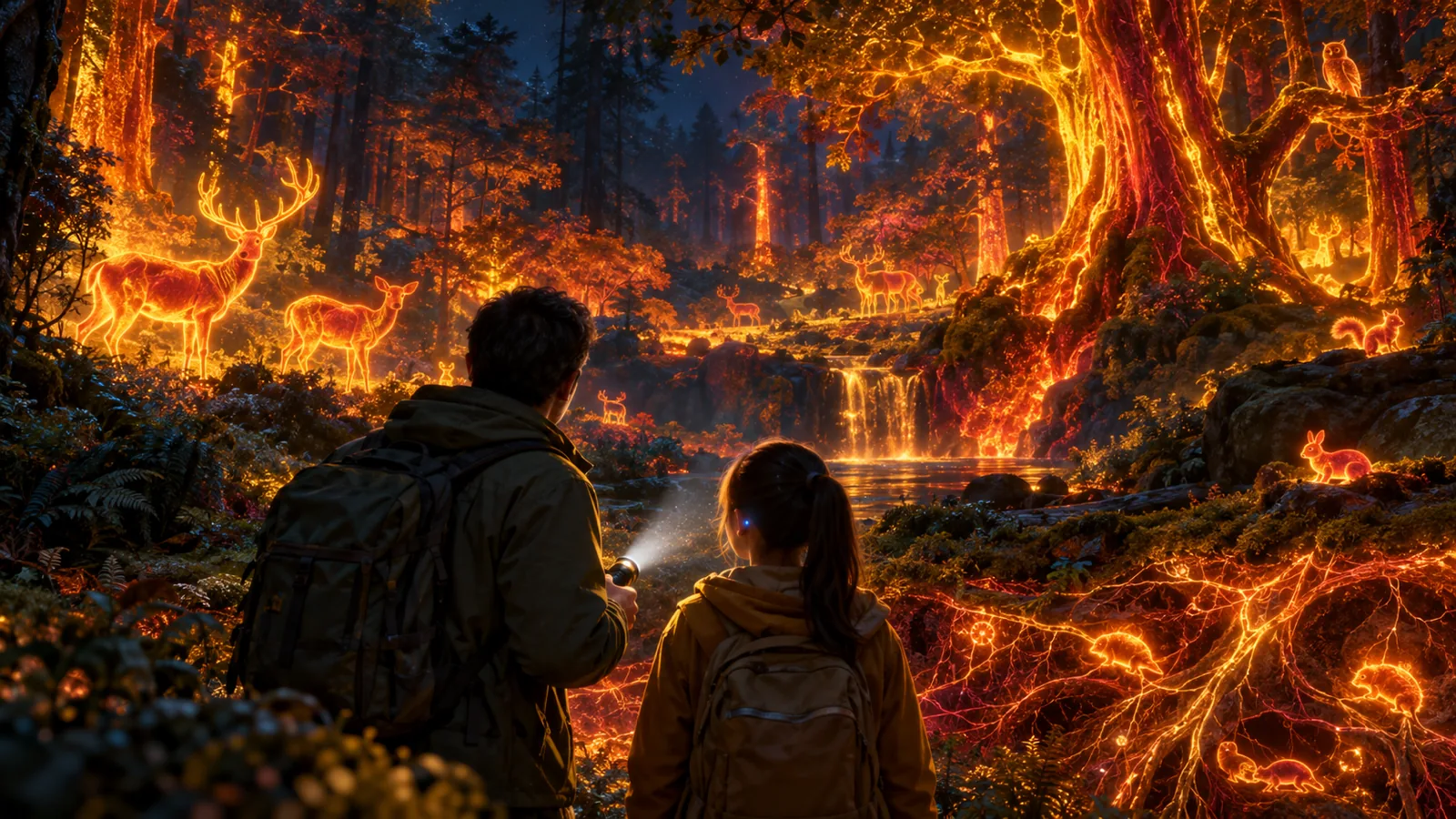
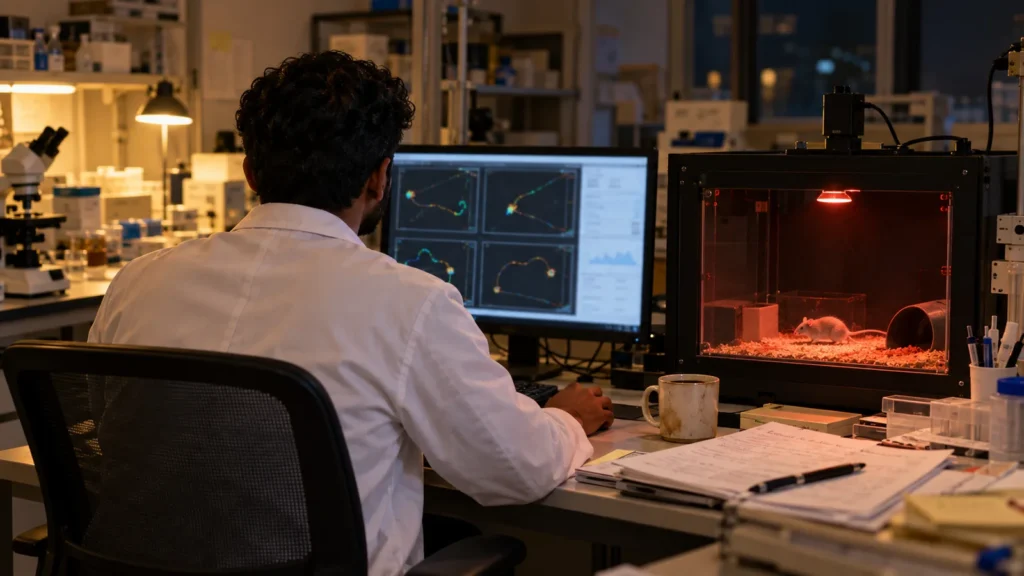
In February 2013, Miguel Nicolelis’s team at Duke University fitted rats with infrared sensors on their heads and fed the signals, as electrical pulses, into the part of the brain that feels the touch of the whiskers. Rats cannot see infrared. Yet after about a month, they were turning their heads to locate the source of infrared light and heading toward it to collect a reward. The surprise was that the same brain region still responded to whisker touch.[4] The new sense did not push out the old one. It settled in beside it.
Colors can be added too. In 2009, researchers at the University of Washington put a human color-vision gene into the eyes of two adult squirrel monkeys that could not tell red from green. About 20 weeks later, the monkeys began telling apart red and green, colors they had never seen in their lives.[5] For our ancestors to get eyes that separate red from green, a gene had to be copied by accident and tens of millions of years of selection had to pile up. In the lab, it took one injection and five months.
A chip that changes the speed of evolution
Biological evolution builds new senses slowly. Rattlesnakes evolved pits between their eyes and nostrils that sense the body heat of prey, and the organ took millions of years to finish. Humans lived for hundreds of thousands of years with eyes that catch only a narrow band of light, 380 to 700 nanometers.
Brain chips reverse that order. The sensor comes first, and the brain grows to fit it within weeks. A child who gets a chip young adapts far more deeply than an adult. Like a baby learning a mother tongue, the child builds a brain that takes infrared as part of the world from the start. The first chips implanted in people will be therapies that restore lost function, but the threshold between treatment and enhancement drops faster than anyone expects. The workplace will feel it first, as people with chips start getting promoted ahead of people without them.

January 2064: new rules for hide-and-seek
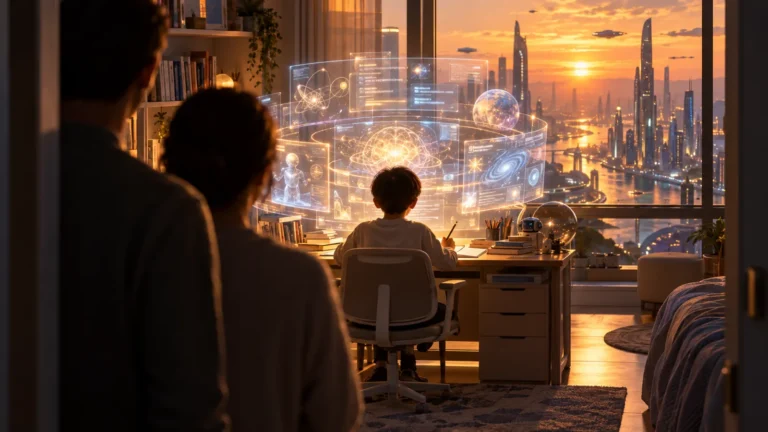
January 2064, a playground in an apartment complex in Incheon, South Korea. It is 9 p.m., and six children are playing hide-and-seek. Ha-jun, 11, always wins when he is “it.” He was born blind and got a vision chip at age three, and the chip shows him infrared along with visible light. The friend hiding behind the slide is, to his eyes, a human shape glowing orange. He can see the two cats beyond the fence and the warmth left on a bench someone just got up from.
In the end the kids made a new rule: when Ha-jun is “it,” heat vision goes off. He grumbles and presses the small button behind his ear. Of the 28 children in his class, three have chips. Two are for therapy. One is an enhancement, put in by parents who want their child to become a firefighter.

The first image in 2027, the first generation by 2070
This is the order in which the human list of senses grows.
- 2027: Blindsight is implanted in a human for the first time. A patient who has lost both eyes tells doors from people on a coarse display of a few dozen points of light.
- 2031: A vision-chip patient switches on infrared mode for the first time. The first case of recognizing a person’s body heat in the dark appears in a journal.
- 2038: A pilot program in the U.S. fits firefighters and search-and-rescue crews with infrared-sensing chips, the first official use of an added sense in people without a disability.
- 2050: Half of blind children receive a vision chip before age five. Their visual cortex grows to process visible light and infrared together.
- 2064: One in ten South Korean elementary school students carries a sensory chip, for therapy or enhancement.
- 2070: The first generation that grew up seeing infrared comes of age. For them, warmth is a color you see before it is something you feel with your hand.
The long-standing explanation in evolutionary biology is that humans came to see red and green separately because we had to find ripe fruit in the forest. The next color comes not from the forest but from the operating room. And the children who see it first will not call it technology. They will just call it the world.
Next in the series · Musk’s “Seed of Civilization” Will Be Stored in AI and Buried on the Moon First: The Doomsday Vault
In 2015 the Syrian civil war forced the first withdrawal from the doomsday seed vault in the Arctic. Humanity’s backup is moving from seed packets to AI, and from the Arctic to the Moon.
Homo Conspirans: The Humans Who Come After Us · Part 8 of 27
Part 9 arrives Nov. 4.
Read next
 AI Will Wire 8 Billion Brains Into One Superorganism, Like an Ant Colony: The Global Brain
 Homo Sapiens Will End in Musk's AI Age, and Homo Conspirans Will Begin: The Next Stage of Human Evolution
 Humans Who Hand Their Thinking to AI Will See Their Brains Shrink Again, Like 3,000 Years Ago: Is AI Making Us Dumber
Trending on Seol Notes
- Kim You-jung Cracked Japan Despite the 'Anti-Japan Drama' Label
- The Emperor of K-pop Came Back, and Korea Flipped
- Ae-sun Left the Baeksang Empty-Handed. Then She Spoke: IU
- K-pop News Today (Oct 27, 2026): IVE's EP Drop, ILLIT 'You're Under Arrest', LISA's 59M
- K-pop News Today (Oct 31, 2026): BTS's 'Arirang' Night in Brazil, JISOO's 'ADDICTED' Tops iTunes, NMIXX Win Music Bank
Sources
- Leigh R. Hochberg et al., “Reach and grasp by people with tetraplegia using a neurally controlled robotic arm,” Nature 485, 372–375, May 17, 2012. https://doi.org/10.1038/nature11076
- The Debrief, “Elon Musk’s Neuralink Receives FDA Breakthrough Designation for ‘Blindsight’ Implant Aiming to Restore Vision,” September 2024 (Elon Musk, X post, September 17, 2024). https://thedebrief.org/elon-musks-neuralink-receives-fda-breakthrough-designation-for-blindsight-implant-aiming-to-restore-vision/
- Paul Bach-y-Rita, Carter C. Collins, Frank A. Saunders, Benjamin White & Lawrence Scadden, “Vision substitution by tactile image projection,” Nature 221, 963–964, 1969. https://doi.org/10.1038/221963a0
- Eric E. Thomson, Rafael Carra & Miguel A. L. Nicolelis, “Perceiving invisible light through a somatosensory cortical prosthesis,” Nature Communications 4, 1482, February 12, 2013. https://doi.org/10.1038/ncomms2497
- Katherine Mancuso et al., “Gene therapy for red–green colour blindness in adult primates,” Nature 461, 784–787, 2009. https://doi.org/10.1038/nature08401
Discover more from Seol Notes
Subscribe to get the latest posts sent to your email.