Part 6 of 27 in Homo Conspirans: The Humans Who Come After Us
Homo Conspirans · Musk’s dream: “AI smarter than the smartest human” → the shrinking individual brain
A humanity that hands its memory, arithmetic and judgment to AI will see its brains shrink. The human brain has shrunk this way once before, and for the same reason: nobody needed to know everything alone anymore.
In October 2021, a team led by the Dartmouth anthropologist Jeremy DeSilva published an analysis of 985 fossil and modern human skulls spanning 10 million years. The brain grew sharply about 2.1 million and 1.5 million years ago. But starting about 3,000 years ago, the team concluded, it began to shrink. They found their explanation in ants. In ant species that divide labor and decide together, each individual has a smaller brain. Humans, they argued, began storing knowledge across the group once writing and cities appeared, and a single head no longer had to hold it all.[1]
The timing is disputed. The following year another team reanalyzed the data and argued there had been no clear decline over the past 30,000 years.[2] But both sides agree on one thing. The brain is an expensive organ, 2 percent of body weight burning 20 percent of the body’s energy, and evolution does not keep an expensive organ around for long when it goes unused.
In this story
The search box took our memory
The brain putting down its work has already been caught in the lab. In a 2011 study in Science, Betsy Sparrow’s team at Columbia had people type out short statements. Those told the statements would be saved on the computer remembered the content worse than those told it would be erased. What they remembered well instead was which folder the information was in.[3] The brain had started memorizing the route to the answer instead of the answer. The phenomenon got a name: the Google effect.
A 2020 study from McGill University in Canada went further. Among 50 drivers, the more someone had used GPS over a lifetime, the worse their spatial memory when finding the way without it. Of the 13 people retested three years later, those who had used GPS more in the meantime showed a steeper decline in spatial memory that relies on the hippocampus, the part of the brain that handles memory and navigation.[4] The sample is small. But it points the same way as Sparrow’s experiment. Whatever the machine does, the brain stops doing.
This time we hand over thinking, not memory
What the search box and GPS took was memory and directions. What AI takes is thinking itself. In an April 2024 conversation with Nicolai Tangen of Norway’s sovereign wealth fund, Musk said AI would be smarter than the smartest human next year, two years at the latest.[5] His timeline was optimistic as usual, but the direction is already reality. People ask AI for the first line of an email, the conclusion of a report, what to cook for dinner and what to tell their child.
The signals are in. IQ scores of hundreds of thousands of Norwegian military conscripts rose through men born in 1975 and then began falling in the generations born after. The drop shows up even between brothers with the same parents, the younger scoring lower than the older. That means the change comes from the environment, not from genes.[6] Researchers have also measured how brain activity changes in people who write with ChatGPT.

The individual head shrinks; humanity’s head grows
None of this makes humanity stupid, and the ants show why. What caught DeSilva’s team’s attention was that ant species with smaller brains are not dumber. Each ant’s brain is small, but the colony as a whole pulls off more complex work.[1] If the human brain shrank 3,000 years ago, the timing lines up with the arrival of writing, law codes and cities. Each person memorized less, and society remembered more.
The AI age is the same bargain. The human brain sets down phone numbers, directions, spelling and arithmetic one after another and spends the freed energy elsewhere: choosing which questions to ask, deciding which of the AI’s answers to trust, reading other people’s minds. The individual brain gets smaller, and the head of humanity as a whole, built from people and AI together, gets bigger. One person grows less clever. Humanity grows cleverer.

May 2052: a grandmother who knows 50 phone numbers
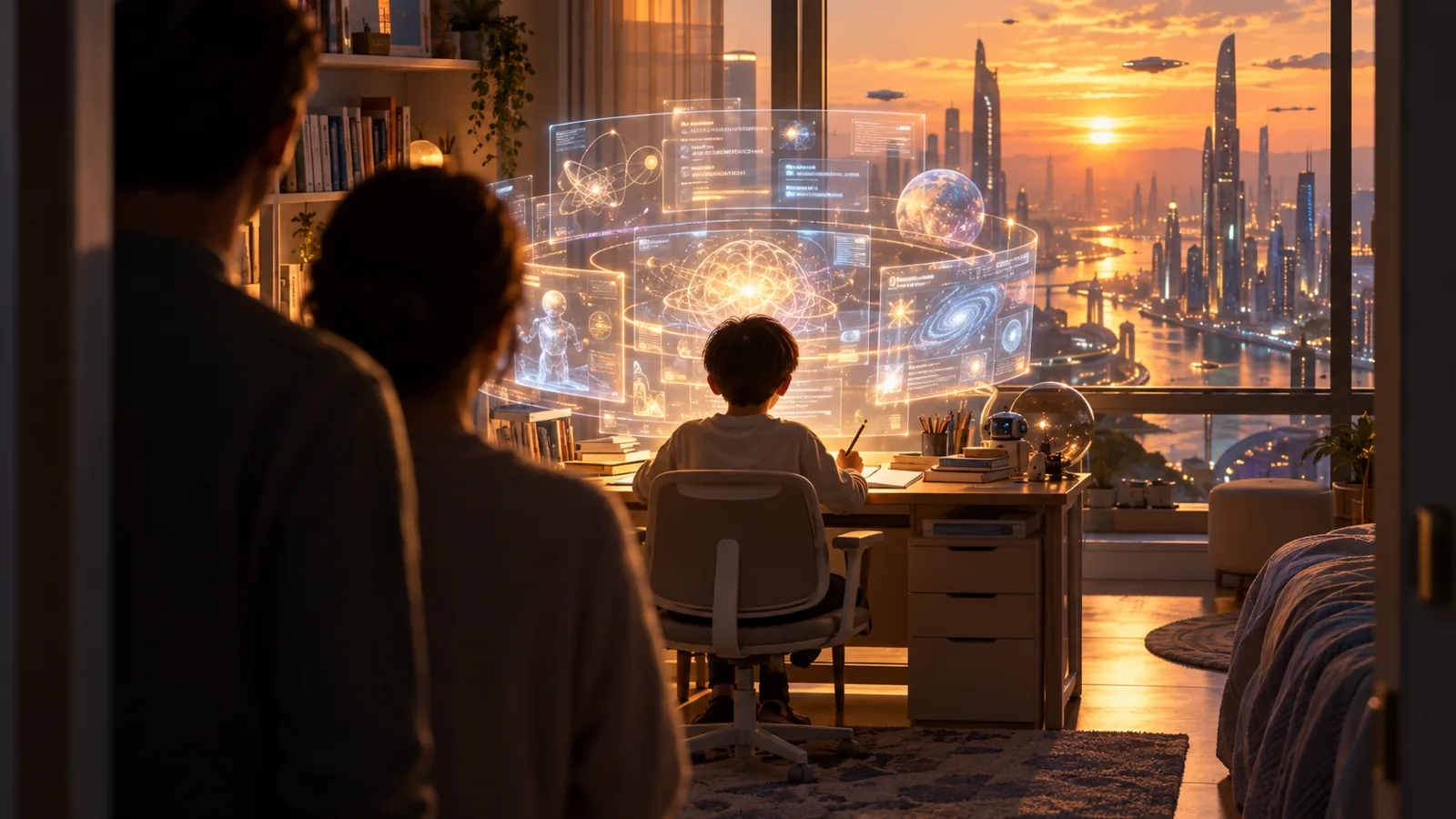
Parents’ Day 2052, at a restaurant in Daejeon, South Korea. A 78-year-old grandmother plays a trick on her granddaughter: she recites 50 phone numbers of family and friends without a single mistake. The 14-year-old looks as if she has just seen a magic trick. She does not know her own mother’s number. She has never once dialed a number by hand. Instead she does something her grandmother never could. From her aunt’s face as she reads the menu, she works out what happened to her at the office yesterday. The AI in her ear flagged the tremor in her aunt’s voice, but choosing what to ask was the girl’s own doing.
An international study published the same year finds that the first generation raised talking to AI for most of the day has a hippocampus a few percent smaller on average than people born in the 1990s. The connections in the brain regions that read faces and intentions, though, are denser.

The hippocampus in 2035, brain volume in 2070
This is the order in which the individual brain shrinks.
- 2030: Half of the school exams in rich countries become “solve it together” exams that allow AI. Memorization questions disappear from the test paper.
- 2035: The first large study shows that people who use AI more than six hours a day have a smaller hippocampus than those who do not.
- 2040: Most adults cannot recite their family’s phone numbers or describe the way to places they go often. Diagnostic manuals list this as normal, not as a disorder.
- 2052: The first generation raised with AI is measured with a smaller average hippocampus than the generation before, and denser connections in the regions for social judgment.
- 2070: The third generation raised with AI has a smaller average brain volume than people born in the 1990s. In the same year, humanity makes ten times as many scientific discoveries as it did in 2020.
When the brain shrank 3,000 years ago, humanity gained writing. As the brain shrinks this time, humanity gains AI. When a scholar of the future measures our fossilized skulls, she will find a second era in which the individual got smaller and the group grew enormous.
Next in the series · When Artificial Wombs and AI Take Over Birth, Human Evolution Will Start With the Pelvis: Artificial Wombs
Eight lambs grew for four weeks inside plastic bags. The day birth no longer passes through the birth canal, the tug-of-war between the baby’s head and the mother’s pelvis that has lasted millions of years comes to an end.
Homo Conspirans: The Humans Who Come After Us · Part 6 of 27
Part 7 arrives Nov. 2.
← Part 5: AI Will Reverse Human Aging, Even If Musk Says We Need Death: Reverse Aging
Read next
 AI Will Wire 8 Billion Brains Into One Superorganism, Like an Ant Colony: The Global Brain
 When AI Robot Bodies Become Free, People Who Keep Mortal Bodies Will Become a Minority: Galaxy Express 999
 Children Raised by AI on Musk's Mars Will Evolve Bodies That Can Never Return to Earth: How Humans Would Evolve on Mars
Trending on Seol Notes
- Kim You-jung Cracked Japan Despite the 'Anti-Japan Drama' Label
- The Emperor of K-pop Came Back, and Korea Flipped
- Ae-sun Left the Baeksang Empty-Handed. Then She Spoke: IU
- K-pop News Today (Oct 27, 2026): IVE's EP Drop, ILLIT 'You're Under Arrest', LISA's 59M
- His First Film Never Opened. His First Role Had No Name. Then Korea Called Him "Sam-sik"
Sources
- Jeremy M. DeSilva, James F. A. Traniello, Alexander G. Claxton & Luke D. Fannin, “When and Why Did Human Brains Decrease in Size? A New Change-Point Analysis and Insights From Brain Evolution in Ants,” Frontiers in Ecology and Evolution 9, 742639, October 22, 2021. https://doi.org/10.3389/fevo.2021.742639
- Brian Villmoare & Mark Grabowski, “Did the transition to complex societies in the Holocene drive a reduction in brain size? A reassessment of the DeSilva et al. (2021) hypothesis,” Frontiers in Ecology and Evolution 10, 963568, July 29, 2022. https://doi.org/10.3389/fevo.2022.963568
- Betsy Sparrow, Jenny Liu & Daniel M. Wegner, “Google Effects on Memory: Cognitive Consequences of Having Information at Our Fingertips,” Science 333(6043), 776–778, 2011. https://doi.org/10.1126/science.1207745
- Louisa Dahmani & Véronique D. Bohbot, “Habitual use of GPS negatively impacts spatial memory during self-guided navigation,” Scientific Reports 10, 6310, April 14, 2020. https://pmc.ncbi.nlm.nih.gov/articles/PMC7156656/
- Nasdaq (Benzinga), “Musk Predicts AI Will Outsmart Humans By 2026,” April 2024 (X Spaces interview with Nicolai Tangen, April 8, 2024). https://www.nasdaq.com/articles/musk-predicts-ai-will-outsmart-humans-by-2026
- Bernt Bratsberg & Ole Rogeberg, “Flynn effect and its reversal are both environmentally caused,” PNAS 115(26), 6674–6678, 2018. https://pmc.ncbi.nlm.nih.gov/articles/PMC6042097/
Discover more from Seol Notes
Subscribe to get the latest posts sent to your email.