

Some Japanese viewers called 100 Days of Deception, Kim You-jung’s new drama, an “anti-Japan drama.” Six days after it premiered, it was in Netflix Japan’s Top 10. The label lost to the show, and what carried the show across the border was Kim’s choice to play a spy who works in three languages. In the same month, Korea watched a drama based on a Japanese original far more. October 2026 shows people choosing stories, not passports.
In this story
The “anti-Japan” drama made Japan’s Top 10
100 Days of Deception is set in Gyeongseong in 1932. Gyeongseong is what Seoul was called under Japanese colonial rule. Lee Ga-kyung (Kim You-jung), the best pickpocket in the city, goes undercover as an interpreter at the Japanese Government-General of Korea for the resistance group Gugukdan and has to survive 100 days there. It is a spy romance. Her opposite is Kim Tae-woong, Japanese name Sato Hideo (Park Jinyoung), an elite interpreter and the adopted son of senior colonial official Sato Shinichi (Jin Seon-kyu). It is tvN’s 20th-anniversary drama, directed by Yoo In-sik and written by Ryu Bo-ri. A drama about colonial rule has Japanese officials as villains. That is history, not a twist. When some Japanese netizens cried “anti-Japan,” Korean netizens fired back that it is “a period drama based on clear historical fact” and that the accusation was the distortion (Sports Kyunghyang, Oct. 15, 2026).
TVING’s official highlight sets the scene: 1932 Gyeongseong, and a lie that bets everything.
Then, on Oct. 15, six days after the premiere, the show entered Netflix Japan’s TV Top 10 at No. 10, according to the streaming chart tracker FlixPatrol (Sports Kyunghyang, Oct. 15). English-language critics noticed too. Ready Steady Cut wrote that a drama this critical of Japan’s colonial rule finding an audience in Japan is proof that “good stories win out” (Oct. 19, 2026).
Netflix Japan’s own trailer for 100日の嘘 (The 100 Days of Lies).
Also read: A Med Student Wrote It the Night Before an Exam. Kim Kwang-seok Made It Last.
Not anti-Japan. Anti-colonial.
What this drama targets is colonial rule, not Japanese nationality. The difference is in the heroine. Lee Ga-kyung is not a flag-waving freedom fighter. She is a pickpocket who wants a ticket out of the country. What drives the story is not hatred of a nation but lies and survival.
The heroine is a thief first. Netflix K-Content calls this one “the most graceful arrest ever.”
Some Japanese viewers put their finger on exactly that point. On Filmarks, Japan’s big drama review site, the show has 205 reviews averaging 4.2 out of 5 (checked Oct. 24). There are reviews saying the scenes of Japanese military brutality are hard to watch, and some wish Japanese actors had been cast in supporting roles. But next to them are reviews saying the heroine is more interesting precisely because she is not a fiery independence fighter, that the cast prepared so well the Japanese characters never grated, and praise for Kim You-jung’s fluent Japanese and English (Filmarks reviews, paraphrased). The praise ends up in the same place: the acting.
Japanese YouTube is doing homework, too. Misa’s K-drama guide channel posted an explainer on “what kind of era 1932 Gyeongseong was” and the background of Japanese rule viewers should know before watching. It drew 73,000 views in a week (YouTube, Oct. 25, 2026).
Japanese-language acting is what hooked Japan
The peak of the Japanese-language acting is Jin Seon-kyu. He did not know hiragana. He practiced in Japan for two months, seven hours a day, and some Japanese netizens took him for a real Japanese actor (Harper’s Bazaar Korea, Oct. 24, 2026).
The lead was cast on language from the start. Writer Ryu Bo-ri explained the choice: “It had to be an actor with the diligence to handle Japanese and English fluently, and the explosive power to make a character’s huge swings convincing. The answer was Kim You-jung” (Tenasia, Sept. 23, 2026). In a single episode, Kim moves between polite Japanese, English and Busan dialect (Tenasia, Oct. 19, 2026). For a woman living under a fake identity, language is not decoration. It is a weapon.
Now a junior interpreter at the Government-General, Ga-kyung becomes the Gugukdan’s way in.
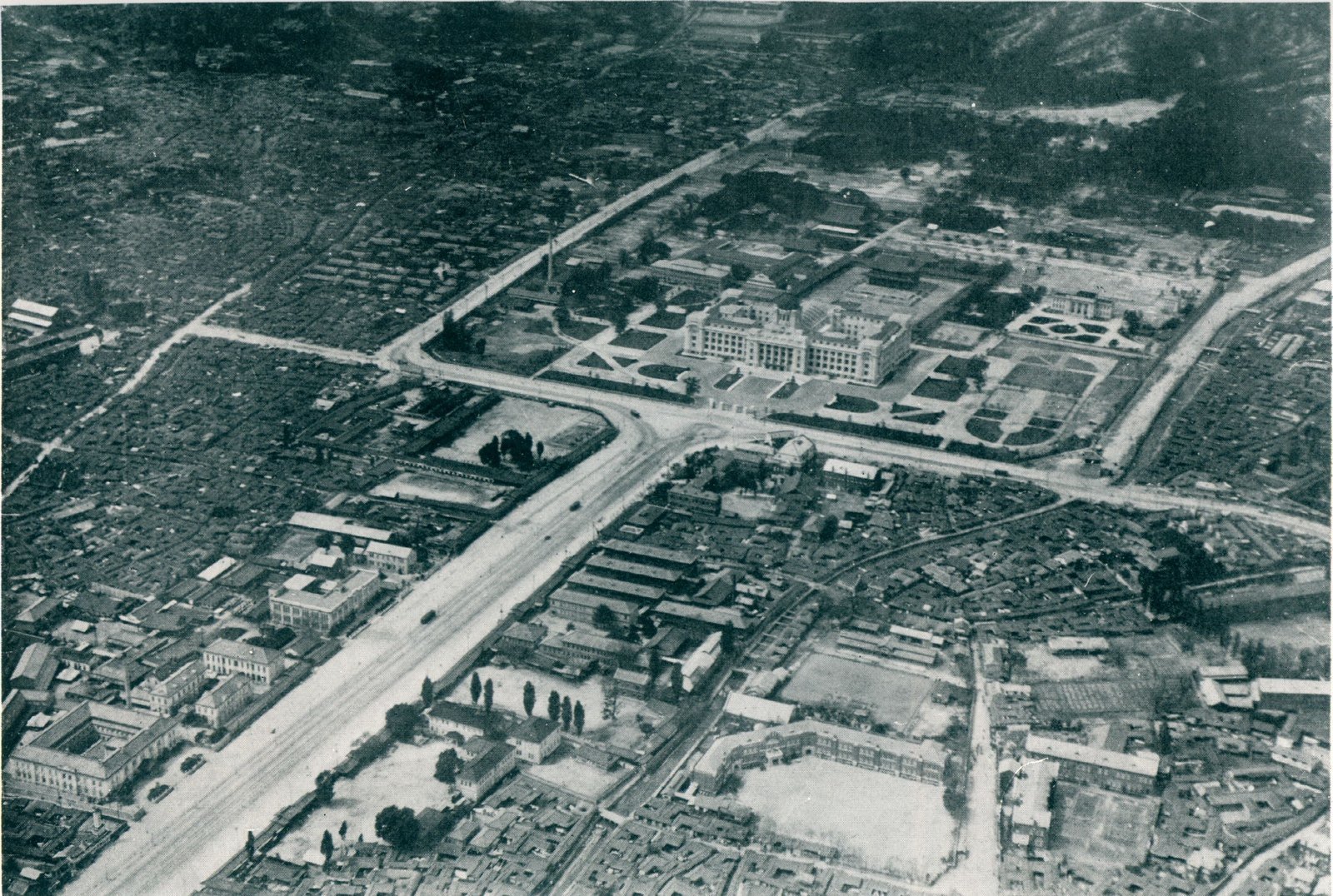
From romance lead to psychopath to three-language spy
This role is not luck. It is the next move in Kim You-jung’s career. She debuted as a child actor in 2003, and Korea first fell for her as the young Yeon-woo in MBC’s Moon Embracing the Sun (2012).
In 2016 she took her first adult lead in KBS’s Love in the Moonlight, playing Hong Ra-on, a girl disguised as a palace eunuch. The dance scene from episode 4 is the one fans still rewatch.
Lovers of the Red Sky (2021) won her the Excellence Award at the SBS Drama Awards, where she and Ahn Hyo-seop also took Best Couple.
My Demon (2023) took her to Netflix audiences worldwide as an icy heiress opposite Song Kang.
Then she broke her own image. In Dear X (2025) she played Baek Ah-jin, a psychopath hiding cruelty behind a beautiful face, and the same year she won the Busan International Film Festival’s Busan International Actor Award (Wikipedia).
An actress remembered as a romance lead went through a psychopath and arrived at a three-language spy. The prepared acting that Japanese reviewers praised is that road.
That same month, Korea watched the Japanese original twice as much
Traffic also crossed the border the other way. SBS’s Doctor X: Age of the White Mafia, starring Kim Ji-won and based on TV Asahi’s Japanese hit Doctor-X, drew 18.5% nationwide for episode 4, peaking at 20.8%, first among all miniseries (Nielsen Korea via Sports Kyunghyang, Oct. 19, 2026). That same week, episode 4 of 100 Days of Deception drew 9.0% nationwide (peak 9.8%), with a 10.6% peak in the Seoul metro area, first across all channels in its slot (Nielsen Korea via SPOTV News, Oct. 19). That is more than double. The gap kept growing: on Oct. 24, Doctor X episode 6 hit 19.5% while 100 Days of Deception episode 5 slipped to 6.5% (Nielsen Korea via OSEN, Oct. 25, 2026). In a PMI survey asking 5,000 adults which streaming title they were most excited about that week, Doctor X led with 21.7% and 100 Days of Deception was third for the second week running at 12.7% (Sports Kyunghyang, Oct. 19). In Korea the two shows do not even start on the same line: one is a Friday-Saturday drama on terrestrial SBS, the other a weekend drama on cable tvN.
Kim You-jung’s weapon is speed. The show opened at 5.3% and reached 9.0% by episode 4, a jump of nearly 70% (Top Star News, Oct. 20, 2026). That 5.3% was the best premiere of any tvN weekend drama in 2026 (Soompi, Oct. 11, 2026), and in Fundex’s third-week-of-October buzz ranking for actors, Kim You-jung and Park Jinyoung were second and third (Top Star News, Oct. 20).
Netflix Korea’s promo with the two leads passed 970,000 views in nine days.
Read next



Trending on Seol Notes
- The Emperor of K-pop Came Back, and Korea Flipped
- Korea Out-Earns Germany and Japan Combined. Its Stocks Are the World's Cheapest.
- Rosé Cried Singing His Song. Bang Si-hyuk Won His Contest. Who Was Yoo Jae-ha?
- A Med Student Wrote It the Night Before an Exam. Kim Kwang-seok Made It Last.
- A Firm With Zero Investors Says It Will Buy TWICE's Agency
Sources – Sports Kyunghyang, “They said it was an anti-Japan drama,” Oct. 15, 2026 – Sports Kyunghyang, Doctor X episode 4 ratings, Oct. 19, 2026; PMI streaming survey, Oct. 19, 2026 – Tenasia, Doctor X original, Oct. 7, 2026; writer Ryu Bo-ri interview, Sept. 23, 2026; Kim You-jung’s performance, Oct. 19, 2026 – SPOTV News, episode 4 ratings, Oct. 19, 2026 – OSEN, episode 5 and Doctor X episode 6 ratings, Oct. 25, 2026 – Top Star News, ratings trend and Fundex, Oct. 20, 2026 – Soompi, premiere ratings, Oct. 11, 2026 – Harper’s Bazaar Korea, Japanese-language acting in period dramas, Oct. 24, 2026 – Filmarks, 100日の嘘 reviews – Ready Steady Cut, Oct. 19, 2026 – FlixPatrol, 100 Days of Deception; Netflix Japan title page – Misa韓ドラGuide on YouTube, 1932 Gyeongseong explainer – Wikitree, Doctor X original comparison, Oct. 17, 2026 – Wikipedia, Kim You-jung – Images: Keijō Station postcard and aerial view of the Government-General of Korea building, both colonial-era photographs in the public domain, via Wikimedia Commons
Discover more from Seol Notes
Subscribe to get the latest posts sent to your email.