
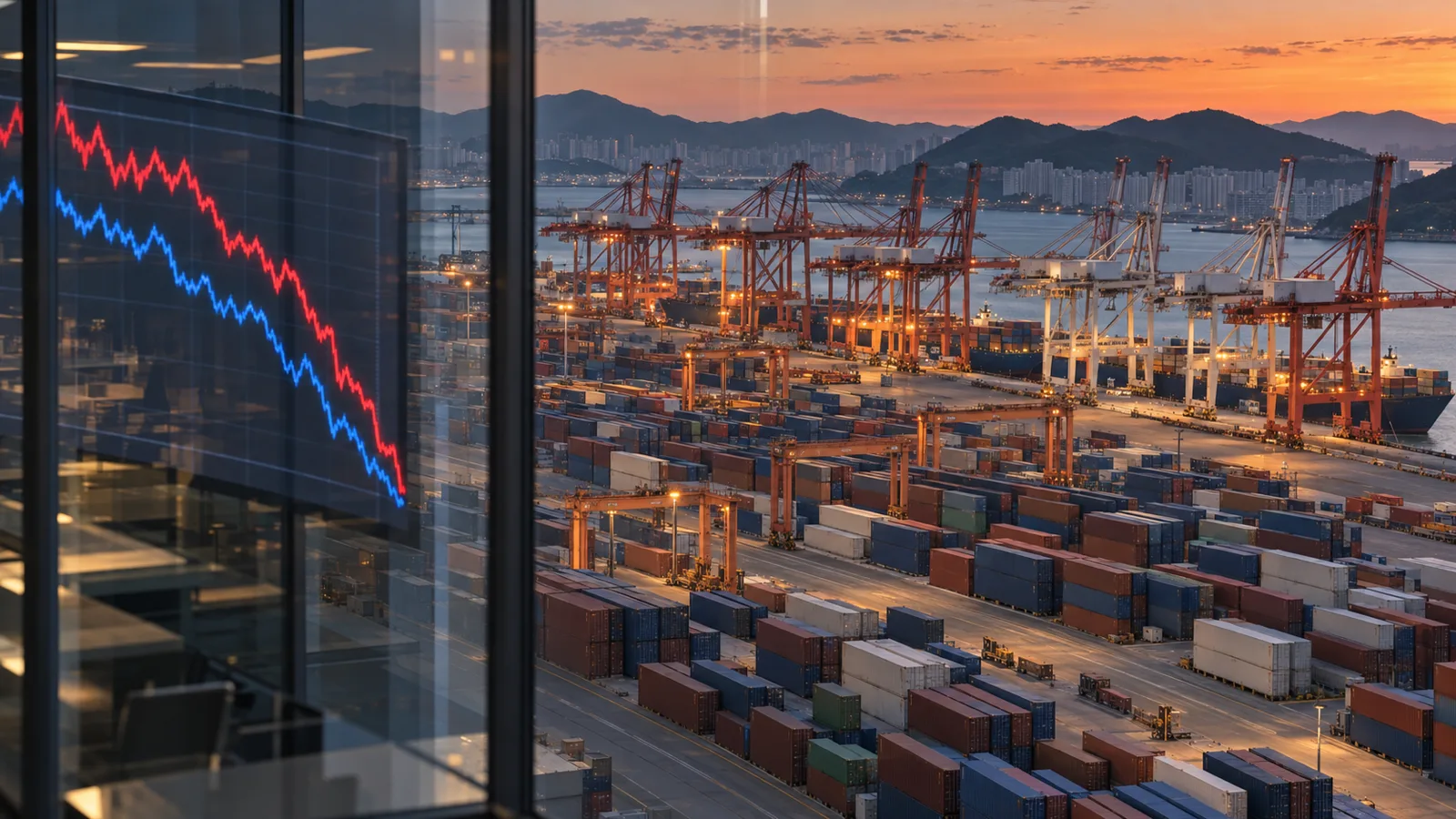
In the second quarter of this year, South Korea earned more from the rest of the world than Germany and Japan put together. In the very same week those numbers came out, global investors priced Korean stocks lower than any other major market on earth. The gap between those two facts is a verdict: the world doesn’t credit Korea’s surplus to Korea. It credits it to the price of one product, memory chips.
Three months that Germany and Japan together couldn’t match
The current account is what a country keeps after all its trade and investment with the world. According to IMF figures posted to the Bank of Korea’s statistics system on Oct. 25, Korea’s current account surplus in the second quarter was $116.6 billion, second only to China ($193.7 billion) among the 36 major economies with data. Germany posted $52.3 billion and Japan $50.6 billion. Combined, that’s $102.9 billion, or $13.7 billion short of Korea. It’s the first time this has happened since 1996, when comparable data for all three begins (Economist Korea, YTN). In July and August Korea added another $88.2 billion, beating the two countries’ combined total by $7.4 billion.
The full-year picture is the same. The IMF expects Korea’s surplus to hit $421.9 billion this year. That would lift Korea from fifth in the world to second, and the one-year jump of roughly $298.9 billion is the largest of any of the 190 economies the IMF tracks. At 18.8% of GDP, it would be Korea’s highest since 1980 (Economist Korea). On Oct. 25, President Lee Jae-myung wrote on X that “South Korea is now advancing as a leading nation that drives the flow of the global economy” (Seoul Shinmun).
Also read: A Firm With Zero Investors Says It Will Buy TWICE's Agency
The same week, Korean stocks became the cheapest on the planet
The market’s verdict went the other way. By Bloomberg’s count, the KOSPI, Korea’s benchmark index, fell to about 4 times its 12-month forward earnings. No market among the 18 that topped $1 trillion in value at the start of the year has traded that low since 2006 (Edaily, Oct. 23). A forward P/E of 4 means shares are selling for four years of expected profit. Indonesia, which just got a downgrade warning from index provider MSCI, trades at 8. Taiwan, Korea’s chipmaking rival, trades at 16 (same report).
The KOSPI hit a record 9,114.55 on June 22 and has since fallen more than 35%. On Oct. 23 it broke below 5,400 intraday before clinging to 5,500 (Electronic Times, Money Today). Goldman Sachs, which set a 12,000 target in June, cut it 25% to 9,000 on Oct. 25 (Chosun Biz). Interestingly, over the same stretch, analysts’ 12-month forward earnings estimates for KOSPI companies actually rose 22% (Electronic Times). The world expects Korean companies to make more money, and is paying less for every dollar of it.
What the world bought was memory prices, not Korea
The answer to the paradox sits inside the surplus. Chip exports hit $113.9 billion in the second quarter, up 181.6% from a year earlier, and $148 billion in the third, up 218.7% (Statistics Korea, via Economist Korea). AI data centers are buying up every memory chip they can, so Korea sold roughly the same volume at far higher prices. “The surplus is fundamentally about semiconductors, and about price rather than volume,” said Yang Jun-seok, an economics professor at the Catholic University of Korea. If the AI boom fades or memory competition heats up, he warned, “the current account will fall sharply” (Economist Korea). The IMF itself expects Korea’s surplus to shrink to $295.7 billion by 2029.
The stock market magnifies that dependence. Samsung Electronics and SK hynix alone make up nearly half the value of Korea’s main board. Foreign investors sold a net $180 billion or so of KOSPI shares between January and Oct. 23, and 82.5% of it was those two names (Korea Economic Daily). Foreign ownership of Samsung Electronics fell to 46.38% on Oct. 8, the lowest since the 2008 financial crisis (Kookmin Ilbo). As AI money rotated out of memory and into American software companies, the KOSPI fell 21.6% in a month while the Nasdaq slipped 3.6% (Korea Economic Daily). The market’s math is blunt: strip out memory, and Korea has no next company making money from AI.
The president talked about the tide. The comments talked about spoons.
In the same post, President Lee quoted John F. Kennedy: “A rising tide lifts all boats.” On the Naver news story that reported it, the most-liked comment read, “Companies did all the work and he’s sticking his spoon in,” the Korean idiom for grabbing credit for someone else’s meal (Seoul Shinmun comments, checked Oct. 25). Under the story about Korean stocks becoming the world’s cheapest, the top comments were “If it’s cheap, there’s a reason it’s cheap” (64 likes) and a call to fix the law first because companies “only think about skimming shareholders’ money, so of course the stock price looks like this” (90 likes) (Electronic Times comments). Korean retail investors have had a name for this for decades: the “Korea discount,” the habit of pricing Korean companies below their earnings because of chaebol family control, stingy shareholder payouts and North Korea risk.
The tide isn’t lifting every boat outside the stock market either. In September, while the surplus was swelling to a record, employment among 15- to 29-year-olds fell for the 47th straight month (JoongAng Daily, Oct. 16). In Seoul, young shoppers have answered by dressing like the rich daughter who has nothing left to buy.
SK hynix reports earnings on Oct. 28 and Samsung Electronics on Oct. 29 (Money Today). By Goldman Sachs’ math, Korean chip stocks are currently priced as if 65% of the industry’s profits will vanish next year. The country that out-earned Germany and Japan combined is selling its shares at a price that assumes two-thirds of the chip profits that earned that money will be gone next year.

Read next



Trending on Seol Notes
- The Emperor of K-pop Came Back, and Korea Flipped
- Korea Out-Earns Germany and Japan Combined. Its Stocks Are the World's Cheapest.
- Rosé Cried Singing His Song. Bang Si-hyuk Won His Contest. Who Was Yoo Jae-ha?
- A Med Student Wrote It the Night Before an Exam. Kim Kwang-seok Made It Last.
- A Firm With Zero Investors Says It Will Buy TWICE's Agency
Sources
- Current account (IMF data via Bank of Korea ECOS): Economist Korea, Oct. 25, 2026, YTN, Oct. 25, 2026
- President Lee’s X post: Seoul Shinmun, Oct. 25, 2026
- KOSPI P/E (Bloomberg data): Edaily, Oct. 23, 2026, Electronic Times, Oct. 25, 2026
- Goldman Sachs target cut: Chosun Biz, Oct. 25, 2026, Money Today, Oct. 25, 2026
- Foreign selling and Nasdaq comparison: Korea Economic Daily, Oct. 25, 2026, Kookmin Ilbo, Oct. 12, 2026
- Youth employment: JoongAng Daily, Oct. 16, 2026
- Exchange rate: $1 = about ₩1,327 (Oct. 23, 2026). Foreign net selling of ₩238.9 trillion ≈ $180 billion.
Discover more from Seol Notes
Subscribe to get the latest posts sent to your email.