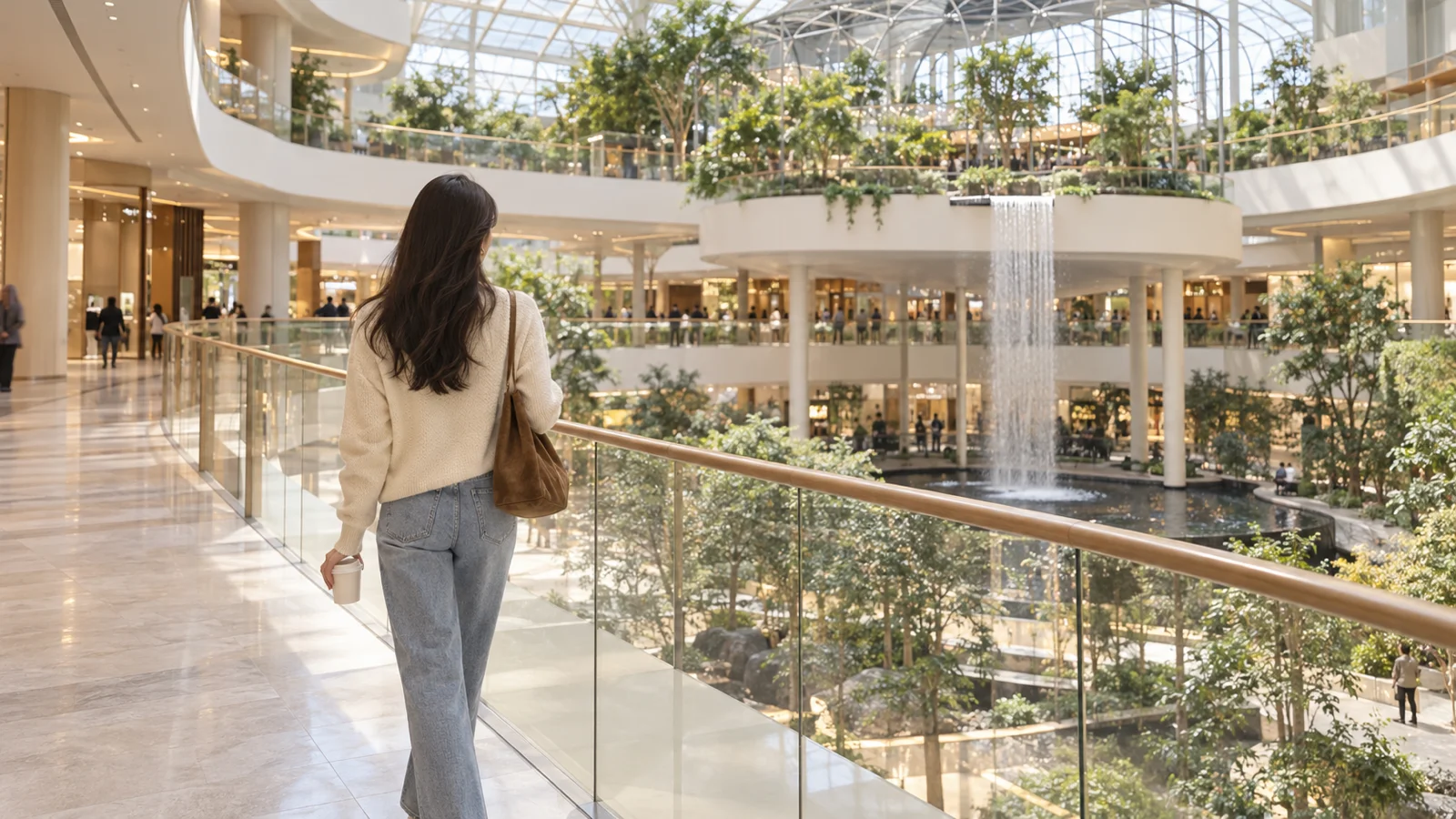
The role model young Seoul is copying right now is not the person who worked hard and made it. It is the rich man’s daughter who was born with everything and has nothing left to buy. The trend is called Hyunbaek-core, or Hyundai-core, and it is a small window into what South Korea looks like in 2026.
What Hyundai-core is
Hyunbaek is the everyday Korean nickname for Hyundai Department Store, one of the country’s three big department store chains. Add “core,” the suffix that gave English normcore and gorpcore, and you get Hyunbaek-core. On Instagram and X, people describe it in one line: “the vibe of a rich girl who came to the department store and is bored because she already has everything” (Newsis, Sept. 30, 2026; X user @donbaek2).
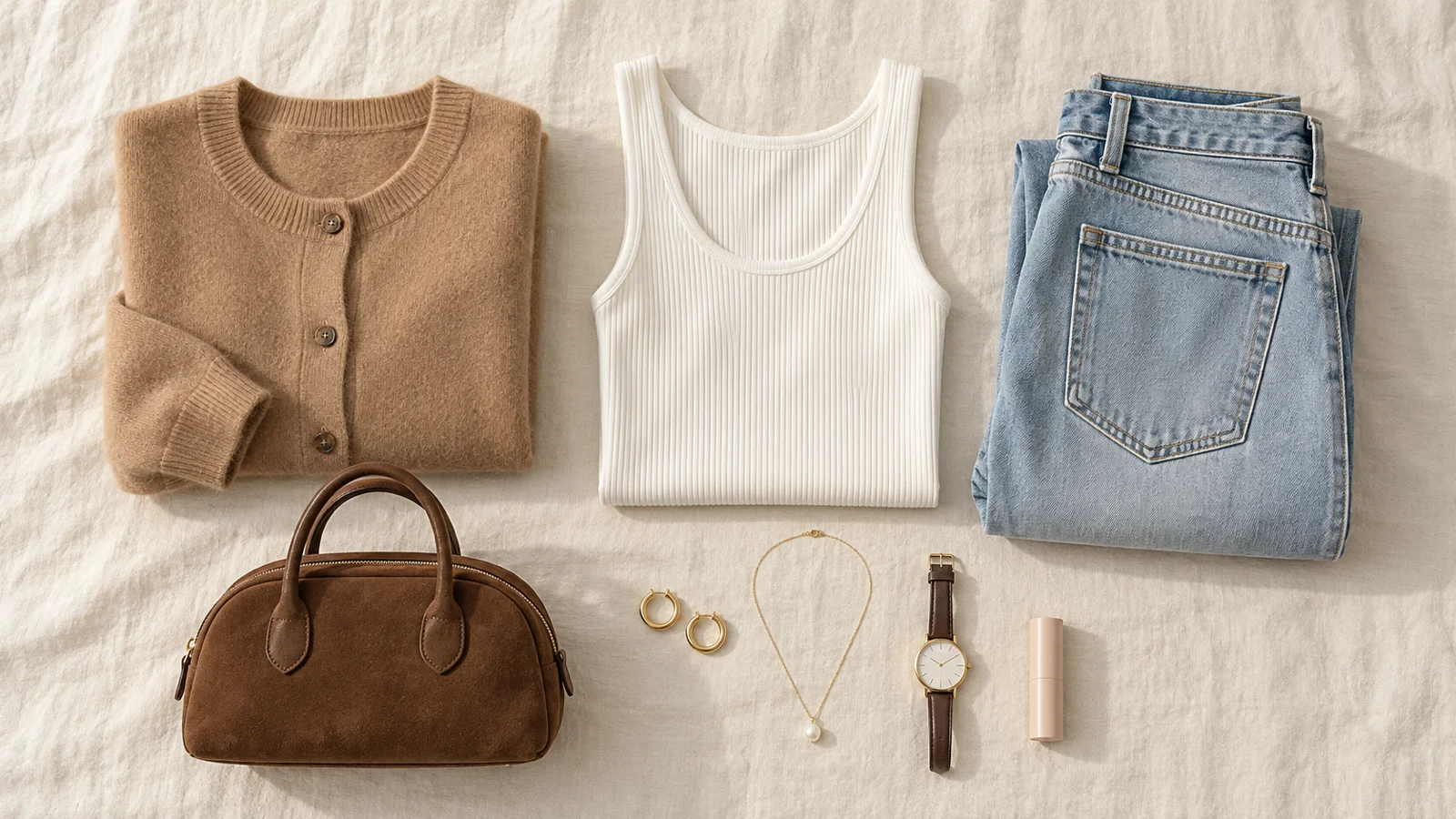
The makeup looks like she just stepped out to the corner store. Clothes are about fabric and silhouette, not color. Jewelry is small and classic. No logos. Fashion magazines boil it down to a neutral cashmere cardigan, a white tank, straight denim and a soft brown suede bag (Allure Korea, Oct. 19, 2026). The everyday outfits of actresses Moon Ga-young and Go Youn-jung are the reference images people keep posting (Newsis).
To see the look itself, scroll Moon Ga-young’s @m_kayoung and Go Youn-jung’s @goyounjung. A gray knit, pale denim, hair pushed to one side on a sofa. A slim black tee with gray trousers, an oversized black bag and a small cross pendant. A black shirt worn open over jeans, sunglasses pushed up into her hair. On Go Youn-jung, an oversized jacket or cardigan in neutral tones with a plain shoulder bag. That is the whole recipe, and Korean fashion bloggers have been reposting these exact looks as Hyundai-core guides since early October. Korean fans have noticed how much of the trend rides on two faces. “Honestly this is just Moon Ga-young and Go Youn-jung core,” one commenter wrote under a Hyundai-core explainer on the fan community FanMaum (Oct. 12, 2026).
View this post by Moon Ga-young (@m_kayoung) on Instagram
View this post by Moon Ga-young (@m_kayoung) on Instagram
View this post by Go Youn-jung (@goyounjung) on Instagram
The look has already split by store. Lotte-core means an ivory knit, a mini skirt and a plush coat. Shinsegae-core means leather, fur and sunglasses (Asia Business Daily, Oct. 20, 2026). Seoul’s young shoppers now dress by department store the way Americans dress by zip code.
It looks a lot like the quiet luxury and old money aesthetics English-speaking TikTok already knows, with one decisive difference. Balletcore and gorpcore are named after an activity. Hyundai-core is named after a specific department store (The Korea Times, Oct. 16, 2026). That is the whole point. What people want is not the clothes. It is the social class that looks like it belongs in that building.
Also read: A Firm With Zero Investors Says It Will Buy TWICE's Agency
Inherited wealth has replaced the self-made dream
“Stories of self-made success and the rags-to-riches narrative have lost their persuasive power,” Lee Jun-young, a consumer studies professor at Sangmyung University, told The Korea Times. What fills the gap, he says, is admiration for inherited wealth. Lee Eun-hee of Inha University points to the panoplie effect, where people buy things tied to a class so they can feel like part of it, and links it to falling social mobility (same article). Kim Yun-tae of Korea University says young Koreans giving up on dating, marriage and children is a structural problem, not a personal choice (Money Today, Oct. 24, 2026).
The key phrase in Hyundai-core is “nothing left to buy.” The character being performed is not someone who earns and spends. It is someone who already has it all and no longer needs to want anything. When the road to getting what you want closes, you dress like someone who never had to want it.
Why it happened
The answer is in the numbers. In September, employment among Koreans aged 15 to 29 fell by 147,000 from a year earlier, the 47th straight monthly decline, and the youth employment rate dropped 1.1 points to 44.0% (Korea JoongAng Daily, Oct. 16, 2026; National Data Agency, Sept. 2026 Employment Trends). In the same month, total employment rose by 113,000, and people aged 60 and over carried that gain with 172,000 more jobs. Within that group, the 60 to 64 bracket actually fell by 82,000, so the growth came almost entirely from people 65 and older (Sidae Ilbo, Economy Times). Grandparents are going back to work while their grandchildren are stuck at the door of their first job.
The blockage is built into the system. Only 10.2% of Korean companies still hire mainly through the traditional once-a-year graduate recruitment, and the top hiring criterion is job-related experience, at 67.6% (Federation of Korean Industries 2026 hiring survey, cited by Money Today). No experience, no job. No job, no experience. Meanwhile 31.6% of young households spend more than 30% of their monthly income on rent (Ministry of Land, Infrastructure and Transport housing survey 2023, same article). Upbit, Korea’s largest crypto exchange, had 5.48 million accounts held by people in their 20s and 30s as of December 2025, equal to 44% of that age group (Dunamu, same article). When saving won’t get you up the ladder, you look for a way to jump.
Two Seouls in the same department store
Korea’s department store market is a three-way race between Lotte, Shinsegae and Hyundai. So why did this culture of looking rich borrow Hyundai’s name?
At The Hyundai Seoul in Yeouido, the company gave up about 11,240 square meters, the floor space of roughly 170 clothing stores, to an indoor garden, and filled the building with pop-ups and exhibitions to make it a place where you can stay without buying anything (Korea Economic Daily, Oct. 9, 2026). The industry says competition has moved “from ownership to experience” (same article). You can enjoy the atmosphere without spending money, and that is the soil Hyundai-core grew from. From January to September this year, the number of customers in their 20s at Hyundai Department Store rose 38.1% from a year earlier (Korea Economic Daily, Oct. 9).
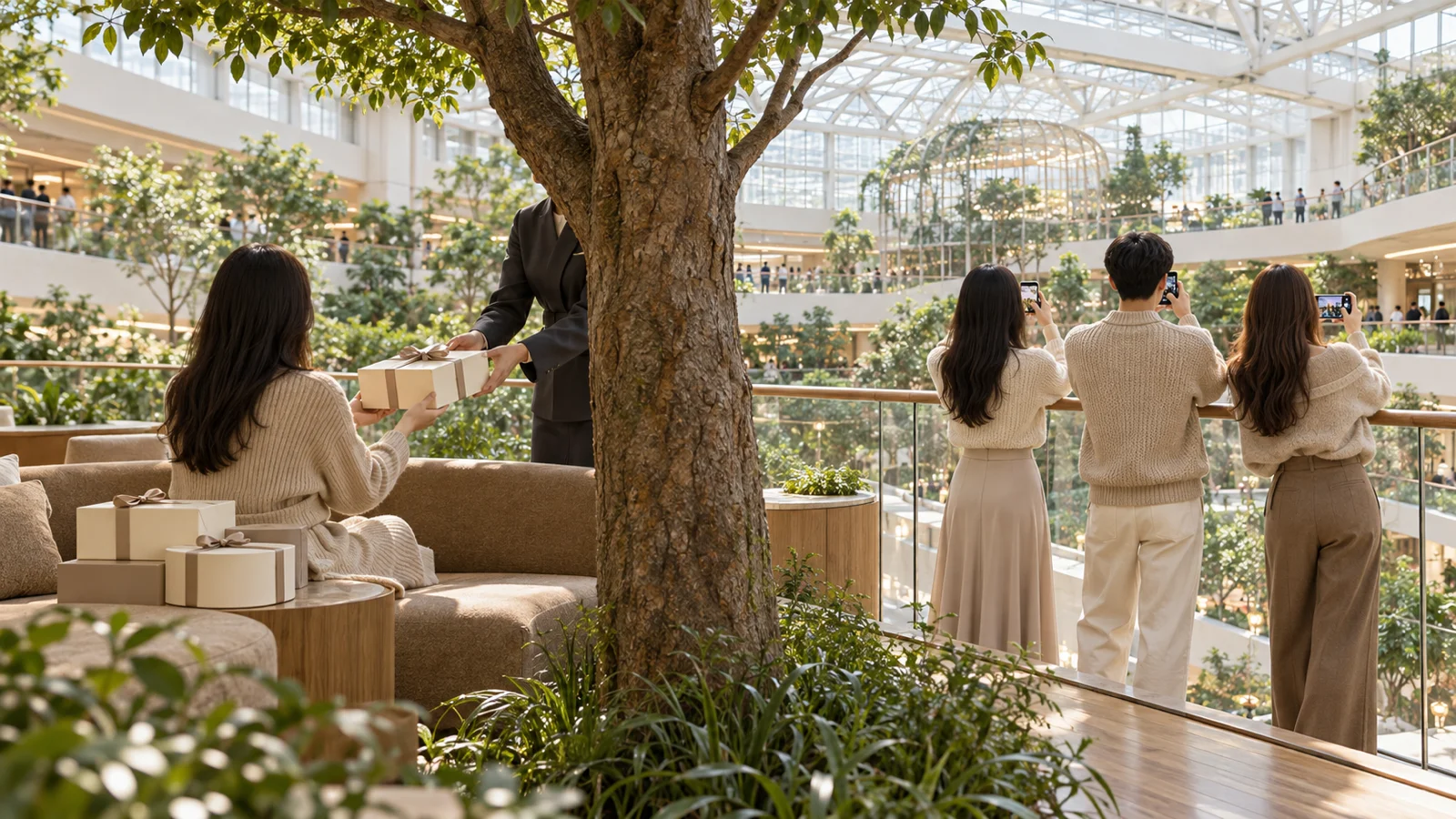
There are real young rich people in that building too. Membership in Club YP, Hyundai’s program for shoppers aged 20 to 45 who spend more than about $23,000 (30 million won) a year, more than doubled from 2024 (Korea Economic Daily). Average spending per customer in their 20s rose 10.8% (same article). Yet while customers in their 20s grew sharply in number, they account for only 10.4% of sales (Korea Economic Daily, Oct. 17, 2026). Those numbers describe two Seouls under one roof: a small group with real inherited ease, and a much larger group wearing that ease as an outfit. Hyundai-core is the second Seoul imitating the first.
Read next


Trending on Seol Notes
- The Emperor of K-pop Came Back, and Korea Flipped
- Korea Out-Earns Germany and Japan Combined. Its Stocks Are the World's Cheapest.
- Rosé Cried Singing His Song. Bang Si-hyuk Won His Contest. Who Was Yoo Jae-ha?
- A Med Student Wrote It the Night Before an Exam. Kim Kwang-seok Made It Last.
- A Firm With Zero Investors Says It Will Buy TWICE's Agency
Sources
- National Data Agency, September 2026 Employment Trends (Korea Policy Briefing, Oct. 16, 2026)
- Korea JoongAng Daily, Oct. 16, 2026; Sidae Ilbo; Economy Times
- Korea Economic Daily, Oct. 9, 2026 and Oct. 17, 2026
- Newsis, Sept. 30, 2026; X @donbaek2
- The Korea Times, Oct. 16, 2026
- Money Today, Oct. 24, 2026
- Allure Korea, Oct. 19, 2026
- Asia Business Daily, Oct. 20, 2026; FanMaum community post, Oct. 2, 2026
- Video: 오늘의감도 GAMDO on YouTube; 14F (MBC), Oct. 12, 2026; Heizle, Oct. 17, 2026
- Instagram: Moon Ga-young, Sept. 30, 2026 and Oct. 23, 2026; Go Youn-jung, June 4, 2026
Discover more from Seol Notes
Subscribe to get the latest posts sent to your email.