
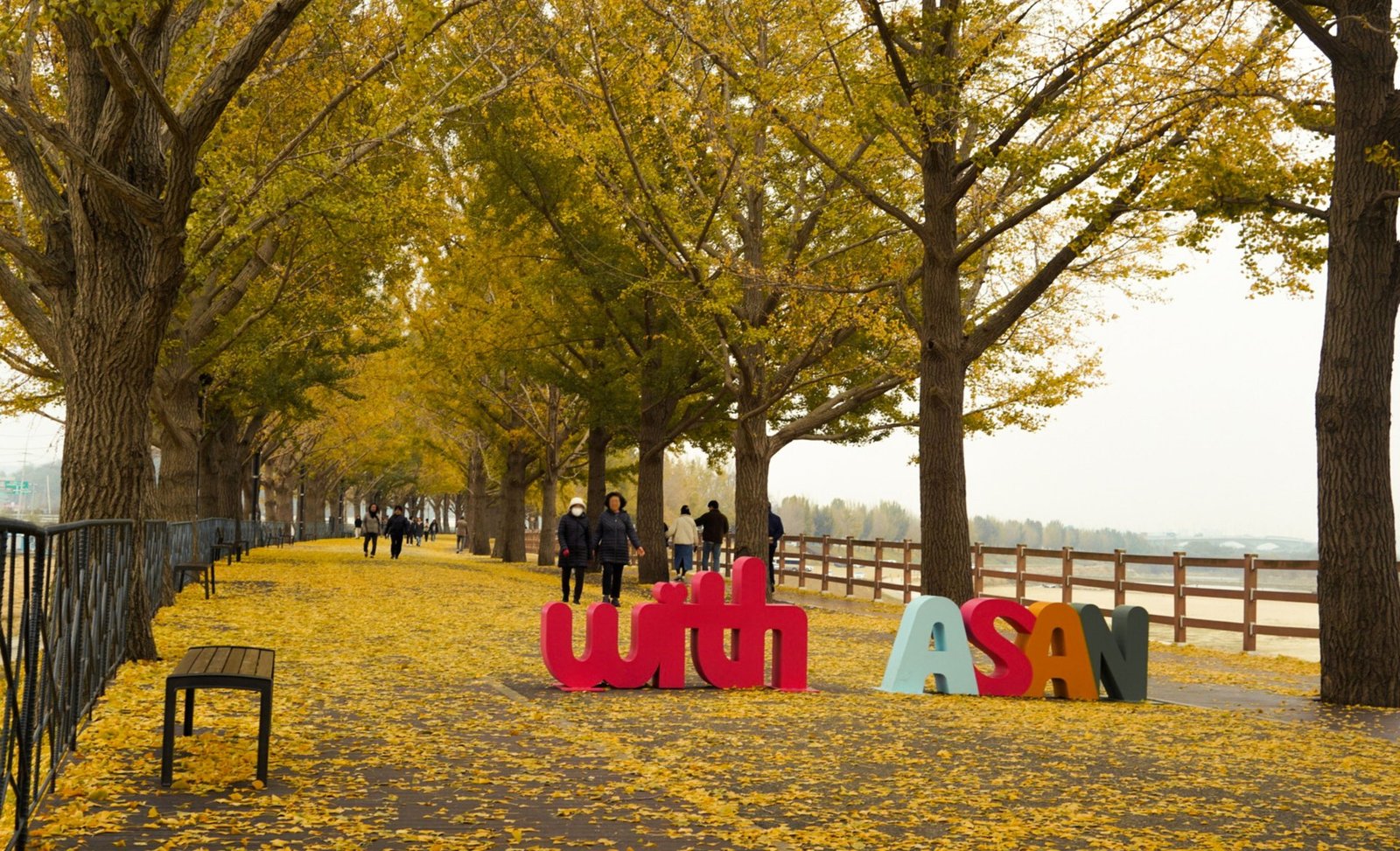
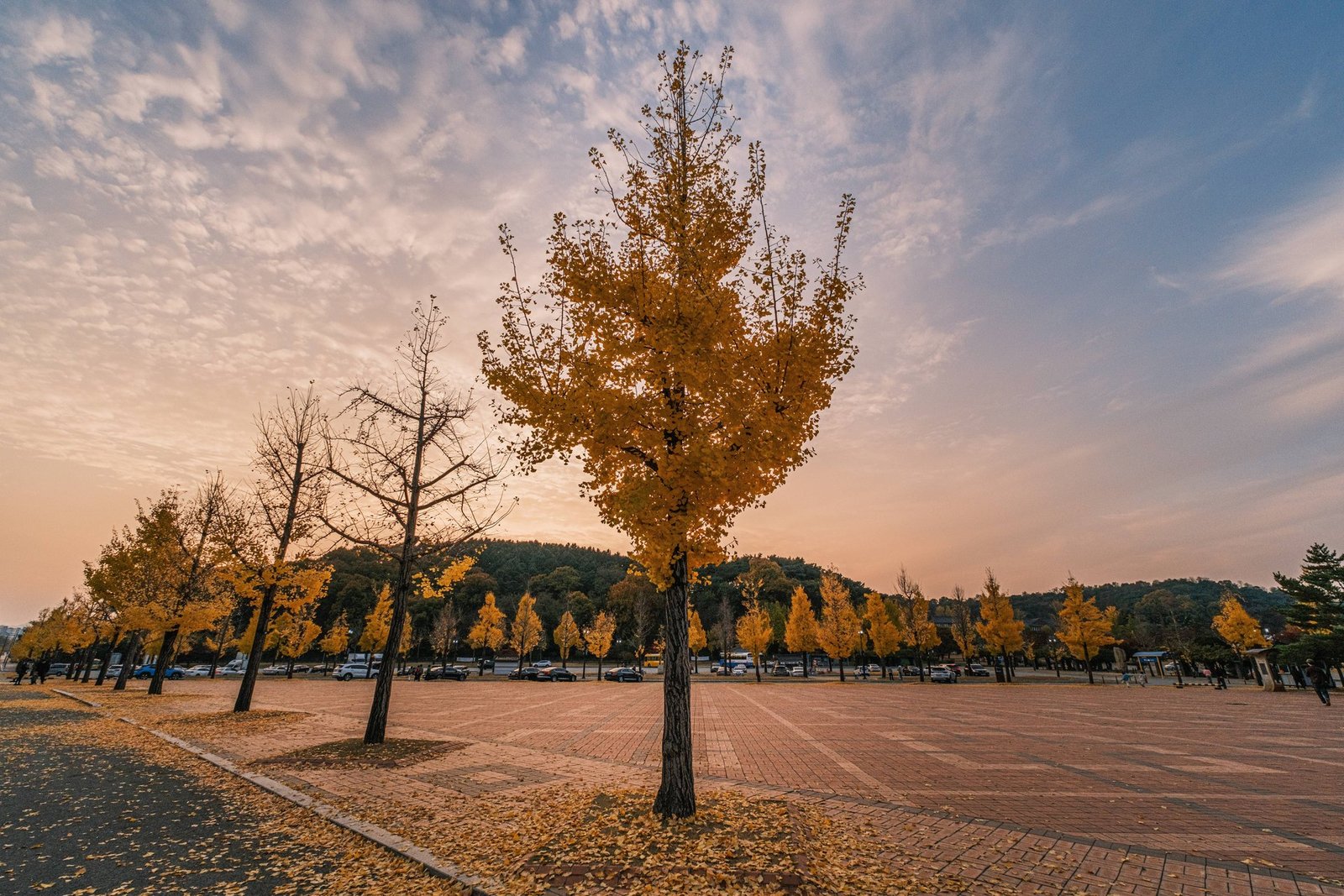
Featured photo: People walking the Gokgyocheon Ginkgo Road, carpeted in yellow leaves, past the “with ASAN” sculpture. Photo: Jeon Ji-min, Korea Tourism Organization / KTO Photo Korea, KOGL Type 1.
Ride Seoul subway Line 1 south with nothing but a transit card, and in Asan, South Chungcheong Province, a tunnel of yellow ginkgo trees runs for more than 2 km along the Gokgyocheon Stream. Walk through it in the afternoon, stop for a 27.9-meter media wall in the middle of the tunnel, and after sunset soak your feet in the free hot spring foot bath outside Onyangoncheon Station: that’s a late-autumn day in Asan.
At a glance
- When to go: In on-site video shot October 29, only about 10% of the leaves had turned (YouTube channel “Noransyeocheu Sanai Mattour,” filmed October 29, 2026). Last year, one visitor found the leaves at their peak on a weekday as late as November 13 (Naver blog, November 14, 2025), so this year the best bet is the second half of the first week of November through the second week. There’s no official peak forecast, so check the shooting dates of recent photos two or three days before you go.
- From Incheon Airport: Take the AREX airport railroad to Seoul Station (about an hour on the all-stop train). From there, either take the KTX to Cheonan-Asan Station (about 33 minutes) and then Line 1 three stops from Asan Station, in the same building, to Onyangoncheon Station, or stay on Line 1 the whole way (below).
- From Myeongdong: Take Line 4 two stops to Seoul Station, then a Line 1 train bound for Sinchang and get off at Onyangoncheon Station. No transfers after that, and an express takes 1 hour 46 minutes from Yeongdeungpo (Naver blog, 2026). Pay with your T-money transit card. Some time slots have no express back toward Seoul from Sinchang, so one visitor’s trip home took about 30 minutes longer (Naver blog, November 23, 2024).
- Faster option: KTX from Seoul Station to Cheonan-Asan in about 33 minutes, then Line 1 three stops to Onyangoncheon (Naver blog, July 21, 2026). Janghang Line ITX-Maeum and Mugunghwa trains also run direct from Yongsan Station to Onyangoncheon Station.
- From the station to the ginkgo road: From the stop in front of Exit 1 at Onyangoncheon Station, take bus 700, 702, 970 or 971 and get off at “Sinil Apartment Entrance” (Naver blogs, 2024 and 2025). Buses 970 and 971 alternate at 30-minute intervals, so check bus arrival info first.
- By car: The Ginkgo Road public parking lot (71-9 Songgok-ri, Yeomchi-eup), Lot 1 (519-2 Baegam-ri), Lot 2 (258 Baegam-ri) and the Gokgyocheon riverside lot (60-4 Gwongok-dong) are all free (Asan’s Yi Sun-sin Tourism Experience Center, cited on a Naver blog, 2026). On weekends, arrive before 9 a.m. to get a close spot.
- Admission: The ginkgo road, Hyeonchungsa, Yeohaenaru and the foot bath are all free. You only pay for the hot spring baths, Oeam Folk Village and food.
Top 10 things to do in Asan
1. Walk the 2.1 km yellow tunnel to the end (photo spot)
For about 2.1 km from Chungmugyo Bridge to the entrance of Hyeonchungsa, the ginkgo trees on both sides of the road meet overhead to form a tunnel (Korea Tourism Organization description, cited on a Naver blog, 2026). The trees were planted as 10-year-olds in 1973, so today they’re all massive and more than 60 years old. While the leaves hang on, it’s a yellow roof; after they fall, a yellow carpet.
- Time needed: An hour to an hour and a half for the ginkgo road alone, or about 4.2 km round trip if you come back the same way (Naver blog, 2026).
- Framing: Stand in the middle of the road and let the rows of trees converge on a single point; the perspective makes the tunnel look deeper. Pedestrians and cyclists share the road, so don’t block it for long.
- Tip: Ginkgo fruit falls here and it smells. Wear shoes you don’t mind stepping in it with, and watch out for slippery wet leaves.
2. The embankment boardwalk and the picture-frame photo spot (photo spot)
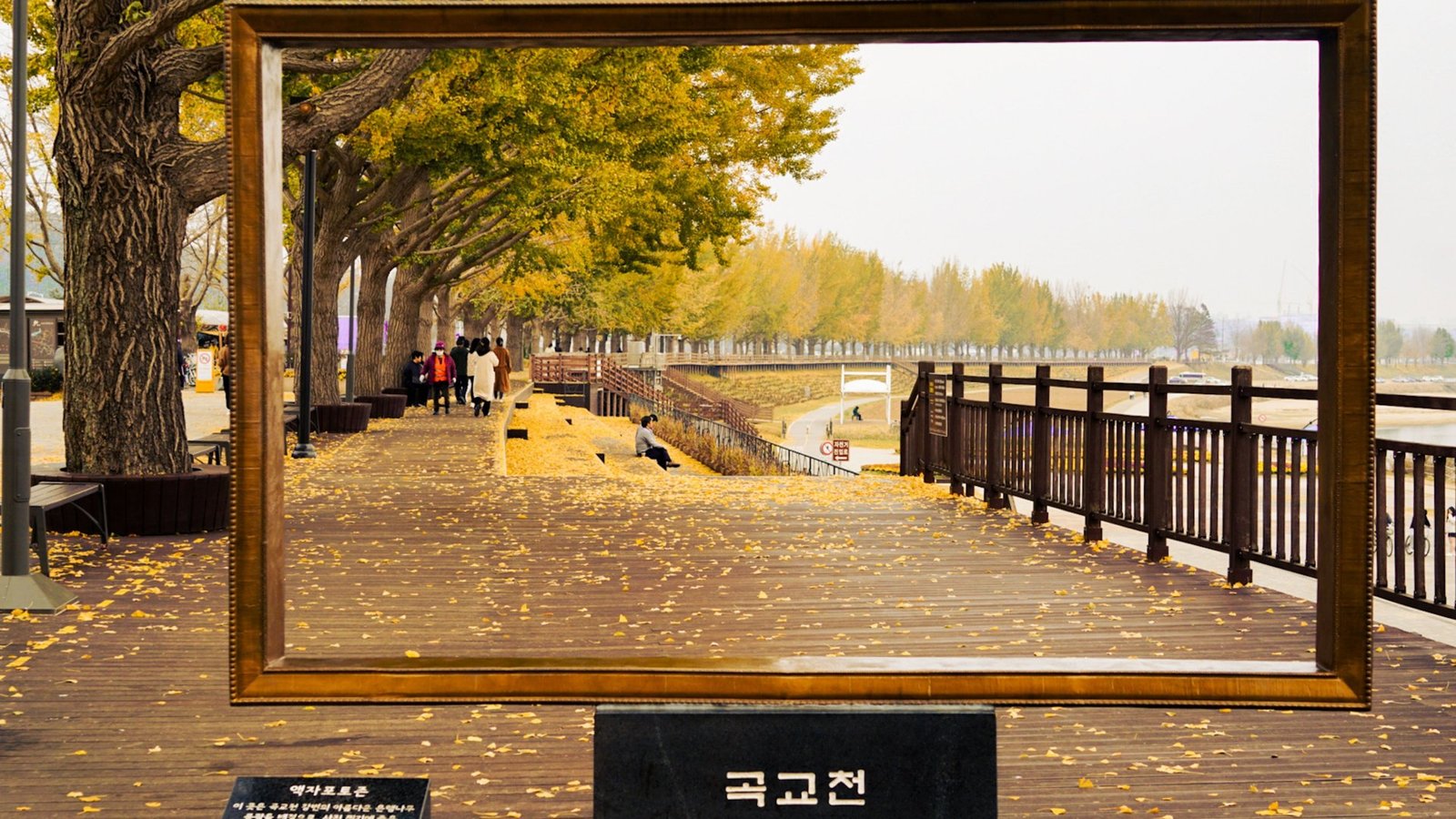
Walk only down the middle of the ginkgo road and you’ve seen half of it. A raised boardwalk runs along the embankment beside the stream, so from up there you can fit the rows of ginkgo trees and the water of Gokgyocheon into one frame (Naver blog, 2025). A big wooden picture-frame sculpture stands on the boardwalk, and a photo with the yellow road inside the frame is the signature shot here.
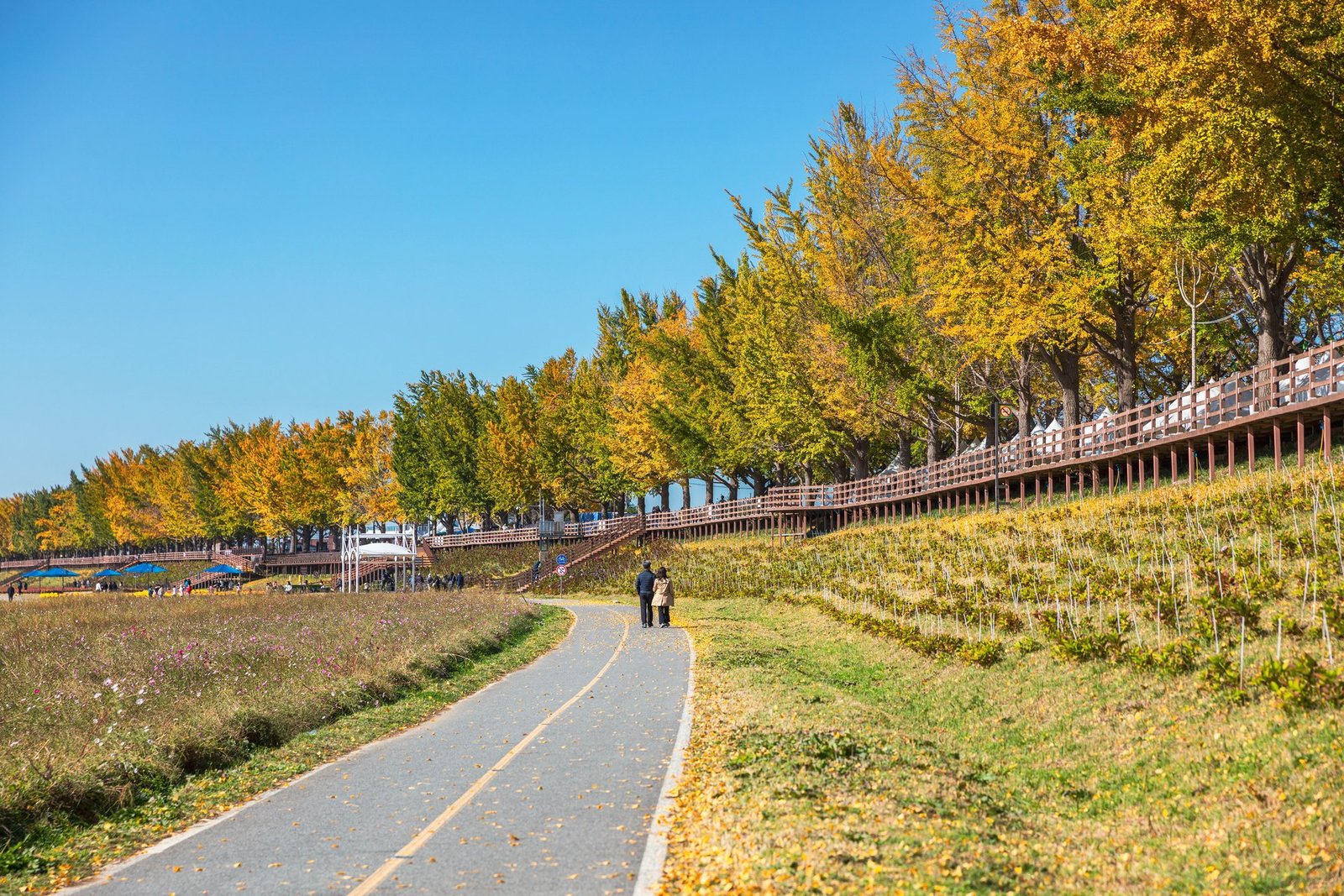
- Tip: Look up from the bike path below the embankment and you’ll see the line of ginkgo trees curving along the stream. Mornings with blue sky are best.
3. The 27.9-meter media wall at Yeohaenaru (experience)
In the middle of the ginkgo road stands Yeohaenaru, the Yi Sun-sin Tourism Experience Center, and across its front is an outdoor LED media wall 27.9 meters wide and 7 meters tall. Starting October 31, on every day the center is open, six media art works chosen in this year’s competition play for an hour each at 2 p.m. and 4 p.m. (Gukje News, October 29, citing the city of Asan). Stopping in front of a giant screen in the middle of the yellow tunnel is this autumn’s new sight.
- Hours: The center is open Tuesday to Sunday, 10 a.m. to 7 p.m. (until 6 p.m. December to March), and closed every Monday, so the media wall is off on Mondays too. Free (Yeohaenaru official website).
- Tip: The Yi Sun-sin exhibition and restrooms inside the center are also free, so it’s a good place to rest mid-walk. Time your walk to hit 2 p.m. or 4 p.m.
4. A night walk under the lit-up ginkgo trees (experience)
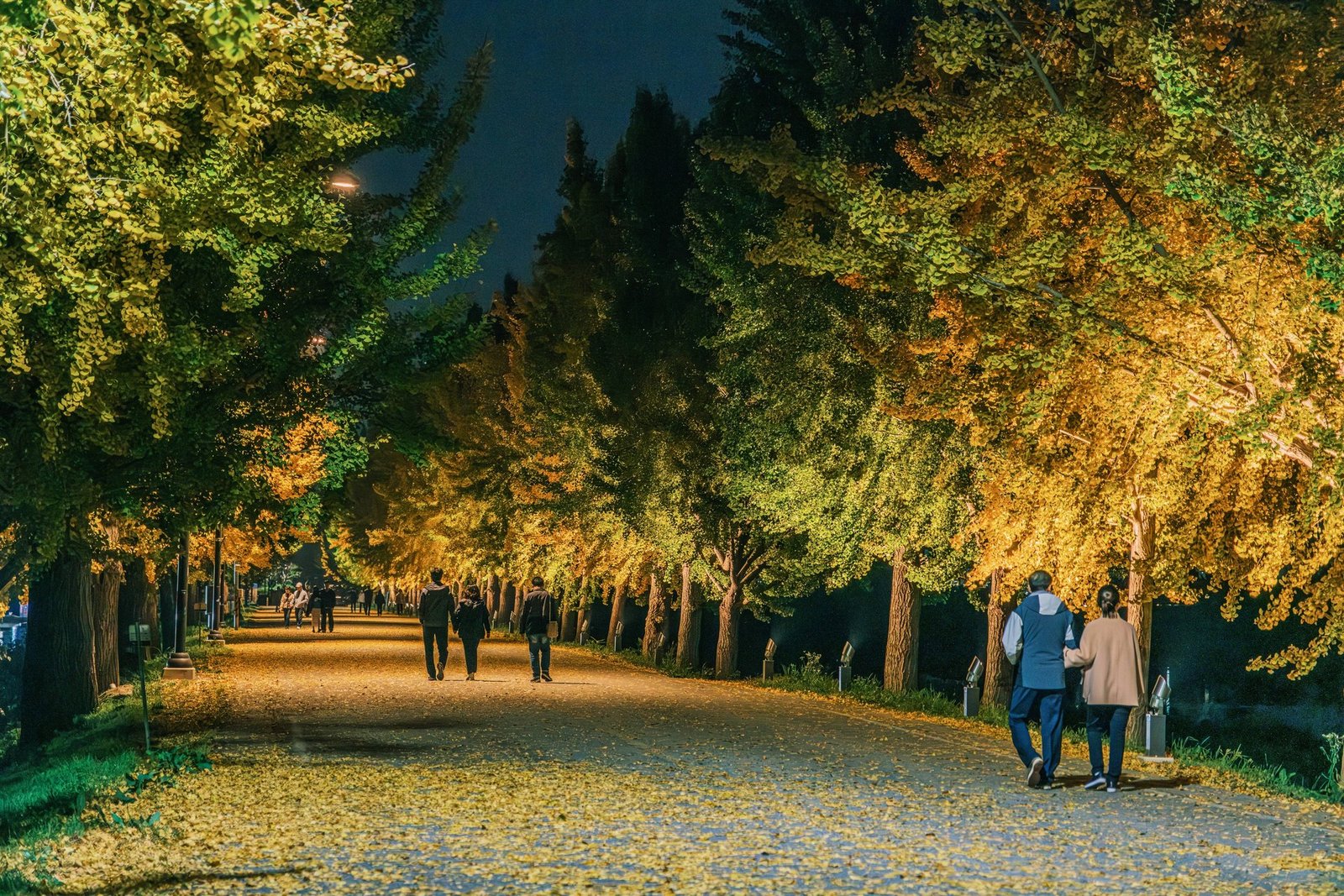
When the sun goes down, floodlights come on under the ginkgo trees and light sculptures brighten the road (Jeonguk Maeil). Lit from below, the yellow leaves glow gold, and with fewer people around, the tunnel looks completely empty. Swinging by once more before your evening hot spring is the most efficient route.
- Tip: I couldn’t find the lighting hours in any public source, so plan to arrive soon after dark. The wind off the stream gets cold at night, so bring a jacket.
5. Two 570-year-old ginkgo trees at Hyeonchungsa (sight)
At Hyeonchungsa, the shrine that continues from the end of the ginkgo road, two protected ginkgo trees stand side by side at the archery ground next to Admiral Yi Sun-sin’s old house. They’re about 570 years old, and when they turn yellow they look like two huge yellow umbrellas opened up; there are benches around them, good for sitting and resting (Naver blog, visit in late October 2026). Unlike the roadside rows, this is a tree that overwhelms you with the size of just one.
- Admission and hours: Free. November to February, 9 a.m. to 5 p.m. (last entry one hour before closing), closed every Monday (Naver blog, 2026).
- Tip: Both trees are female, so lots of fruit falls. The ginkgo plaza around the big parking lot also makes great photos at sunset.
6. Spicy noodles at the Ginkgo Road noodle shop (eat)
This noodle shop sits right beside the main ginkgo path, so it’s easy to duck into mid-walk. Janchi-guksu (warm noodle soup) is 8,000 won (about $6.00) and bibim-guksu (spicy cold noodles) 8,500 won (about $6.40), and many customers add a shrimp and chive pancake (15,000 won, about $11.30) (Naver blog, October 30, 2026).
- Hours: 11 a.m. to 7 p.m., close to the Ginkgo Road public parking lot (Naver blog, 2026).
- Tip: On peak weekends there’s a line at lunch. Eat when it opens at 11 and walk in the afternoon.
7. The free foot bath in front of Onyangoncheon Station (experience)
Step off Line 1 and there’s a foot bath with flowing hot spring water right on the station plaza. Under a roof shaped like a little house, locals sit side by side with their feet in the water, and paper towels are provided for drying off (South Chungcheong Province official blog, December 19, 2025). Twenty minutes here after a full day on the ginkgo road, before you catch the train home, is the last piece of this route.
- Admission and hours: Free, open year-round (Naver blog, 2026). Hours change with the season; call 041-540-2061 to check.
- Tip: Bring a small towel. Wear pants you can roll up to your knees.
- Source: South Chungcheong Province official blog, “Wontang Sincheontang: an Asan winter hot spring trip”
8. Wontang Sincheontang and the Onyang Tourist Hotel’s big bath (experience)
If your feet alone aren’t enough, the public baths are a five-minute walk from the station. Sincheontang, the “original bath” that opened in 1960, uses pH 9.0 alkaline hot spring water, and the Onyang Tourist Hotel’s big bath and the Onyang Cheil Hotel’s bathhouse sit just across the street from each other (South Chungcheong Province official blog, December 19, 2025).
- Wontang Sincheontang: Adults 10,000 won (about $7.50), 5 a.m. to 6 p.m., 1469 Oncheon-daero.
- Onyang Tourist Hotel big bath: Adults 12,000 won (about $9.10), 6 a.m. to 9 p.m. (last entry 8 p.m.), closed every Tuesday, 1459 Oncheon-daero.
- Onyang Cheil Hotel bathhouse: Adults 12,000 won (about $9.10), 6 a.m. to 8 p.m. (last entry 7:30 p.m.), 1462 Oncheon-daero.
- Tip: Sincheontang closes at 6 p.m., so if you plan to stay on the ginkgo road until late afternoon, go to the Tourist Hotel or Cheil Hotel instead. Prices are as of December 2025, so double-check on site.
9. Beef-head soup and three-color hotteok at Onyangoncheon Market (eat)
This traditional market is right in front of Onyangoncheon Station. Soup houses like Hyundai Sikdang (8 a.m. to 8:30 p.m.), which serves only someori-gukbap (beef-head rice soup) and seonji-haejangguk (blood-sausage hangover soup), share the alleys with stalls selling dumplings, steamed buns, three-color hotteok (sweet filled pancakes) and twisted doughnuts (Naver blog, 2026). Close the day with a bowl of soup after the hot spring and a hotteok to eat on the train.
- Tip: On dates ending in 4 or 9, the Onyang five-day market sets up and the area gets even busier (Naver blog, 2026). Soup prices vary from shop to shop.
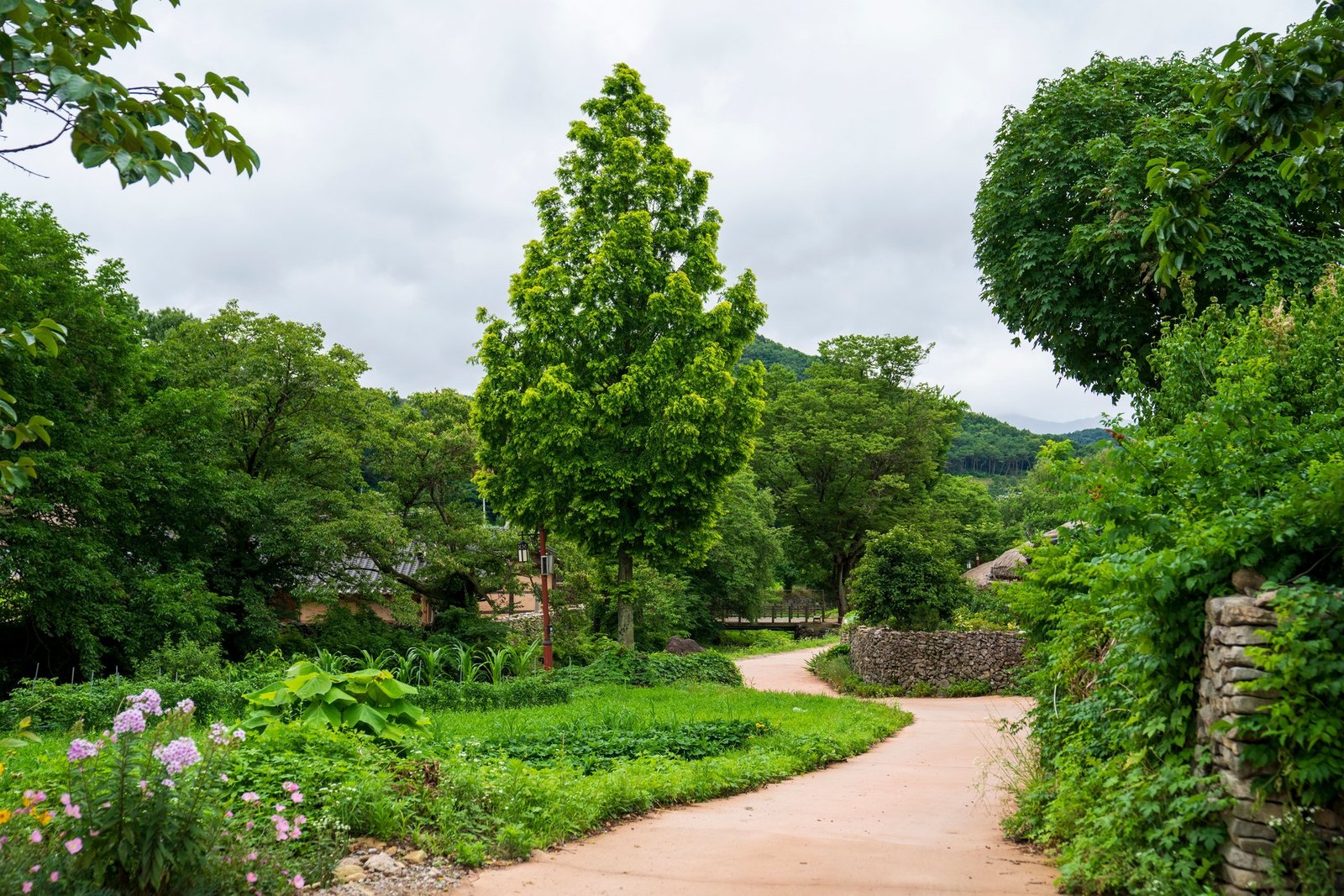
10. The stone-wall lanes of Oeam Folk Village (sight)
An old village where people still live, with low stone walls winding endlessly between thatched and tiled houses. In late autumn, persimmon trees and red leaves hang over the walls. South Chungcheong Province recommended it in the November issue of Monthly Chungnam as a course together with Gokgyocheon and Hyeonchungsa (Gukje News).
- Admission and hours: Adults 2,000 won (about $1.50), 9 a.m. to 5 p.m. in winter, open every day, free parking (Oeam Folk Village official website, Naver blog, 2026).
- Time needed: 1.5 to 2 hours for a loop of the stone-wall lanes (Naver blog, July 21, 2026).
- Tip: Oeam is a separate drive from the ginkgo road, so if you don’t have a car, go to Oeam in the morning and the ginkgo road in the afternoon, with one bus transfer.
Nearby places to add
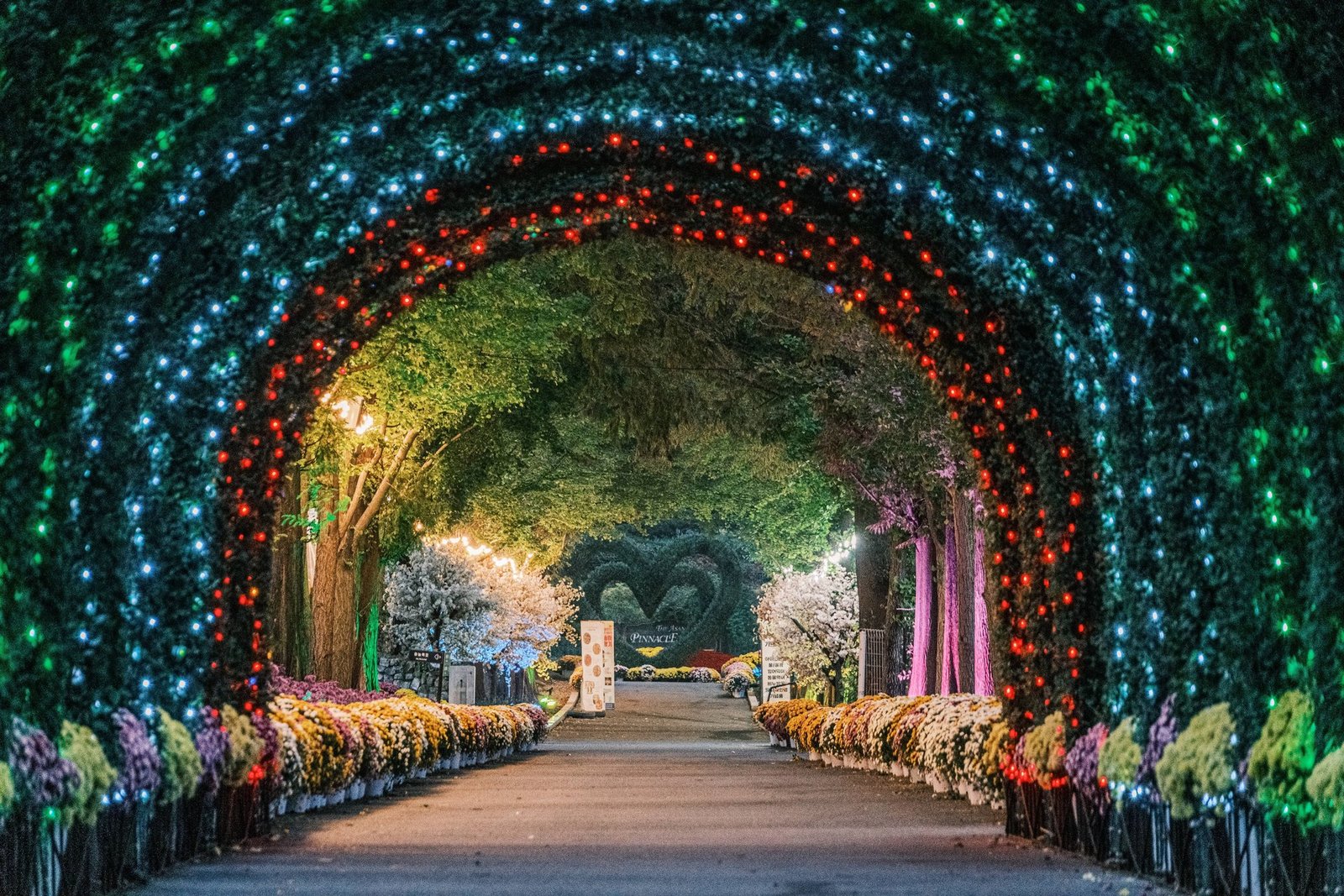
- Pinnacle Land chrysanthemum festival: A hillside arboretum overlooking Asan Bay holds its chrysanthemum festival through November 30. General admission 15,000 won (about $11.30), children and seniors 13,000 won, 1,000 won off when you book through Naver. Open 9 a.m. to 6 p.m. on weekdays and Sundays, and until 9 p.m. on Saturdays, when the light tunnel comes on at night (Naver blog, 2026).
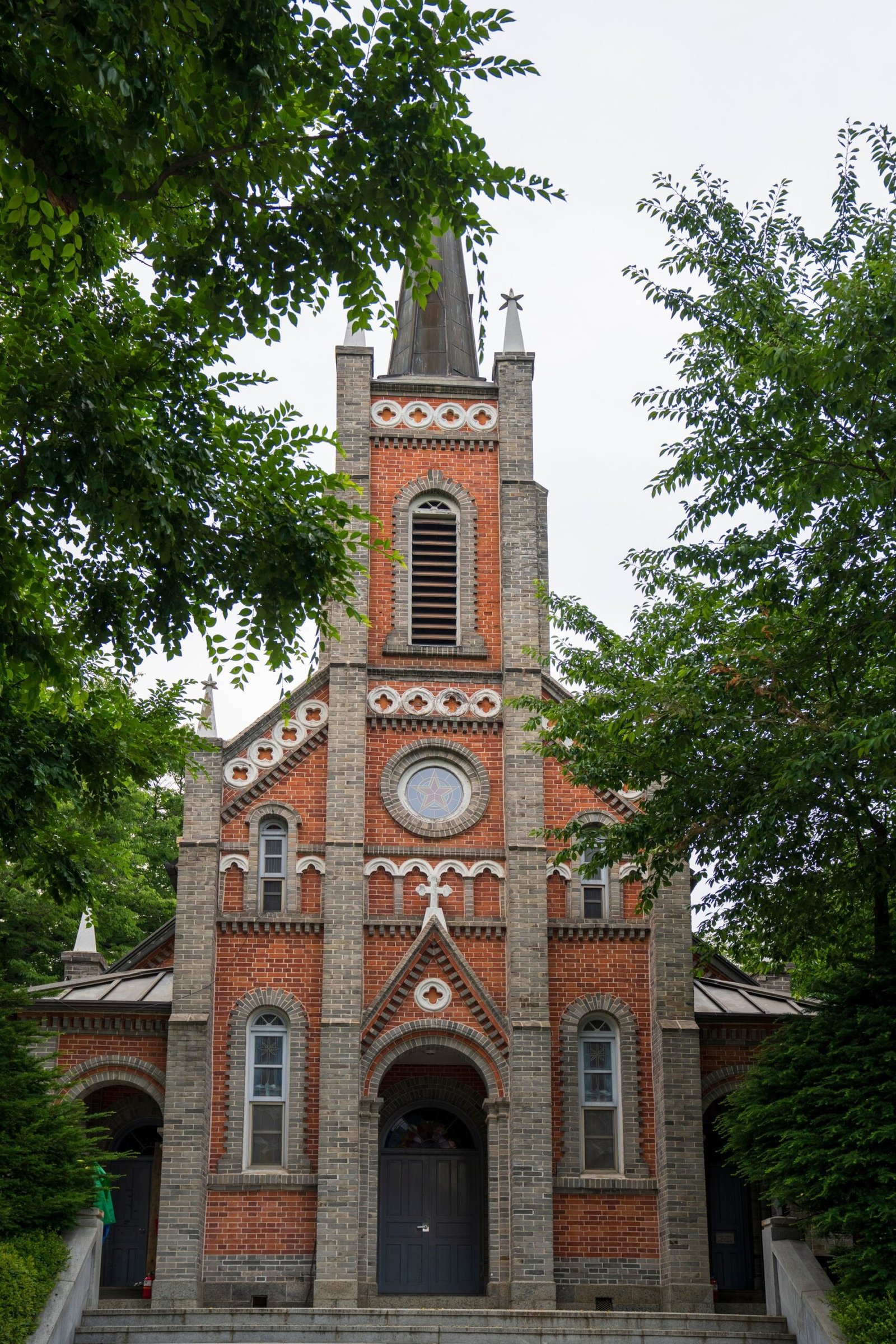
- Gongseri Cathedral: A hilltop church where red brick meets old trees. It’s on the same Asan Bay side as Pinnacle Land, so the two pair well.
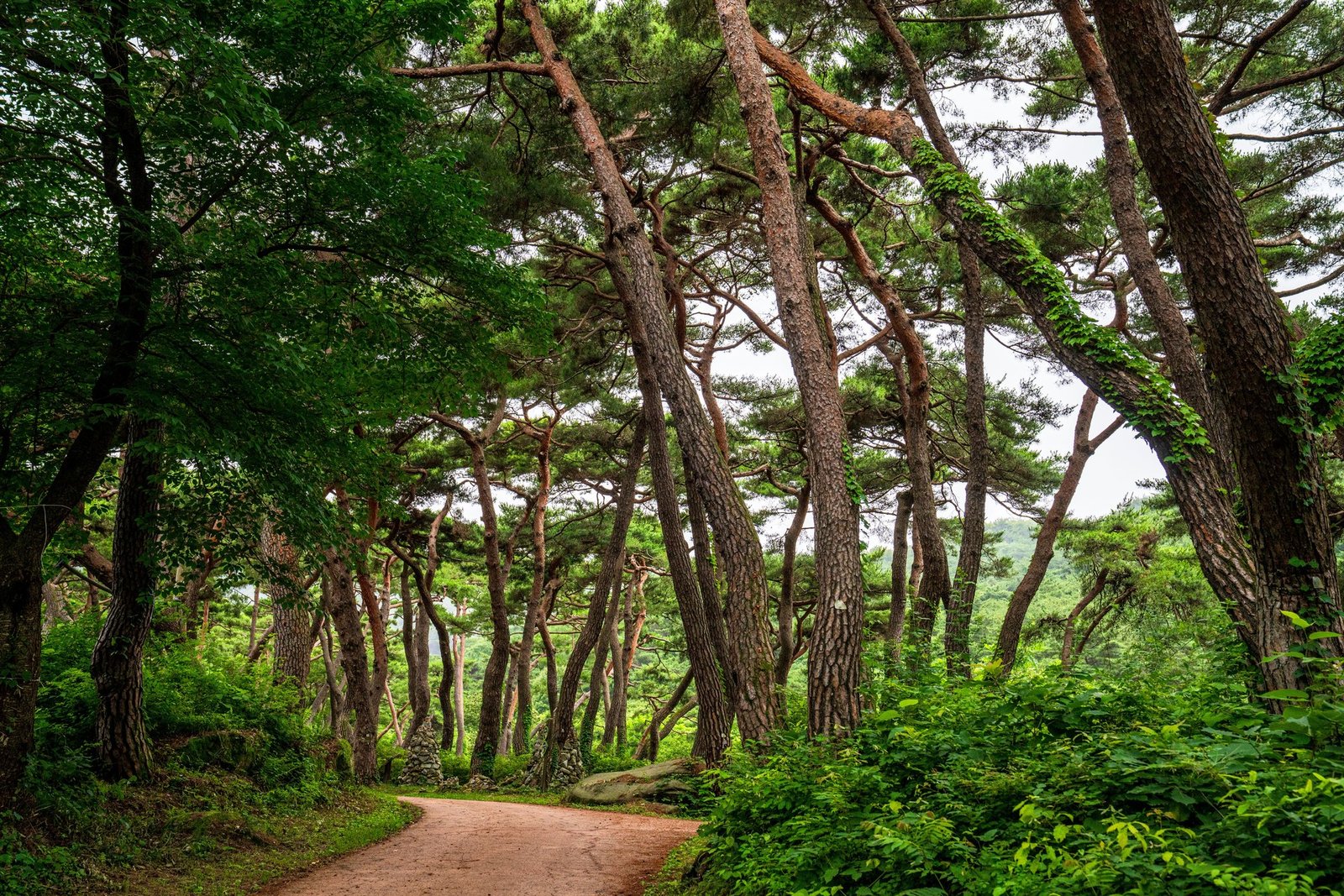
- Bonggoksa Thousand-Year Forest Path: A dirt path climbs to the temple between crooked pines leaning in from both sides. Go when you want to swap the yellow of the ginkgo road for green forest (Sisa Journal Chungnam 24).
-
Ginkgo Road street arts festival “Art Street”: November 14–15 (Saturday and Sunday), 1 to 5 p.m. on the Gokgyocheon Ginkgo Road, with street performances, hands-on activities and photo zones. Free (Asan Cultural Foundation notice, cited on a Naver blog, 2026). If the leaves are still up, you get the performances and the yellow road at once.
-
Sources: Pinnacle Land chrysanthemum festival prices, October 7, 2026, Sisa Journal Chungnam 24, street arts festival schedule
Hotels nearby
A day trip is plenty, but if you want a slow evening soak and an early walk on an empty ginkgo road the next morning, stay a night at one of the hot spring hotels in front of Onyangoncheon Station. Many have hot spring water in the rooms and share the big public bath.
- Onyang Cheil Hotel: About a five-minute walk from Onyangoncheon Station, right above its own bathhouse. The value pick.
- Onyang Tourist Hotel: About a five-minute walk from the station (1459 Oncheon-daero), with the big bath (closed Tuesdays) and a garden.
- Business hotels around Cheonan-Asan Station: Handy if you want to catch the first or last KTX.
Check current rates on a booking site before you go (location info from the South Chungcheong Province official blog).
A sample day
- Morning: Line 1 express from Seoul (or KTX + Line 1) → Onyangoncheon Station → bus 700, 970 or 971 → walk the ginkgo road (No. 1) and the embankment boardwalk (No. 2)
- Lunch: Ginkgo Road noodle shop (No. 6)
- Afternoon: Hyeonchungsa’s 570-year-old ginkgo trees (No. 5) → the Yeohaenaru media wall at 2 or 4 p.m. (No. 3)
- Dusk: The lit-up ginkgo road (No. 4) → bus back to Onyangoncheon Station
- Evening: The free foot bath at the station (No. 7) or a big hot spring bath (No. 8) → soup and hotteok at Onyangoncheon Market (No. 9) → Line 1 home
More than 50 years ago, ten-year-old saplings were planted along the road to a shrine; now they reach across to each other to form a 2 km roof. And where that roof ends, a subway station and a hot spring are waiting. That’s the whole reason people from Seoul ride Line 1 to the end of the line every November.
Read next
 That Golden "Forest" Is a Single Tree: Wonju's 1,300-Year-Old Bangyeri Ginkgo and the Sogeumsan Suspension Bridge
 One Ticket, Five Entries, and It Closes November 15: Last Call for the Gwangju Biennale, Then Songjeong Tteokgalbi
 You Can Spot a Daejeon Tourist by the Sungsimdang Cooler Bag: Daejeon Bread Trip and Expo Bridge at Night
Trending on Seol Notes
- Kim You-jung Cracked Japan Despite the 'Anti-Japan Drama' Label
- The Emperor of K-pop Came Back, and Korea Flipped
- Ae-sun Left the Baeksang Empty-Handed. Then She Spoke: IU
- 85,000 Fans in São Paulo Sang 'Arirang,' and BTS Put Down Their Microphones
- K-pop News Today (Nov 4, 2026): RESCENE's 'With' Hits No. 1 on Melon, TWS Sell 630,000 on Day One, AND2BLE's Career-High Week
Sources
- Gukje News, October 29, 2026: Yeohaenaru media wall competition and screening schedule, Gukje News, October 28, 2026: Monthly Chungnam, November issue, Sisa Journal Chungnam 24, Jeonguk Maeil: Asan autumn spots and night lighting
- South Chungcheong Province official blog, December 19, 2025: Onyang hot spring foot bath and bath prices, Yeohaenaru official website, Oeam Folk Village official website
- YouTube, October 29, 2026: Gokgyocheon ginkgo color at 10%, on-site video
- Naver blog visit reports (prices, hours, buses): see the link under each item, posts from 2024 to 2026
- Photos: Korea Tourism Organization / KTO Photo Korea, KOGL Type 1 (photographer credited on each photo)
- Currency conversion: 1,324.6 won per dollar (Seoul FX market base rate, October 23, 2026)
Discover more from Seol Notes
Subscribe to get the latest posts sent to your email.