
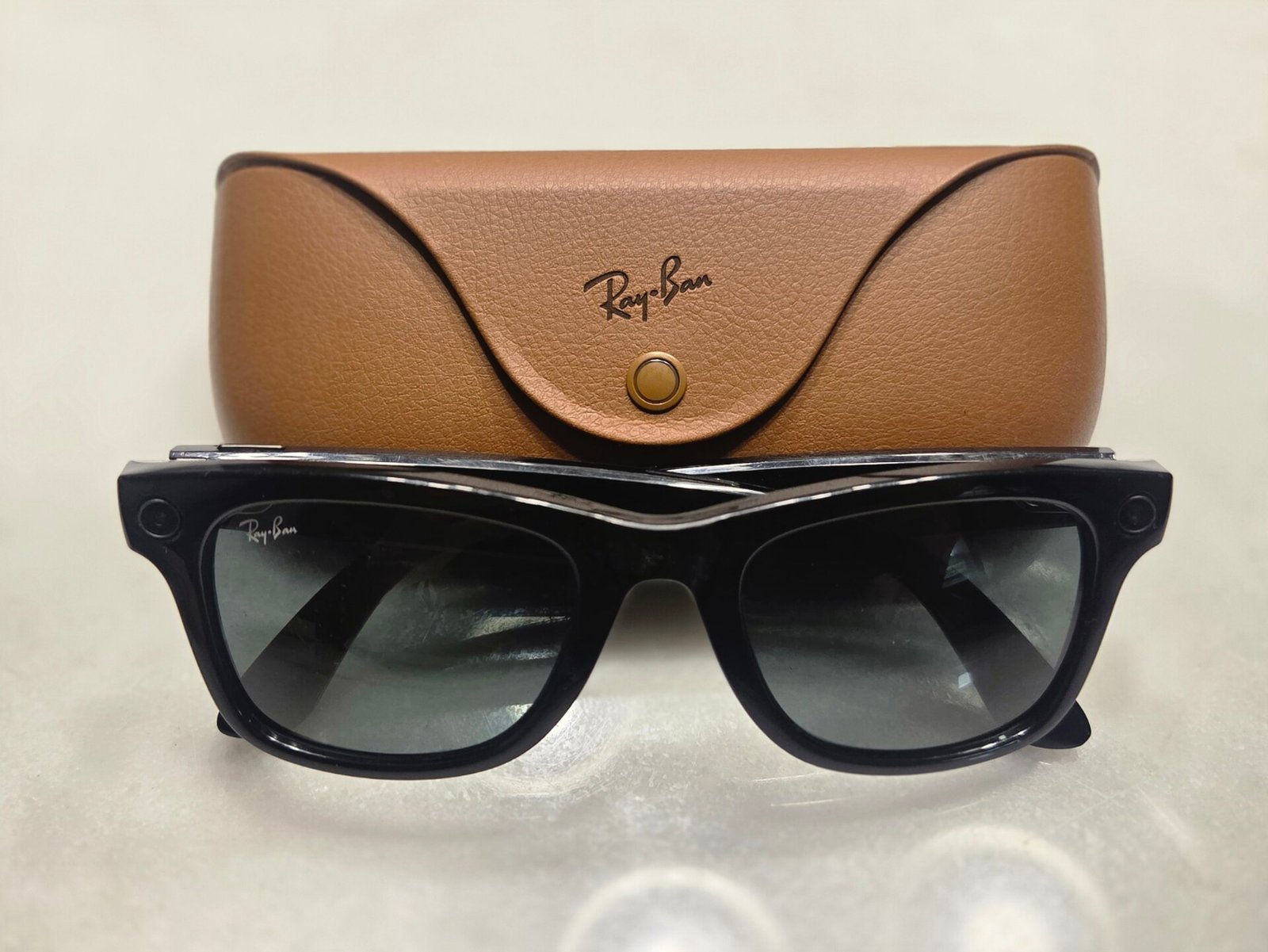
Featured photo: Smart glasses that look almost exactly like ordinary frames. Photo: CCadio / Wikimedia Commons, CC BY 4.0.
To take a developer hiring test in Korea, you now have to take off your glasses and photograph them from four directions. On October 28, Grepp, which runs Programmers, a coding test platform used by some 1,400 Korean companies, said 21 companies had adopted its “glasses verification” feature within two months of its August launch [1]. Once companies started looking for “people who are good at using AI,” the tests and documents that used to prove that skill all became things AI could fake.
In this story
Four photos of your glasses before the test
Big Korean conglomerates and IT companies often follow the résumé stage with an online coding test, and Programmers has had more than 810,000 test takers [1]. That test room now has a new step. Before the test, candidates who wear glasses take them off and use the app to photograph the front, the side, the inside and the tips of both temples. If a suspicious moment shows up, a proctor compares these photos with the glasses in the test video [1].
The reason is smart glasses. They look almost the same as ordinary glasses, so they’re hard to spot by eye, and new models keep coming out, so they’re hard to catch by specs (Grepp) [1]. The 21 adopters include IT and semiconductor, finance, automotive and retail companies, public corporations and broadcasters. Grepp is developing a vision-language model feature to catch candidates switching glasses mid-test, targeted for a November update [1].
College admissions fought the same problem the same month. In October, test takers wearing smart glasses were caught at essay exams at Yonsei University and the University of Seoul [2], and on October 29 the Ministry of Education announced it would station one person dedicated to spotting smart glasses at each of the 1,312 test sites for the national college entrance exam, and file criminal complaints against anyone caught [3].
An ‘AI career’ for $377
It’s not only the tests that are being beaten. When a Dong-A Ilbo reporter posed as a junior developer applicant and asked for help, one vendor replied: “For 500,000 won (about $377), I’ll make it look like you took part in a development project using AI and build your whole portfolio” [4]. “I’ve done hundreds of portfolio jobs so far,” he said. “There’s never been a single problem” [4].
Search “AI portfolio” on one freelance marketplace and about 200 sellers come up, ten of them advertising that they’ll “build the project for you” [4]. Simple projects start at about $38; complex ones with documentation run over about $113 [4]. An HR staffer of eight years said, “From the documents alone, it’s hard to tell whether someone else made it. We try to filter them out in interviews, but I can’t say we can verify 100%” [4].
The skill companies want most became the easiest to fake
This market exists because what companies want has changed. In a Korea Chamber of Commerce and Industry survey, 69.4% of about 500 companies said they need AI specialists, and in the second half of last year, the skill HR managers valued most was the ability to use AI (69.2%), ahead of communication and collaboration (55.4%) and job expertise (54.9%) [4]. Job postings moved the same way. On JobKorea in the first half of this year, AI job postings rose 128% from a year earlier, while app developer postings fell 32.2% and game developer postings 26.4% [5]. In a market where junior positions are shrinking (Korea bought AI tokens instead of junior developers), “AI project experience” became the ticket to the seats that remain.
The trouble is that AI makes that ticket better than anyone. What companies want to see is evidence that you’ve built something with AI, and that evidence is exactly what AI produces fastest. The same tool prints both the certificate and the forgery.
Nexon threw out the coding test altogether
Some companies changed the test itself instead of tightening inspection. This year Nexon dropped the conventional coding test from “Nextorial,” its internship-to-hire program for game programmers, and introduced AI interviews and hands-on task reviews [6]. Kim Jin-ho, head of Nexon Korea’s algorithm research team and chief problem-setter for the Nexon programming contest NYPC, explained why: “LLMs solve standard algorithm problems well, and it’s hard to check whether a person solved it or an AI did” [7].
Other companies are shifting tests toward watching “the process of using AI.” Krafton runs an internship open to any major that evaluates AI skills, Doosan has candidates write a report with AI in 30 minutes, and SK hynix runs a half-day interview combining an AI job task with a humanities discussion [8]. Now you have to watch someone make the result in front of you, not just the result, to believe it.
The candidate on the other side of the screen was overseas
Remote hiring’s biggest gap showed up in nationality. Korean police are investigating a case in which North Korean IT workers, hiding their identities, were reportedly hired by a private Korean company and even did real development work. It’s the first known case of North Korean IT workers getting jobs in Korea under false identities [9]. The workers never entered Korea and worked remotely from abroad [10]. Police say no direct damage such as data leaks or hacking has been found so far [11].
In the US, the scheme is already an industry. North Korean IT workers sat video interviews with AI-generated fake faces, and when foreign companies tightened screening by asking candidates in interviews to “insult Kim Jong Un,” they paid legal US residents to take the interviews for them [10]. According to the FBI, about 90 work laptops were found in a house in Arizona in 2023, and from that base North Korean IT workers took jobs at 309 US companies under false identities over three years and earned $17 million [10]. A Korean developer with six years’ experience said, “Startups short on staff may outsource for speed, which can make them targets for fake hires” [12].
Grepp’s AI proctoring solution, Monito, already watches more than 3,600 tests a year at about 1,000 organizations [1]. The first AI that Korean companies looking for AI-savvy new hires brought into the test room is an AI that catches candidates secretly using AI.
Read next


Trending on Seol Notes
- Kim You-jung Cracked Japan Despite the 'Anti-Japan Drama' Label
- The Emperor of K-pop Came Back, and Korea Flipped
- Ae-sun Left the Baeksang Empty-Handed. Then She Spoke: IU
- K-pop News Today (Nov 4, 2026): RESCENE's 'With' Hits No. 1 on Melon, TWS Sell 630,000 on Day One, AND2BLE's Career-High Week
- 85,000 Fans in São Paulo Sang 'Arirang,' and BTS Put Down Their Microphones
Sources
- Hansbiz, October 28, 2026: Grepp Monito glasses verification adopted by 21 companies
- OhmyNews, October 20, 2026
- Yonhap, October 29, 2026: criminal complaints for smart-glasses cheating on the college entrance exam
- Dong-A Ilbo, October 30, 2026: “AI portfolio, done for 500,000 won”
- 4th.kr, citing JobKorea’s first-half AI job posting analysis
- Newsworks: Nextorial for game programmers
- 4th.kr: Q&A with Nexon’s Kim Jin-ho
- The Public, October 23, 2026
- Yonhap, October 22, 2026
- Chosun Ilbo, October 23, 2026
- Financial News, October 27, 2026
- Sidae Ilbo, October 25, 2026
- Currency conversion: about 1,325 won per dollar (Seoul FX market, October 27, 2026). The US figure of $17 million is in dollars in the original.
Discover more from Seol Notes
Subscribe to get the latest posts sent to your email.