
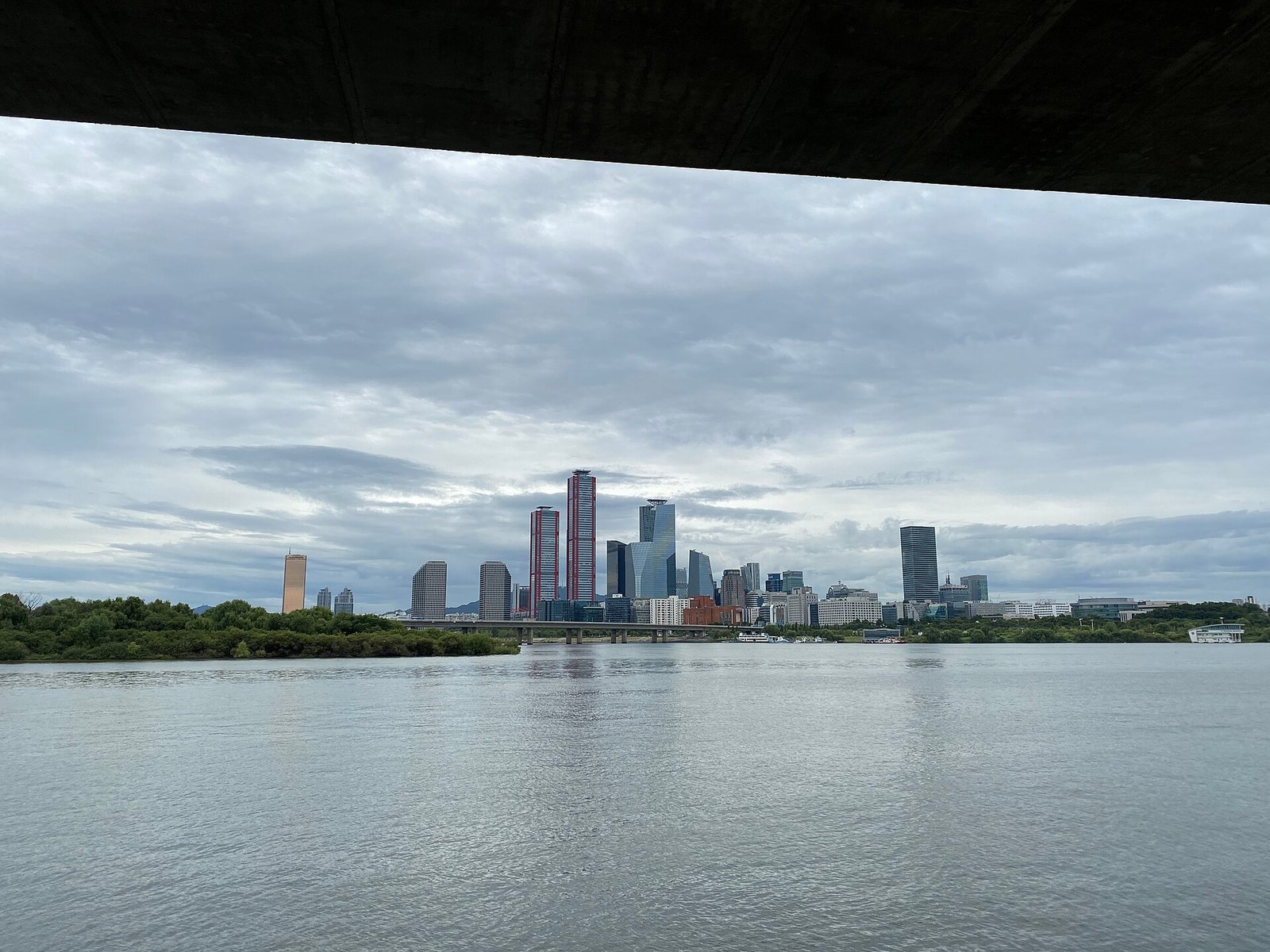
Featured photo: Office towers in Yeouido, Seoul’s financial district. Photo: lazy fri13th / Wikimedia Commons, CC BY 2.0.
A new employee two weeks into the job said, “I’ll work two extra hours Monday through Thursday and take Friday off,” and became a laughingstock among Korean office workers. The very same week, Korea got a survey saying seven in ten people want a 4.5-day week, and the National Assembly was passing around a “flexibility” plan to let people work heavy weeks in a row and lighter weeks after. The new hire’s math wasn’t wrong. He just wasn’t the one allowed to do it.
The new hire who did the math on Friday
It started on Remember, an anonymous community for Korean office workers that grew out of a business-card app. An employee in charge of training newcomers posted, “Our new hire uses his leave in a weird way.” When asked to hold a midway work check-in the following Friday, the new hire, there less than two weeks, asked to move it because he planned to take that day off (Dong-A Ilbo, October 27, 2026).
In Korea, an employee with less than a year on the job earns one day of paid leave for each month of perfect attendance. Told he didn’t have any leave yet, the new hire answered: he’d work two extra hours every day Monday to Thursday to make up eight hours, and take Friday off. “Leave isn’t a savings account,” the poster wrote. “It was so novel I was speechless for a moment” (Newsis, Edaily, October 27, 2026).
Within two days, the story spread to Dong-A Ilbo, Newsis, Financial News, Edaily and TV Chosun. The Dong-A story drew 248 comments, and the second most-liked (104 likes) read: “An employee getting a salary changes company rules however he wants? Fire him.” The most-liked comment mocked the new hire by tying him to the government’s four-day-week slogan. Under another story: “So that’s why we’ve stopped hiring new grads” (comments on a Segye Ilbo story, checked October 30, 2026).
By the letter of the law, it’s not one Friday but a day and a half
Plug the new hire’s math into the law and the result is surprising. Ten hours a day for four days is 40 hours a week, within the legal limit. But Korea’s Labor Standards Act counts any time past eight hours a day as overtime. All eight extra hours the new hire would work are overtime, and at a workplace with five or more employees, they must be paid at 150% (Segye Ilbo, October 28, 2026, citing a Ministry of Employment and Labor consultation from September).
If the company has a “compensatory leave” system that pays overtime in time off instead of money, the math tilts further his way: 8 hours of overtime plus 4 hours of premium is 12 hours, or 1.5 days for someone on an 8-hour day (same article). He asked for one.
The problem wasn’t the math; it was the pen. Whether it’s compensatory leave or a selective working-hours system that lets employees set their own start and end times, it only exists if the company and an employee representative agree in writing. As Segye Ilbo put it, these systems “don’t mean an employee can divide up his own work week by himself.” Bunching hours and bunching rest is perfectly legal in Korea. The only question is who gets to write the schedule.
The Friday the state is drawing
Korea’s government wants a shorter week too. The Lee Jae-myung administration made a 4.5-day week a national policy goal and promised to bring working hours down to the OECD average by 2030 (Sisa Journal, October 27, 2026). In 2025, employed Koreans worked 1,833 hours a year, against an OECD average of 1,736 (Segye Ilbo, July 5, 2026, citing OECD data).
People want it too. In a survey commissioned by a lawmaker, 69.4% of office workers and self-employed people supported a 4.5-day week. But if it meant a pay cut, support fell to 35.8%, and while 84.2% of people at companies with 1,000 or more employees were in favor, only 48.2% at workplaces with fewer than five agreed (Rep. Kim Wi-sang and PMI, September 29–30, 2026, 800 respondents). At those smallest workplaces, 57.1% said it was “impossible at my current job.”
The effects showed up in numbers too. In 2025, Gyeonggi Province became the first in Korea to support a 4.5-day week with no pay cut at 107 companies: weekly hours fell from 41.2 to 36.5, turnover dropped from 22.8% to 17.4%, and applicants per opening rose from 10.3 to 17.7 (Etoday, October 2026). Even so, Gyeonggi decided to end the program a year early, because the national government’s “Work-Life Balance + 4.5 Project” budget more than doubles next year to 56.8 billion won (about $42.9 million) and overlaps with it (Kyeongin Ilbo, October 29, 2026).
The ‘bunched hours’ the state is drawing
At the same time, the National Assembly’s talks on labor exemptions carry a schedule pointing the opposite way: stretching the settlement period for selective working hours from the current one to three months to as long as six. That would allow working 69 hours a week for 13 weeks and only 35 hours a week for the next 13 (Sisa Journal). It’s what the new hire wanted to do within four days, done in half-year units.
A special-zone bill introduced on October 20 by Democratic Party Rep. Park Sang-hyuk would exempt managers and “professionals and related workers” from the 52-hour weekly cap and from rules on breaks and paid holidays, and allow employers not to pay overtime, night and holiday premiums (Sisa Journal). It’s an exemption meant for large national projects such as semiconductors, and both of Korea’s major labor federations have vowed to block it. The name these plans go by is “working-hours flexibility.”
The new hire who wanted to squeeze a 40-hour week into four days heard “fire him.” A plan to let half a year’s work hours be squeezed together sits on the National Assembly’s table under the name “flexibility.” Both are the math of working in bulk and resting in bulk. There’s only one difference: the new hire’s schedule had no line for a signature.
Read next


Trending on Seol Notes
- Kim You-jung Cracked Japan Despite the 'Anti-Japan Drama' Label
- The Emperor of K-pop Came Back, and Korea Flipped
- Ae-sun Left the Baeksang Empty-Handed. Then She Spoke: IU
- K-pop News Today (Nov 4, 2026): RESCENE's 'With' Hits No. 1 on Melon, TWS Sell 630,000 on Day One, AND2BLE's Career-High Week
- 85,000 Fans in São Paulo Sang 'Arirang,' and BTS Put Down Their Microphones
Sources
- The new hire’s story: Dong-A Ilbo, October 27, 2026, Newsis, October 27, 2026, Edaily, October 27, 2026
- Legal explainer: Segye Ilbo, October 28, 2026
- Survey: Viva100, October 27, 2026, News1, October 29, 2026
- Policy and bills: Sisa Journal, October 27, 2026, Kyunghyang Shinmun, October 26, 2026
- Gyeonggi pilot: Etoday, Kyeongin Ilbo, October 29, 2026
- OECD working hours: Segye Ilbo, July 5, 2026
- Currency conversion: 1,324.6 won per dollar (Seoul FX base rate, October 23, 2026)
Discover more from Seol Notes
Subscribe to get the latest posts sent to your email.