
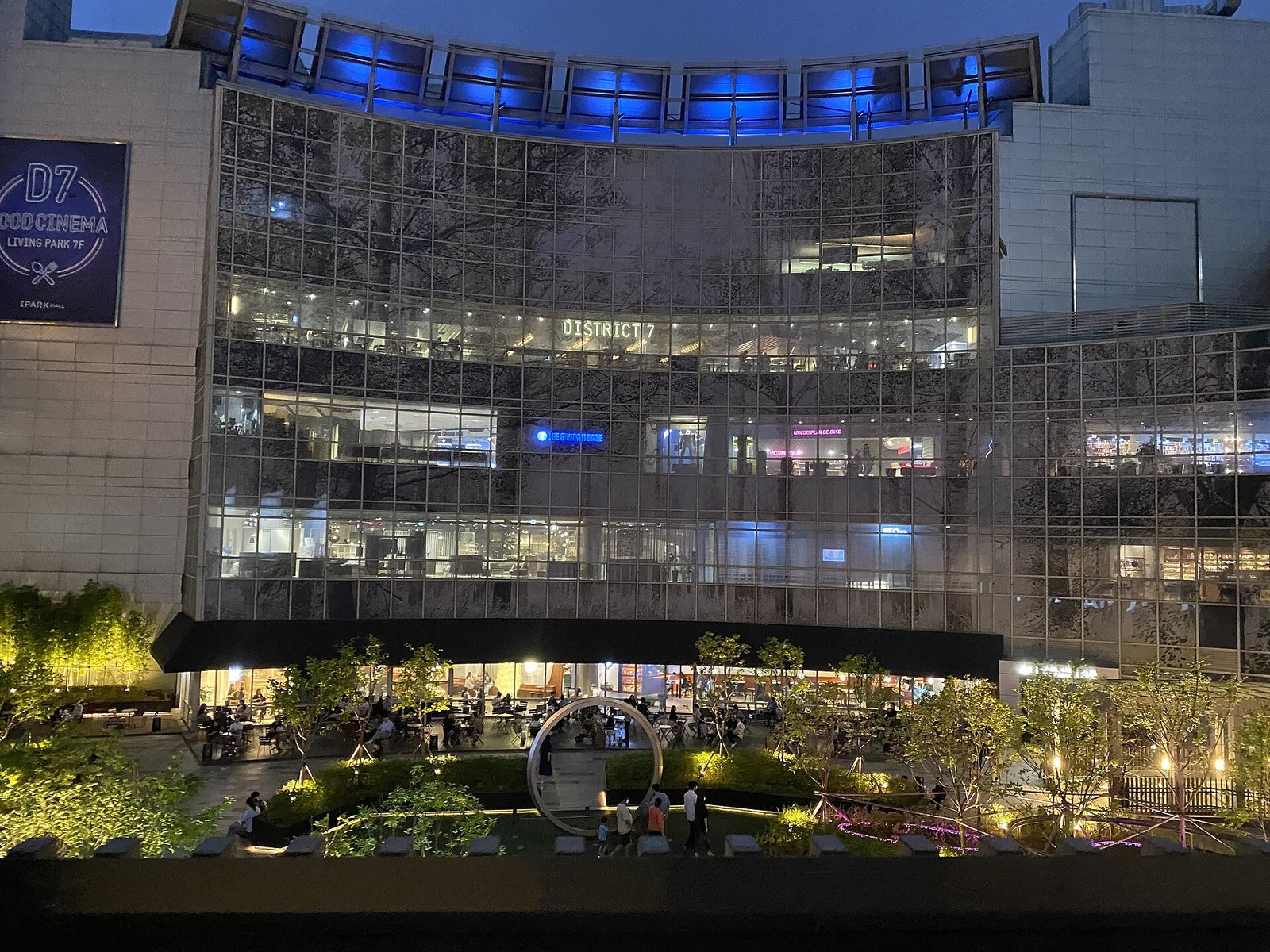
Featured photo: Yongsan Station at night. The I’Park Mall above it is home to the Pokémon card store where lines start the evening before. Photo: Tildin Han / Wikimedia Commons, CC BY-SA 4.0.
At a shopping mall in Seoul’s Yongsan district, a 75-year-old man surnamed Kim lines up in front of a Pokémon card store five times a week. He does it to help his grandchild and his son-in-law, and the son-in-law used to trade stocks (Hankook Ilbo, October 26, 2026). In Seoul right now, Pokémon cards aren’t a children’s toy. They’re an asset, and Koreans have a word for it: potech, Pokémon card investing.
The 7th floor in Yongsan, where the line starts at 9 p.m.
On the 7th-floor rooftop garden of Yongsan I’Park Mall, home of a Pokémon card store, more than 100 people spread out mats and wrap themselves in blankets every morning before dawn, waiting for the doors to open. Some claim their spot at 9 p.m. the night before (Hankook Ilbo). On the afternoon of October 23, the waiting screen read “151 groups waiting, estimated wait 181 minutes” (same article). A 19-year-old college student who arrived at 8 a.m. and got in five hours later said, “I heard the wait had gotten a bit shorter, so I didn’t stay overnight.” Koreans call this kind of line an “open run”: lining up early to dash in the moment the store opens.
Some people in this line do it for a living. A man waiting in a sleeping bag at the store entrance on October 1 had recently quit his job to become a full-time reseller. He said he makes about $151 a day on average, about $2,265 a month. He kept it short: “It pays better than my old job” (Hankook Ilbo).
Also read: Google's AI Gives Bloggers One Link. Korea's Naver Pays Them a Monthly Salary
A box of cards moves like a stock
Store prices run about $11 to $38 a box. The popular “High Class Pack” lists at around $38, but sells for $75 or more, double the price, on secondhand marketplaces. Scarce products go for four to five times list (Hankook Ilbo). Even 30th-anniversary cards sold for about $2.60 a pack from a vending machine in Chuncheon, Gangwon Province, showed up in 20-pack bundles for about $79, 50% over list (Kangwon Ilbo, October 16, 2026).
The stores know this isn’t toy retail. For popular products they sell one box per person per type, and they unwrap purchased packs on the spot to lower their resale value. Resellers get past that wall by mobilizing family, friends and proxy buyers (Hankook Ilbo). Seventy-five-year-old Kim’s place in line is part of that system. Card trading has already become a market where people watch prices and buy and sell like stocks. In the neighboring market for idol photo cards, pricey cards are nicknamed after luxury Seoul apartment complexes like “Banpo Xi” and “Hannam The Hill,” and a single card of BTS’s Jungkook sold for about $1,132 (Korea Economic Daily, May 8, 2026).
The kids of 1996 opened their wallets
It’s adults, not children, who are growing this market. After the Pokémon Trading Card Game’s 30th-anniversary expansion launched worldwide on September 16, new Pokémon card listings on the secondhand platform Bunjang from September 1 to 17 were up 272% from a year earlier, and users searching for them up 337%. People in their 30s and 40s accounted for 58.7% of transaction value, rising to 67.2% for trades over about $113. Their average purchase price was 1.5 times that of buyers 20 and under (Yonhap, September 21, 2026). The kids who first met Pokémon in 1996 are now grown-ups with paychecks.
On the resale platform KREAM, trading card game transactions from January to July this year were about 208 times higher than a year earlier, and 77% of them were Pokémon cards (Seoul Economic TV, September 22, 2026). Demand that started as nostalgia invited investment demand, and investment demand made the lines longer.
100,000 people for one Magikarp card
How big this fever is had already been clear on May 1 in Seongsu-dong, Seoul. When Pokémon Korea announced that people who collected stamps at its 30th-anniversary event “Pokémon Mega Festa 2026” would get a Magikarp card, more than 100,000 people showed up, by the city of Seoul’s estimate. That card had been trading for more than about $151 apiece on the secondhand market. The event was shut down early that morning (Hankook Ilbo, May 3, 2026). Posts saying “some people came at 5 a.m.” spread online (Korea Economic Daily, May 1, 2026).
Yet there’s no law to stop this reselling. In Korea, scalping of concert and sports tickets is regulated by law, but for ordinary goods like cards there’s no legal basis to punish someone who buys in bulk and sells at a markup (Kangwon Ilbo). So the response comes in words instead of laws. Among Naver comments on the Hankook Ilbo story, the most-liked one said, “Don’t call it ‘reselling,’ call it scalping” (checked October 28, 2026). A 23-year-old collector who has gathered cards since childhood said, “People who are actually into cards and the game can’t even get a look” (Hankook Ilbo).
On October 13, at a big-box store in Chuncheon, a man spent more than an hour pulling cards from a Pokémon card vending machine posted with a “one purchase per day” sign. He left when police arrived, then came back and took all of the roughly 900 cards in the machine. The elementary school kids who came to buy cards that day went home empty-handed. One of them told a reporter at the machine, “It’s been empty every time I came” (Kangwon Ilbo).
Read next

Trending on Seol Notes
- Kim You-jung Cracked Japan Despite the 'Anti-Japan Drama' Label
- The Emperor of K-pop Came Back, and Korea Flipped
- Ae-sun Left the Baeksang Empty-Handed. Then She Spoke: IU
- K-pop News Today (Oct 27, 2026): IVE's EP Drop, ILLIT 'You're Under Arrest', LISA's 59M
- The No. 1 Korea Doesn't Want to Believe: Why Fans Doubt A2O
Sources
- Hankook Ilbo, October 26, 2026: “I make 200,000 won a day”… Pokémon card fever has people in their 70s doing open runs
- Kangwon Ilbo, October 16, 2026: “900 Pokémon cards swept up,” police called over hoarding
- Yonhap, September 21, 2026: 30- and 40-somethings hooked on Pokémon cards, listings and searches surge
- Seoul Economic TV, September 22, 2026: Pokémon cards win over big-spending 30- and 40-somethings
- Hankook Ilbo, May 3, 2026: 100,000 people came for a Magikarp card
- Korea Economic Daily, May 1, 2026: What is the Magikarp card?
- Korea Economic Daily, May 8, 2026: 1.5 million won a card, photo cards become investment products
- Currency conversion: 1,324.6 won per dollar (Seoul FX base rate, October 23, 2026)
Discover more from Seol Notes
Subscribe to get the latest posts sent to your email.