Part 9 of 27 in Homo Conspirans: The Humans Who Come After Us
Homo Conspirans · Musk’s dream: “a seed of civilization kept off Earth” → a species that keeps its backup on another world
The “seed of civilization” Musk talks about will be buried on the Moon before Mars. And that seed will not be paper books or seed packets. It will be AI. Humanity will become the first species to keep a backup of itself on another world.
September 2015, high on a frozen mountainside in the Arctic archipelago of Svalbard. The steel door of the “doomsday vault,” held at minus 18 degrees Celsius, opened for a withdrawal for the first time in the seven years since it was built. The request came from the International Center for Agricultural Research in the Dry Areas, which had been headquartered in Aleppo, Syria. With the civil war making it impossible to grow and share seeds at its gene bank, the center asked for roughly 130 of the 325 boxes it had deposited, 116,000 seed samples.[1] Wheat, barley and grasses that grow in dry land. The seeds were grown again in fields in Lebanon and Morocco, and in 2017 their offspring went back into the Arctic vault.[2] The backup worked.
In this story
Musk’s insurance against a dark age
On March 11, 2018, on the SXSW stage in Austin, Texas, Musk put it this way: there is some chance, particularly if there is a third world war, that humanity falls into another dark age. So we need to leave a seed of human civilization somewhere else, enough to bring civilization back, and that is why a base on the Moon and a base on Mars, which could help regenerate life on Earth, really matter.[3]
A month earlier, the first flight of Musk’s Falcon Heavy had launched a red Tesla Roadster into orbit around the Sun. Aboard the car was a quartz disc designed to last 30 million years. On it was Isaac Asimov’s Foundation trilogy.[4] It is the story of a library of knowledge meant to shrink the 30,000-year dark age after a galactic empire falls down to a thousand years. Musk’s idea of a seed that shortens the dark age walked straight out of that novel.
Life has always kept a backup
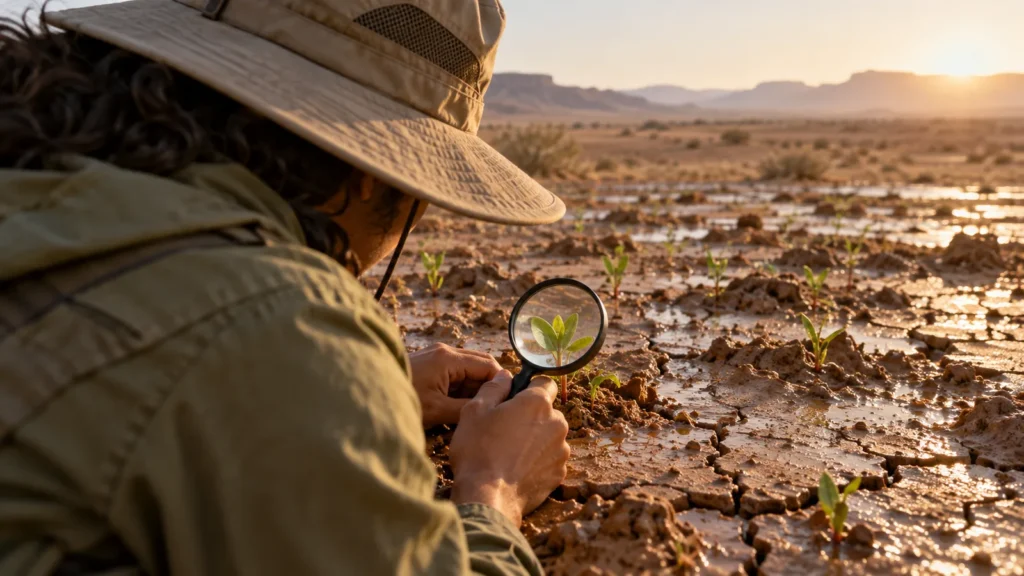
Keeping a backup is one of life’s oldest strategies. Desert annuals do not let all their seeds sprout in a single year. Some sleep in the soil for years at a time. If one year the rain fails and everything that sprouted dies, the sleeping seeds wait for the next rain. In 1966 the Israeli biologist Dan Cohen showed mathematically that this kind of risk-spreading leaves the most descendants in an unpredictable environment.[5]
Some creatures survive extremes. Tardigrades, less than a millimeter long, can last for decades dried to a husk. In 2016 a University of Tokyo team put Dsup, a protein found only in tardigrades, into human cells and found it cut the DNA damage left by X-rays by about 40 percent.[6] Until now, life’s backups have stayed on the same planet. Humanity is about to send one off the planet for the first time.
Bury a teacher, not a library
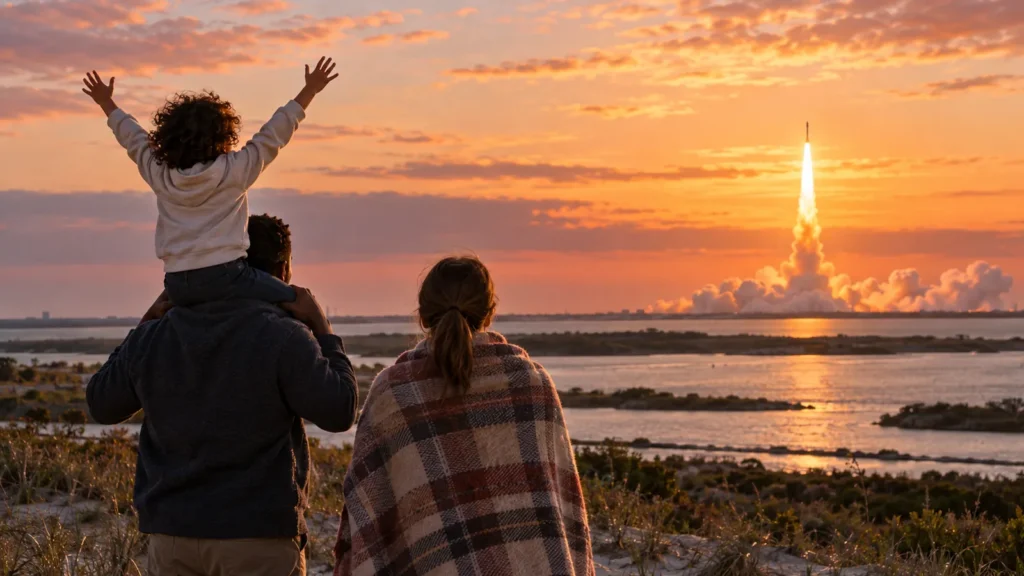
One backup of humanity already lies on the Moon. On April 11, 2019, the Israeli robotic lander Beresheet crashed while trying to land. Aboard was a “Lunar Library” the size of a DVD: 30 million pages of information, the whole English Wikipedia, human DNA and thousands of dried tardigrades.[7]
But for survivors after a collapse, 30 million pages is far too long. What they need is not bookshelves but a teacher who answers questions. How to make fertilizer. What to use when a wound festers. How to get electricity running again. An AI that teaches through conversation is a teacher with an entire library folded into a single file.
The place to keep that teacher is being prepared too. When the lunar lander Athena launched on a SpaceX Falcon 9 on February 26, 2025, it carried Freedom, the first lunar data center. The lander came down on its side on March 6, but Freedom had already completed file storage and encryption tests on the way.[8] And in February 2026, Musk said SpaceX had shifted course to build a self-growing city on the Moon before Mars, because it could be done within ten years.[9] The data centers that run AI are headed off the planet as well.
Chuseok 2049: one page for the Moon
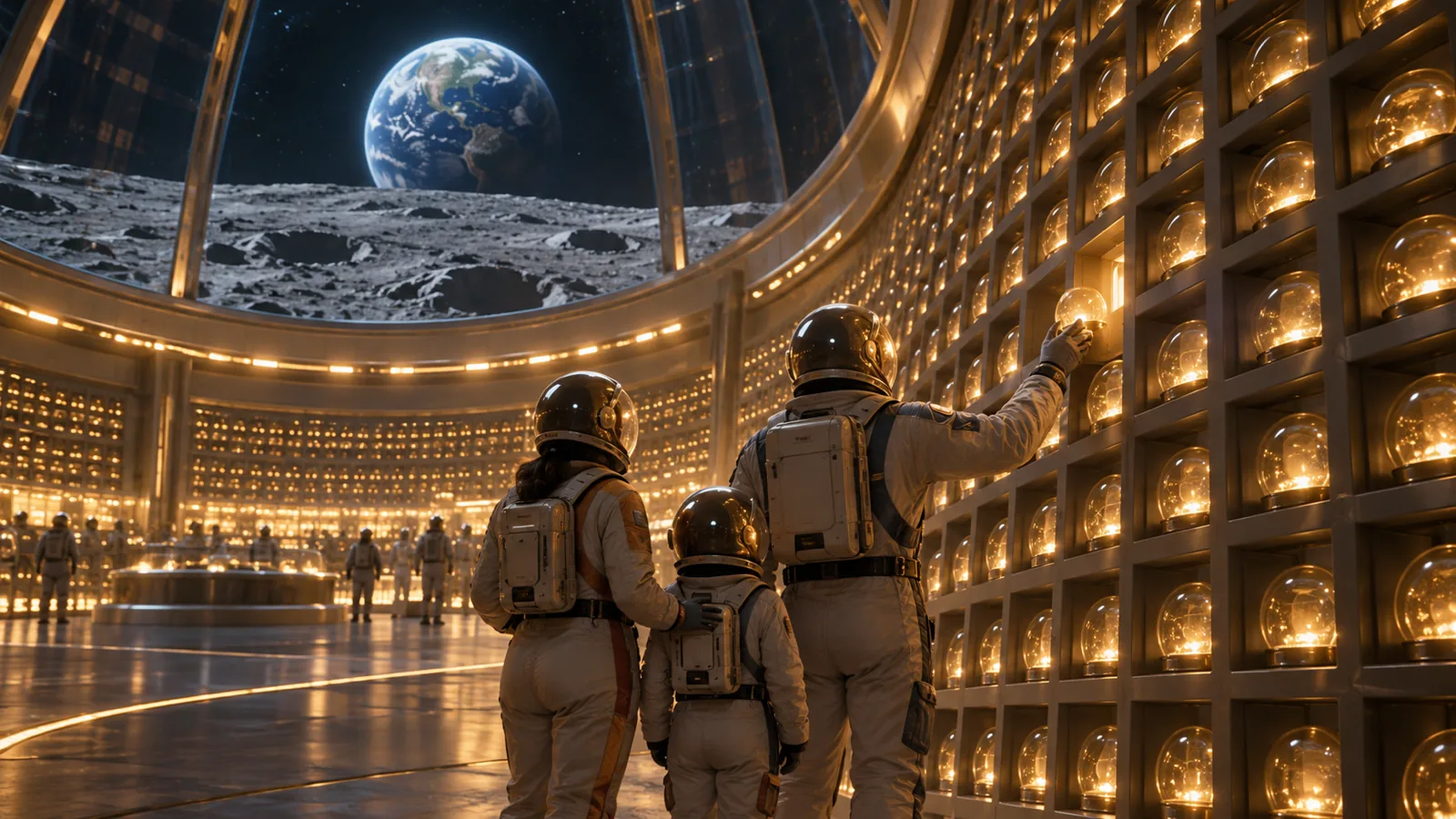
The evening of Chuseok, Korea’s autumn harvest holiday, 2049, in an apartment in Jeonju. An 81-year-old grandmother and her 16-year-old granddaughter sit across the kitchen table. A government program called the Lunar Archive gives every citizen one page in an underground vault on the Moon. The grandmother tells her granddaughter, out loud, how to make kimchi stew with well-aged kimchi, and the girl has an AI tidy it up. The grandmother adds: “A spoonful of perilla oil at the end.”
The same week, at the vault near the Moon’s south pole, the copy of Earth’s AI models gets its quarterly update: a model that can teach farming, medicine and how to build a power plant on its own, even if contact with Earth is lost. The grandmother’s kimchi stew goes in too.

A first copy in 2028, a second planet by 2060
This is the order in which humanity’s backup leaves the planet.
- 2028: A commercial lunar lander sets down a small copy of an AI model on the Moon’s surface for the first time.
- 2034: SpaceX’s Moon base builds a “civilization restart AI” vault inside a lava tube, a solar-powered server that runs on its own if cut off from Earth.
- 2040: An international treaty at the United Nations sets what goes into the lunar vault. Every nation’s languages, legal codes and farming knowledge top the list.
- 2049: More than 30 countries, South Korea among them, run programs that let each citizen leave one page on the Moon.
- 2060: A second copy is installed in a city on Mars. Humanity’s knowledge is now stored across three worlds.
The seeds in Svalbard grow again only if people plant them in a field by hand. The seed buried on the Moon speaks first and teaches people how to plow. Whatever happens on Earth, it waits 380,000 kilometers away for the next person to ask.
Next in the series · Living With AI, Humans Will Domesticate Themselves Again and Become a Tamer Species: Human Self-Domestication
Foxes bred only for tameness began wagging their tails and growing floppy ears within a few dozen generations. In a world where AI filters out human anger, humanity grows gentler once more.
Homo Conspirans: The Humans Who Come After Us · Part 9 of 27
Part 10 arrives Nov. 5.
← Part 8: Humans With Musk's AI Brain Chips Will Evolve to See Infrared: Neuralink Blindsight
Read next
Trending on Seol Notes
- Kim You-jung Cracked Japan Despite the 'Anti-Japan Drama' Label
- The Emperor of K-pop Came Back, and Korea Flipped
- Ae-sun Left the Baeksang Empty-Handed. Then She Spoke: IU
- K-pop News Today (Oct 27, 2026): IVE's EP Drop, ILLIT 'You're Under Arrest', LISA's 59M
- The No. 1 Korea Doesn't Want to Believe: Why Fans Doubt A2O
Sources
- Al Jazeera (Reuters), “Syria war spurs opening of ‘doomsday’ Arctic seed vault,” September 23, 2015. https://www.aljazeera.com/news/2015/9/23/syria-war-spurs-opening-of-doomsday-arctic-seed-vault
- Crop Trust, “More Than 50,000 Seeds Withdrawn From Seed Vault,” 2017. https://www.croptrust.org/news-events/news/more-than-50000-seeds-withdrawn-from-seed-vault-1/
- Al Jazeera, “Musk: In WW3 we could flee to the moon,” March 12, 2018 (SXSW, Austin, March 11, 2018). https://www.aljazeera.com/news/2018/3/12/musk-in-ww3-we-could-flee-to-the-moon
- Arch Mission Foundation, “The Foundation Library (SpaceX, 2018).” https://www.archmission.org/tesla-roadster
- Dan Cohen, “Optimizing reproduction in a randomly varying environment,” Journal of Theoretical Biology 12(1), 119–129, 1966. https://doi.org/10.1016/0022-5193(66)90188-3
- Takekazu Hashimoto et al., “Extremotolerant tardigrade genome and improved radiotolerance of human cultured cells by tardigrade-unique protein,” Nature Communications 7, 12808, 2016. https://doi.org/10.1038/ncomms12808
- EarthSky, “Tardigrades and a lunar library on the moon after Beresheet crash,” 2019. https://earthsky.org/human-world/tardigrades-lunar-library-beresheet-spacecraft-crash-moon
- Lonestar Data Holdings (PR Newswire), “Lunar Data Center Achieves First Success En Route To The Moon,” March 5, 2025. https://www.streetinsider.com/PRNewswire/Lunar+Data+Center+Achieves+First+Success+En+Route+To+The+Moon/24453526.html
- FOX 7 Austin, “Musk says SpaceX shifting focus to ‘self-growing city’ on moon before Mars push,” February 9, 2026. https://www.fox7austin.com/news/musk-says-spacex-shifting-focus-self-growing-city-moon-before-mars-push
Discover more from Seol Notes
Subscribe to get the latest posts sent to your email.