
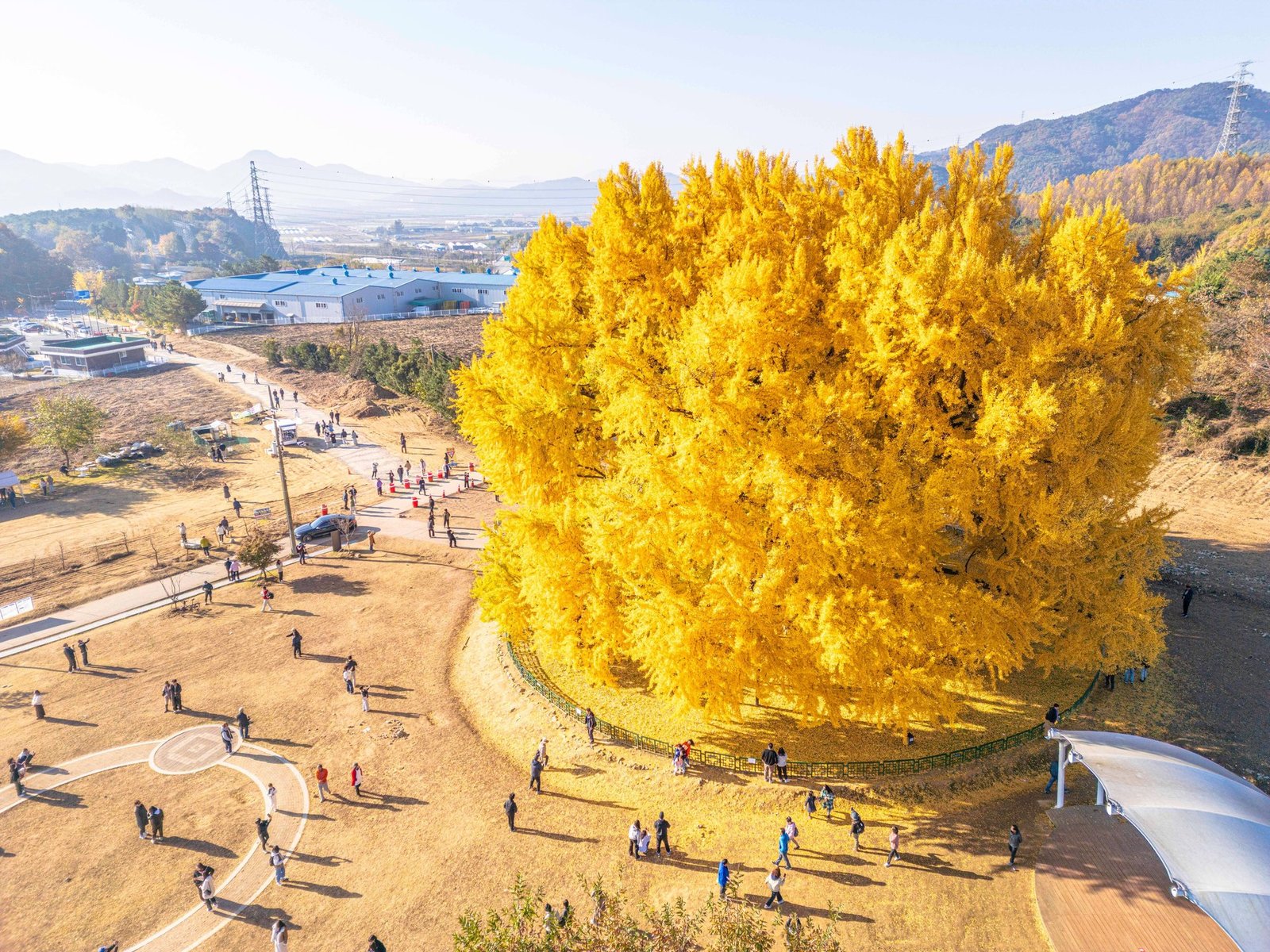
Featured photo: Visitors walking around the golden Bangyeri ginkgo tree. Photo: Hwang Seong-hun / KTO Photo Korea, KOGL Type 1.
In the middle of a field in Munmak, Wonju, in Gangwon Province, what looks from a distance like a small yellow forest is actually one ginkgo tree that has lived more than 1,300 years. Walk under this golden dome in the first week of November, cross the Sogeumsan suspension bridge the same day, and close it out with dumplings at Wonju Jungang Market: that’s late fall in Wonju.
At a glance
- When to go: On October 30, the city of Wonju forecast that the tree’s yellow would “reach its peak as we move past this weekend” (Sports Seoul, October 30). A visitor on October 26 reported about 30% of the leaves had turned, and on October 30 plenty of green was still left (Naver blogs 2026). The first weekend of November through early in the second week is the best bet. Once frost and wind pass through, the leaves drop all at once and lay a golden carpet under the tree (Herald Business).
- Check before you go: Since October 20, Wonju has posted a live video clip of the Bangyeri ginkgo on its tourism website. Check the color and how many leaves are left a few days before you go and again that morning (Naver blog 2026).
- Festival: The 2026 Wonju Bangyeri Ginkgo Festival runs through November 8 around Ginkgo Plaza. The stage, food booths and flea market run 11 a.m. to 5 p.m. (Energy Economic News, October 21), and seeing the tree is free year-round, festival or not.
- By car: About 10 minutes from the Munmak IC on the Yeongdong Expressway (Herald Business). The city is opening about 340 temporary parking spaces around Ginkgo Plaza through November 20 (Energy Economic News, October 21). Last November, with only about 170 public spaces, cars backed up 2 km from the tree for half an hour even on weekdays (Kangwon Ilbo, November 13, 2025). On weekends, aim to arrive before 9 a.m.
- Without a car: From Seoul, the KTX-Eum from Cheongnyangni Station to Wonju Station takes 48–50 minutes, 9,000–10,100 won (about $6.80–$7.60) (Naver blog 2026). From Myeongdong, take Subway Line 4 to Seoul Station and Line 1 to Cheongnyangni. From Incheon Airport, take the AREX to Seoul Station and do the same, or take a direct airport limousine bus to Wonju. From Wonju Station or Wonju Bus Terminal, a city bus toward Munmak takes 30–40 minutes; from Munmak, take public bus 1-1 (eight extra runs a day on weekends and holidays through November 8) or a 5–10 minute taxi (Energy Economic News, Naver blog 2026). Country routes can run one to two hours apart, so check the return times first.
- Admission: Free. The only costs are Sogeumsan Grand Valley and Museum SAN tickets, and food.
The tree stands alone in the middle of the plaza.
Also read: In Seoul, $25 Gets You Into a K-pop Choreographer's Studio: One-Day K-pop Dance Classes
Top 10 things to do in Wonju
1. Shoot the golden dome of the Bangyeri ginkgo from a distance (photo spot)
This tree shows its face from far away, not up close. Its branches spread evenly about 31 meters east to west and 29 meters north to south into a giant yellow dome, and with no buildings around it, the way it stands alone in the field looks unreal (Herald Business). Many visitors say it looks less like one tree than a small forest (Naver blog 2026).
- When: Early morning, when there are fewer people, and 3–4 p.m., when the sun comes in low. You need blue sky for the yellow to pop.
- Framing: Use your phone’s wide-angle lens to fit the whole tree, and put people very small in front of it to show the scale (Naver blog 2026). Walk half a loop of the path around the plaza to pick your angle.
- Time needed: 30–50 minutes for the tree alone (Naver blog 2026).
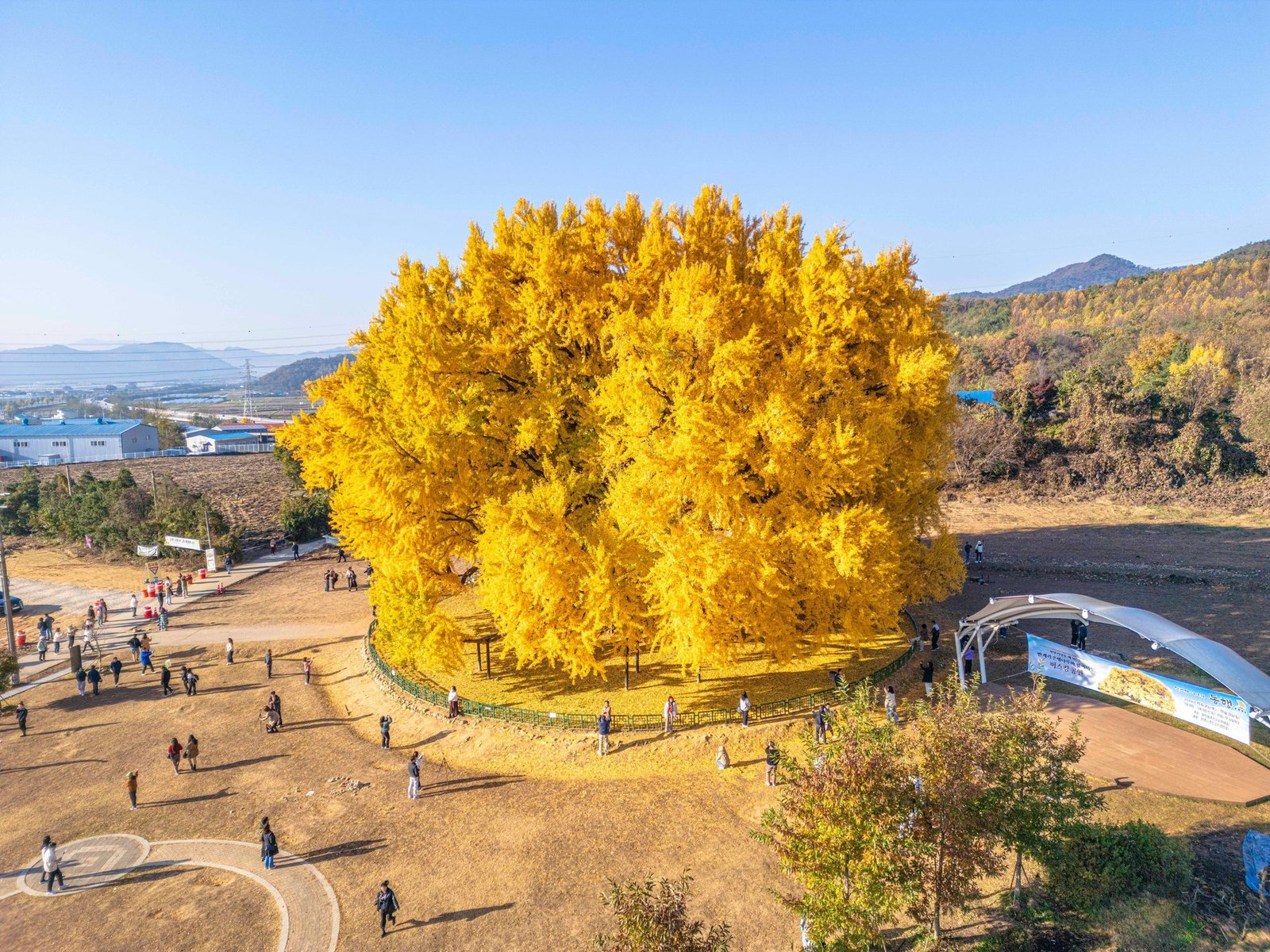
2. The seven-trunk base and the golden carpet (see)
Get closer and you can see it isn’t a forest. A single tree about 32 meters tall and about 16 meters around splits into seven trunks just above the ground (on-site sign, Naver blog 2026). When it was designated a Natural Monument in 1964, it was thought to be 800 to 1,000 years old, but when Wonju had the National Institute of Forest Science re-examine it with a LiDAR scan, it was estimated at about 1,317 years old as of 2024 (on-site sign, JTBC). After the leaves fall, the ground within 15 meters is covered deep enough in yellow to sink your feet into (Herald Business).
- Tip: A rope keeps visitors back, so you walk around it from outside the line. Large branches have broken off before (Wonju MBC), so stay out of the fenced root area. There’s a restroom next to the lightning rod (Naver blog 2026).
- Tip: The signs are in both Korean and English.
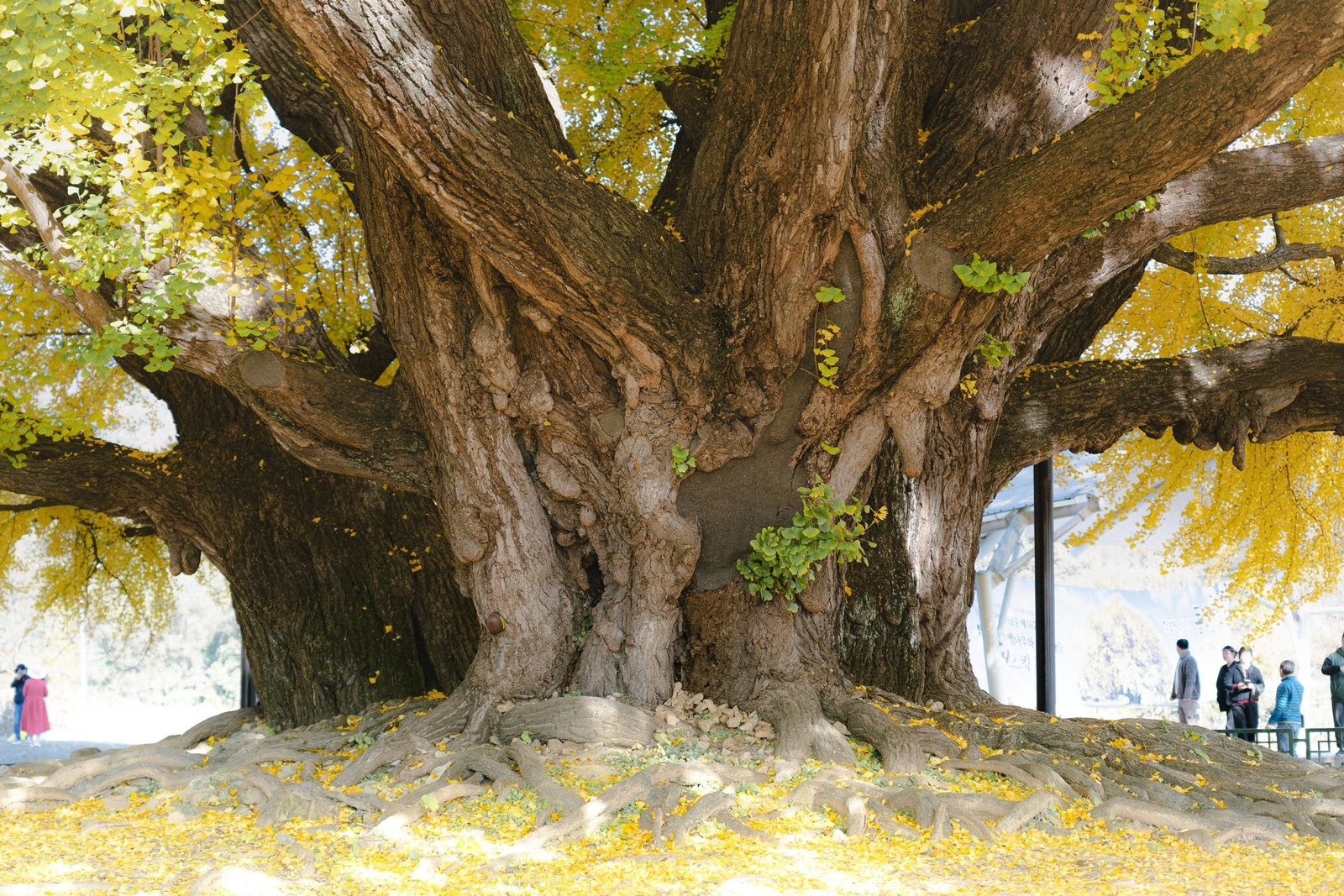
3. The ginkgo festival stage and market (experience)
Through November 8, Ginkgo Plaza has performances, food booths and a flea market (Energy Economic News, October 21). There aren’t shows every day, so plan your date.
- Shows: Sunday, November 1, 2–3:30 p.m., healing busking (Rose Flute Ensemble and others); Friday, November 6, 2–3:30 p.m., healing busking (string ensembles); Sunday, November 8, 2–3 p.m., Maeji nongak farmers’ music and a touring arts performance (Sports Seoul, Naver blog 2026 citing the Wonju tourism schedule).
- Tip: Come in the morning for quiet photos, or at 2 p.m. to see the tree with music. Booth prices vary.
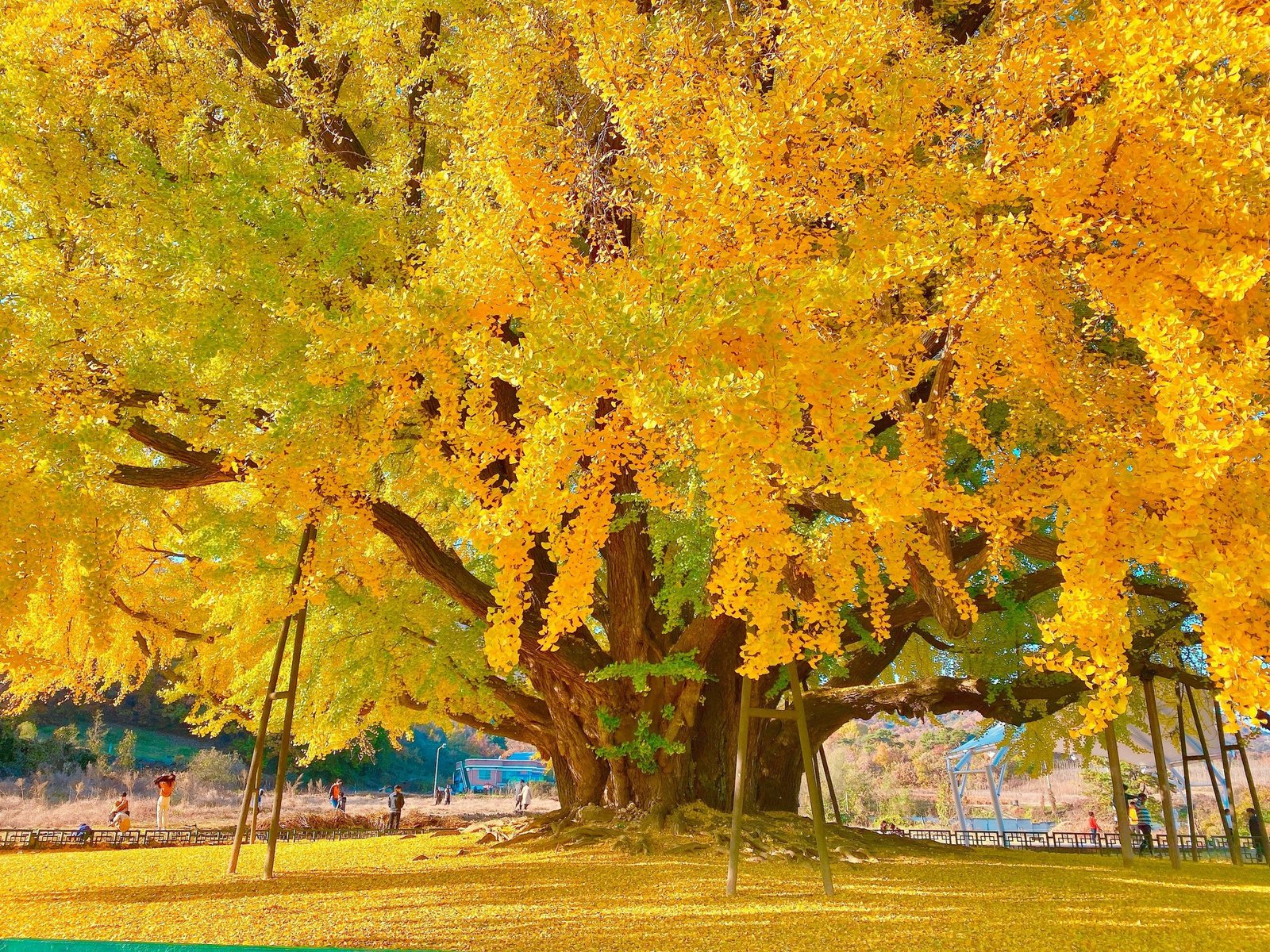
4. The Sogeumsan Grand Valley cable car and suspension bridge (activity)
A cliff-top walking course at Ganhyeon Resort, roughly half an hour by car from Bangyeri. A yellow cable car climbs about 972 meters in six minutes, and you start by crossing a 200-meter suspension bridge (Naver blog 2026). Below your feet is the Samsancheon stream valley, and in late fall the whole mountain turns red.
- Prices: Cable car course 18,000 won (about $13.60) for adults, 10,000 won for children (7–12); hiking course 10,000 won (about $7.50) for adults, 6,000 won for children. A hiking ticket doesn’t let you ride the cable car down. Discounts aren’t available at the self-service kiosks, so go to a staffed window (Naver blog 2026).
- Hours: Winter hours start in November: 9 a.m. to 5 p.m., ticket sales end at 3:30 p.m. Closed Mondays (the next weekday if Monday is a holiday) (Wonju City Facilities Management notice, October 22, via Naver blog 2026).
- Tip: Even the cable car course involves a fair amount of walking between bridges. Arriving by around 1 p.m. gives you breathing room.
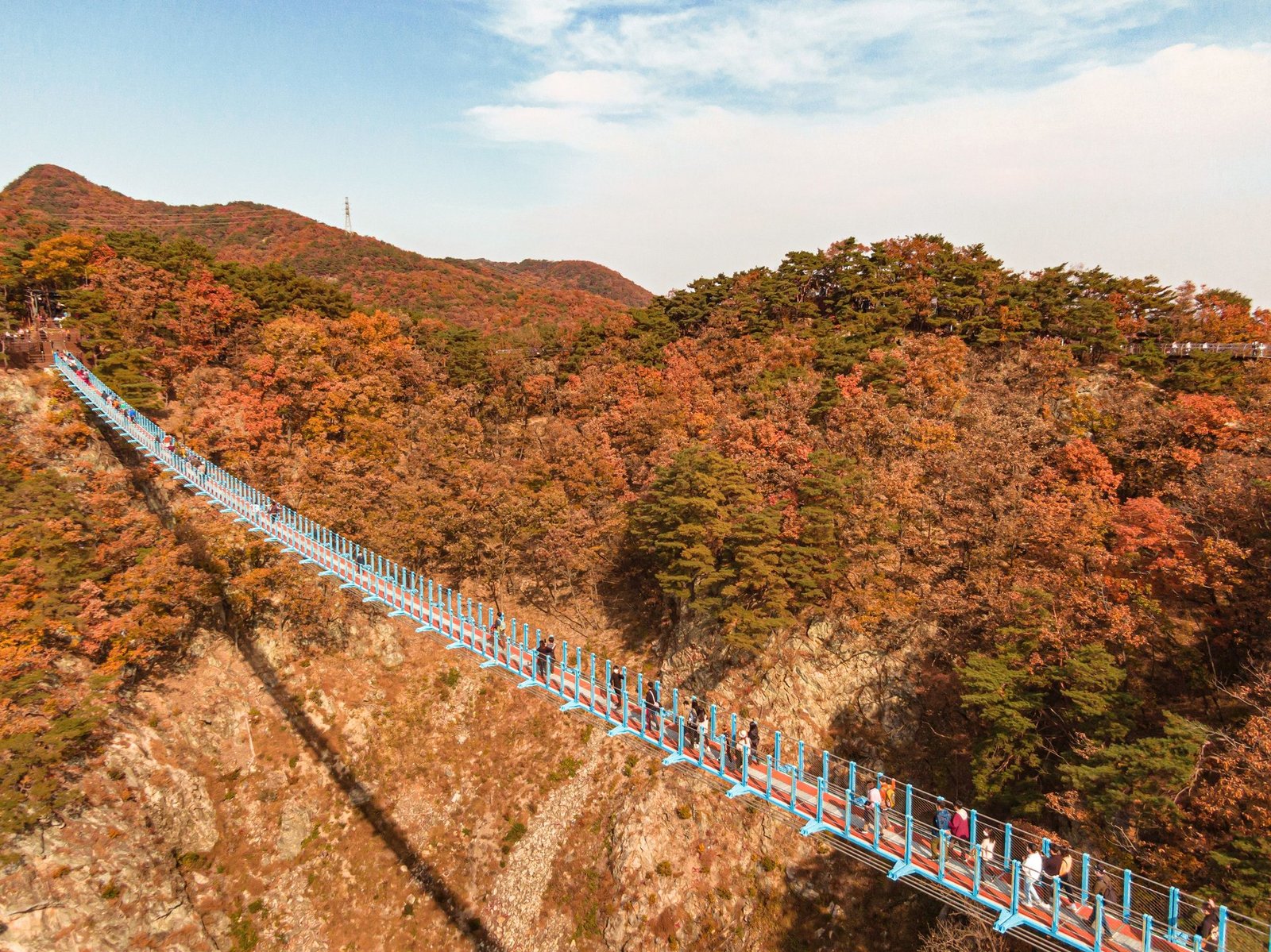
5. The Sogeum cliff walk, Sky Tower and Ulleong Bridge (activity)
Past the suspension bridge come the Sky Garden, about 700 meters of deck trail, the 360-meter Sogeum cliff walkway bolted onto the rock face, and a Sky Tower overlooking the valley, leading to the 404-meter Ulleong Bridge. You finish by riding escalators down (Naver blog 2026).
- Time needed: About 2 hours for the cable car course and 2½ hours for the hiking course, per the on-site sign (Naver blog 2026). Add time for photos and lines.
- Tip: Ulleong Bridge is twice as long as the first bridge and sways more. If you’re nervous about heights, look at it from the entrance before deciding. November wind is cold, so bring a jacket and water.
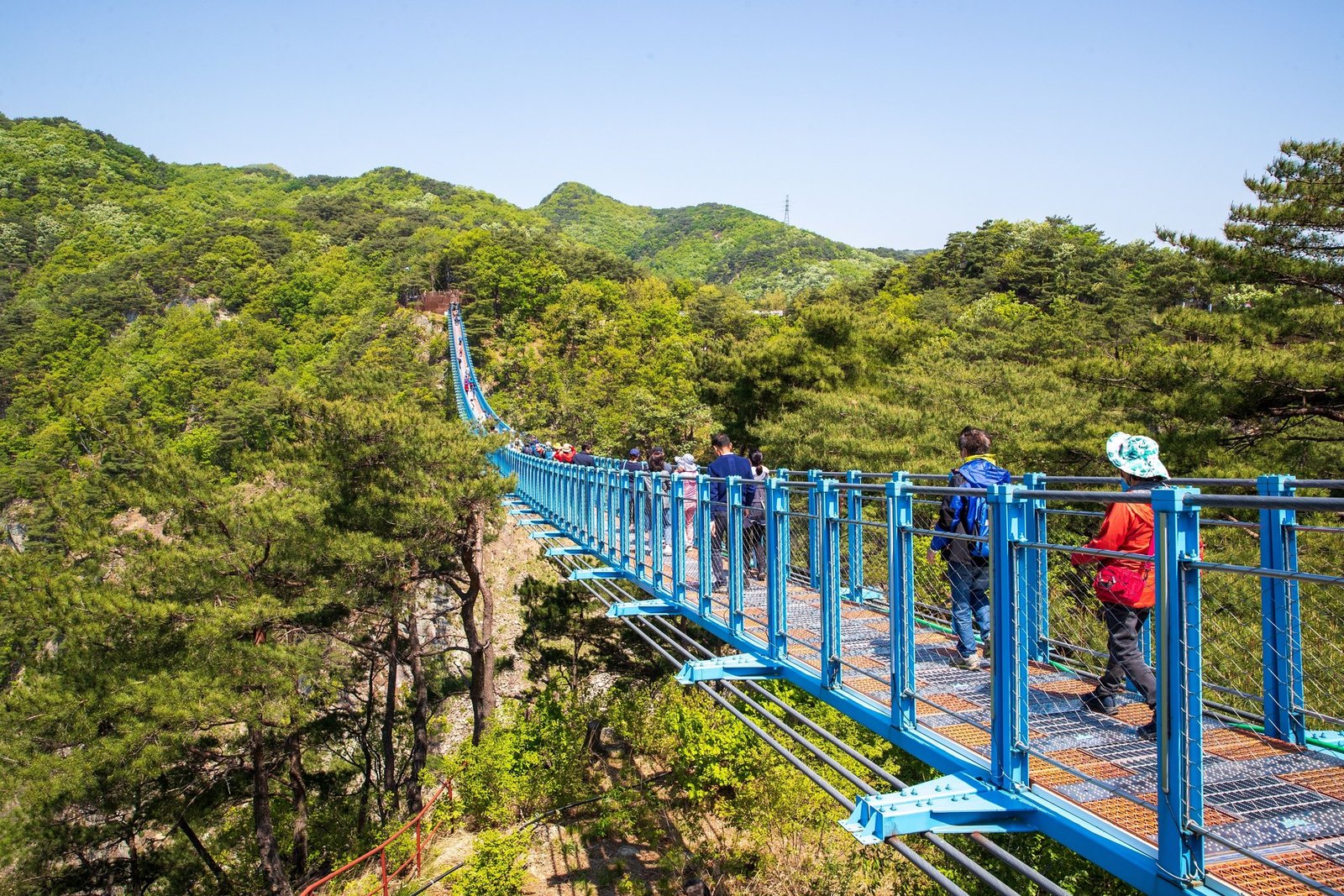
6. Museum SAN’s Water Garden in fall color (see)
A mountain museum designed by Tadao Ando. At the end of a straight path laid across the water stands the stone main building, and the “Water Garden,” where a red arch sculpture reflects on the surface, is the most photographed scene (Naver blog visit, October 30, 2026). This year’s special exhibition, Lee Bae: Waiting, runs through December 6.
- Prices: Basic pass (outdoor gardens, Paper Gallery and museum) 23,000 won (about $17.40) for adults. Add one of the James Turrell space, Meditation Hall or Antony Gormley’s GROUND for 39,000 won (about $29.40), or all three for 59,000 won (about $44.50); the add-ons are timed entry (on-site price board, Naver blog 2026).
- Hours: 10 a.m. to 6 p.m. (tickets until 5 p.m.), closed Mondays.
- Tip: One visitor found the parking lot full even on Friday, October 30. It’s in Jijeong-myeon, like Sogeumsan, so pair them: Sogeumsan in the morning, Museum SAN in the afternoon.
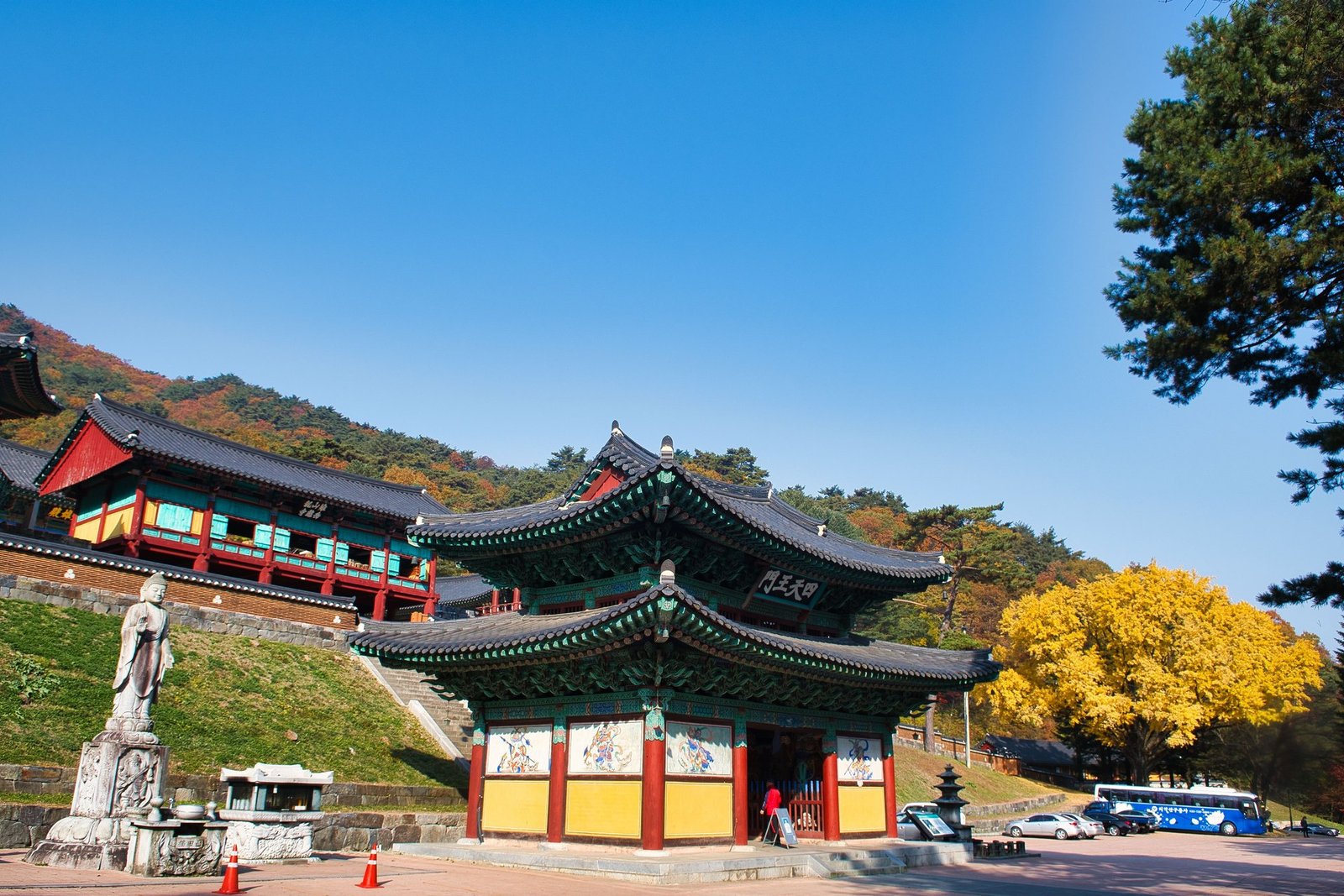
7. Guryongsa’s ginkgo and valley foliage on Chiaksan (see)
A temple in the foothills of Chiaksan, northeast of Wonju. A 200-year-old yellow ginkgo greets you as you enter the parking lot, and you can walk the valley foliage along fir-forest and pine-forest trails (Naver blog, photographed October 28, 2026). The tree is smaller than Bangyeri’s, but you get the temple courtyard and mountain color in the same frame.
- Tip: Put “Chiaksan Guryong Parking Lot” into your navigation app. Entering the temple’s address may send you to the smaller Sinheung-dong lot (Naver blog 2026).
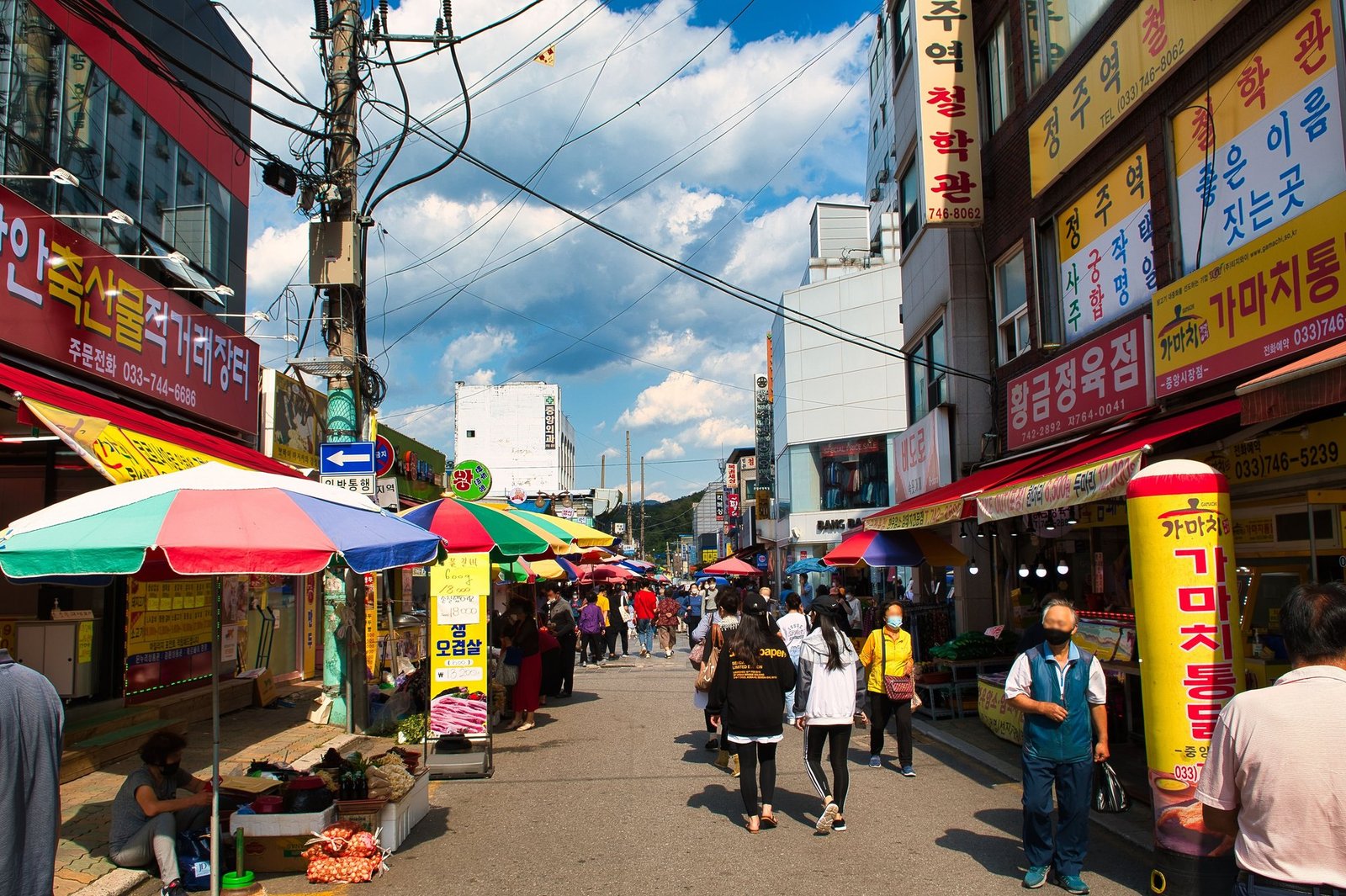
8. Kal-mandu and buckwheat pancakes at Wonju Jungang Market (eat)
Wonju is a dumpling city. Its late-October Mandu Festival drew more than 400,000 people last year (Energy Economic News), and even after the festival, the dumpling shops in the Jungang Market lanes stay open. The signatures are kal-mandu, kimchi dumplings and knife-cut noodles in one bowl, and thin buckwheat pancakes (Naver blog 2026).
- Prices: Steamed dumplings 7,000 won (about $5.30), three buckwheat pancakes 5,000 won (about $3.80) (Naver blog, October 30, 2026). Many customers take home raw dumplings by the 50 (50 kimchi dumplings for 16,000 won, about $12.10).
- Tip: Some shops validate parking at the market’s public lot. Days off differ (some close on the first and third Sundays), so check ahead.
9. Wander the Miro Art Market (experience)
On the second floor of Jungang Market, young entrepreneurs’ shops, craft studios and tiny restaurants run on like alleys. Wandering between hanging lanterns and murals as if you’re lost is exactly what the name (“maze”) promises. A good loop to walk off the dumplings.
- Tip: Shop hours vary, and some close early in the evening.
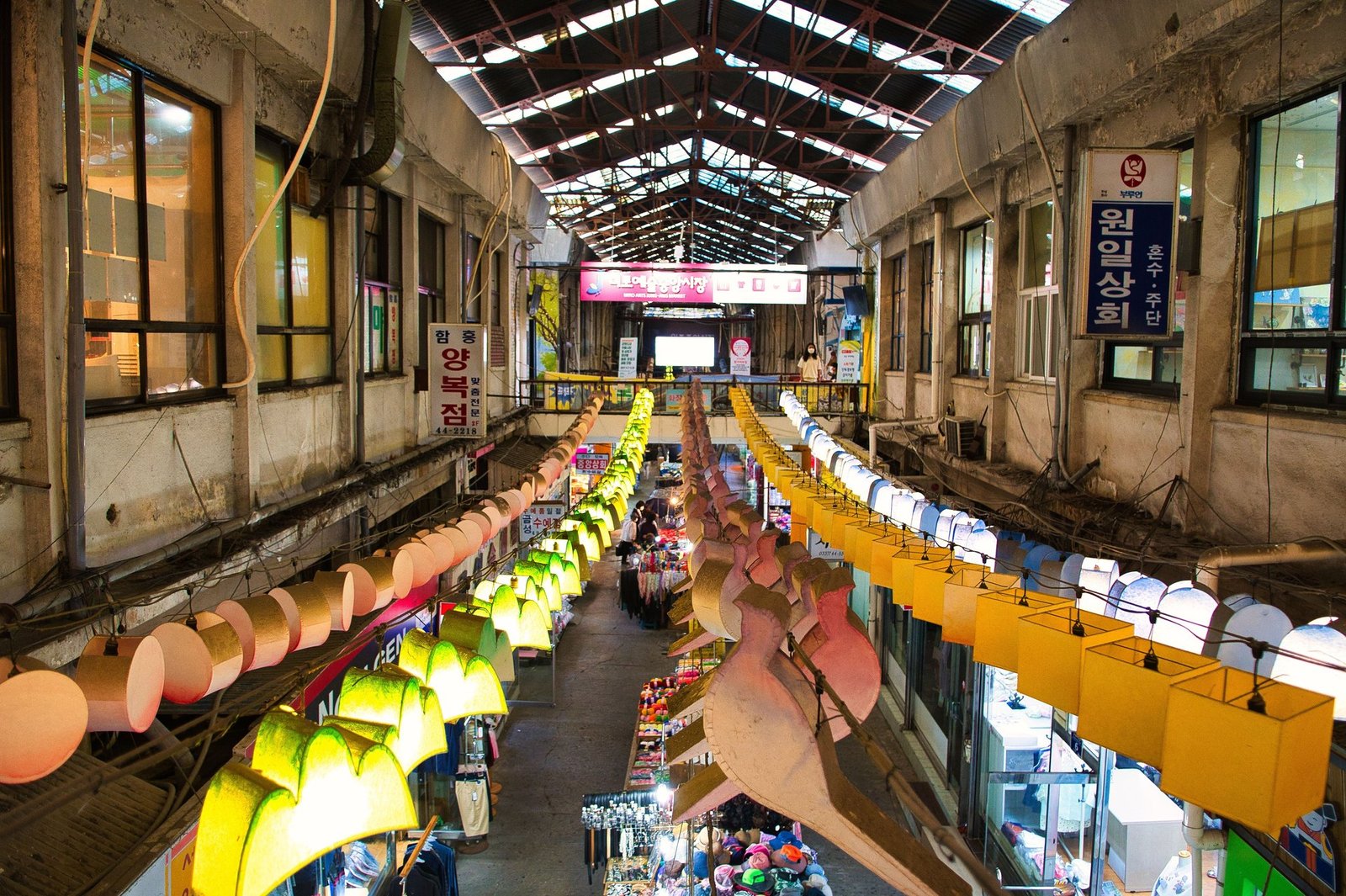
10. A bowl of Munmak chueotang (eat)
The nearest hearty meal to Bangyeri. Wonju-style chueotang is a thick soup of ground loach, eaten with thin wheat noodles stirred in. Jangteo Chueotang opens at 7 a.m., so it’s an easy stop right after seeing the ginkgo early (Naver blog 2026).
- Price: Chueotang (ground or whole loach) 13,000 won each (about $9.80), fried loach 20,000 won (about $15.10). 7 a.m.–8:30 p.m., closed Mondays (Naver blog 2026).
- Tip: Downtown Wonju has plenty of chueotang restaurants too, if your route runs the other way.
Nearby
- Gangwon Gamyeong: The Joseon-era provincial government office of Gangwon, preserved in the middle of downtown Wonju. Free and open 9 a.m. to 10 p.m., so you can walk over from Jungang Market for an evening stroll under the lights (77 Wonil-ro) (Naver blog 2026).
- Yonsei University Mirae Campus ginkgo road: A ginkgo-lined avenue on the campus in Heungeop-myeon; local TV reported that, like Bangyeri, its leaves turned later than usual this year (LG HelloVision Wonju).
- Oak Valley: A resort complex in Jijeong-myeon, near Sogeumsan and Museum SAN, that works as both a place to sleep and a walking course if you stay the night.
Where to stay
There are no big hotels right by Bangyeri, so choose between downtown Wonju, the Enterprise City area (toward Munmak and Jijeong) and Oak Valley. Prices are booking-site searches posted on Naver blogs and vary a lot by date.
| Hotel | Area | Per night (approx.) | Why |
|---|---|---|---|
| Hotel Inter-Burgo Wonju | Downtown Wonju | about $103 for two (Agoda, Saturday, November 7) | Sauna and pool in the building, close to downtown restaurants |
| City Hotel Enterprise City | Wonju Enterprise City | about $76 (Agoda) | Mountain views and an easy drive to Bangyeri and Sogeumsan |
| Oak Valley Resort | Jijeong-myeon | $127–$158 for a large suite (checked for November 24) | Right next to Museum SAN; one room for a family or group |
A sample day
- Early morning: Leave your Wonju hotel → Bangyeri ginkgo around 8 a.m. (Nos. 1–2) → Jangteo Chueotang in Munmak (No. 10)
- Late morning: Sogeumsan Grand Valley cable car and bridges (Nos. 4–5); ticket sales end at 3:30 p.m.
- Afternoon: Museum SAN (No. 6), or on a show day, back to Bangyeri for the 2 p.m. busking (No. 3)
- Evening: Kal-mandu at Jungang Market (No. 8) → Miro Art Market (No. 9) → Gangwon Gamyeong at night, then the KTX-Eum home from Wonju Station
In 1964, the tree was written down as 800 to 1,000 years old; 60 years later, lasers measured it again and came up with 1,317. While people recounted its age, that yellow mass kept standing as one tree, painting the whole field yellow by itself every late fall.
Read next
 You Can Spot a Daejeon Tourist by the Sungsimdang Cooler Bag: Daejeon Bread Trip and Expo Bridge at Night
 Naejangsan Only Turns Red After Seoraksan's Leaves Fall: Jeongeup's Maple Tunnel, Uhwajeong Reflections and Cable Car
 Make 10 kg of Kimchi and Carry It Home: The Kimjang Experience at Pyeongchang's Kimchi Festival
Trending on Seol Notes
- Kim You-jung Cracked Japan Despite the 'Anti-Japan Drama' Label
- The Emperor of K-pop Came Back, and Korea Flipped
- Ae-sun Left the Baeksang Empty-Handed. Then She Spoke: IU
- The No. 1 Korea Doesn't Want to Believe: Why Fans Doubt A2O
- Teachers Get Reported for It. Korean Folk Village Ghosts Get Cheered.
Sources
- Sports Seoul, October 30, 2026: Bangyeri healing busking and peak forecast, Energy Economic News, October 21, 2026: festivals, parking and buses, Kangwon Ilbo, November 13, 2025: Bangyeri parking, Herald Business: six fall scenic spots, KBS, October 30, 2026: festival performances, LG HelloVision Wonju: ginkgo update
- Naver blog visits and roundups (prices and hours), mostly 2026 posts
- Photos: Korea Tourism Organization Photo Korea, KOGL Type 1 (photographer credited on each photo)
- Currency conversion: 1,324.6 won per dollar (Seoul FX base rate, October 23, 2026). Prices may change.
Discover more from Seol Notes
Subscribe to get the latest posts sent to your email.