

Part 7 of 27 in Homo Conspirans: The Humans Who Come After Us
Homo Conspirans · Musk’s dream: “stop the birth rate collapse” → humans who never pass through the birth canal
Once artificial wombs watched over by AI take on the last months of pregnancy, human evolution changes direction, starting with the pelvis. The mother’s birth canal, which held the size of the baby’s head in check for millions of years, stops being the gate.
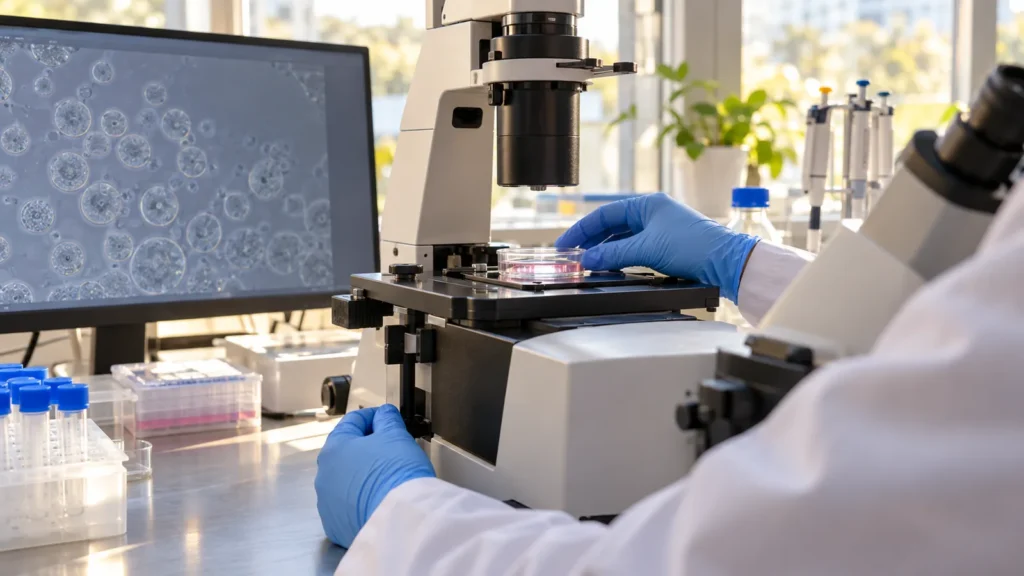
In April 2017, researchers at Children’s Hospital of Philadelphia published a photo in Nature Communications. Inside a clear plastic bag, a hairless pink lamb lay with its eyes closed, shifting in its sleep. Eight lambs, taken from their mothers at a stage equal to 23 or 24 weeks of a human pregnancy, grew inside this “Biobag” for up to four weeks. Their umbilical cords were connected to a machine outside the bag that supplied oxygen and nutrients, and inside it the lambs grew wool and opened their eyes.[1]
On September 19, 2023, the U.S. Food and Drug Administration convened an advisory committee to discuss testing such devices for the first time on extremely premature human babies.[2] It was the day a device from science fiction became an item on a regulator’s agenda.
In this story
The obstetric dilemma
Human birth is unusually dangerous for an evolutionary reason. Walking on two legs requires a narrow pelvis. Giving birth to a big-brained baby requires a wide birth canal. Anthropologists call it the obstetric dilemma. As a result, babies get stuck in the birth canal far more often in humans than in other primates. Worldwide, 3 to 6 percent of births involve obstructed labor, where the baby and the pelvis do not fit.
In 2016 researchers at the University of Vienna published a striking model in PNAS. Bigger babies have a better chance of survival, but a baby too big gets stuck, endangering both mother and child. Nature has kept us balanced right at the edge of that cliff. Then the C-section removed the cliff, and the math changed. Big-headed babies and narrow-hipped mothers who once would not have survived now live and pass on their genes. According to the model, the C-sections of the past few decades alone have raised the rate of baby-pelvis mismatch by 10 to 20 percent.[3]
Also read: AI Will Wire 8 Billion Brains Into One Superorganism, Like an Ant Colony: The Global Brain
South Korea is already at two in three
The country at the very front of this experiment is South Korea. Of the 235,234 babies born there in 2024, 67.4 percent were delivered by C-section, up 16 percentage points in five years from 51.1 percent in 2019. That is double the U.S. rate and more than triple Japan’s.[4] Mothers avoiding pain, doctors avoiding risk and an ever older age at first birth keep pushing the choice.
Births that skip the birth canal are already the majority for Korean babies. The artificial womb is the next step. If the C-section moved the last few hours of birth outside the body, the artificial womb moves the last few months of pregnancy outside it. And what watches over those months is not a person but AI. In January 2022, researchers in Suzhou, China, announced an “AI nanny” that monitors mouse embryos growing in an artificial womb around the clock, catching changes and adjusting the environment.[5]

Technology’s answer to the birth rate collapse
Musk has long called the collapse in birth rates a greater danger to civilization than climate change. South Korea, which has the lowest birth rate in the world, will be the first to show where that road leads. One reason people have fewer children is the cost that pregnancy and birth leave on women’s bodies and careers. The artificial womb is the most direct technology for cutting that cost.
Other doors of reproduction are opening too. In March 2023, Katsuhiko Hayashi’s team at Osaka University made eggs from the cells of male mice and produced baby mice with two fathers.[6] Eggs made outside the body, fetuses grown outside the body. One by one, the ancient premise that life must begin and grow inside a woman’s body is coming undone.
April 2061: 32 weeks in a bag
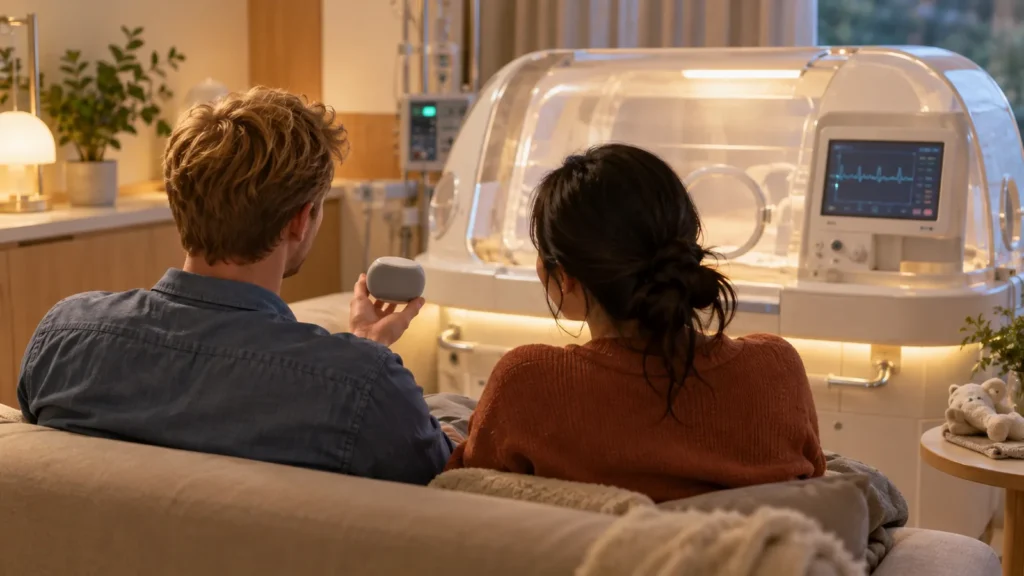
April 2061, a public birth center in Seoul. Ji-eun, 36, and her husband sit in front of a translucent pouch. Inside it their daughter is growing at 32 weeks. Ji-eun carried her herself to 24 weeks, then chose “late-term ex utero gestation,” which national insurance covers. She went back to work two months ago.
The center’s AI puts up today’s numbers. Heart rate 142 beats per minute, weight 1.9 kilograms, head circumference a little above the average for her age in weeks. A note explains that since the baby will never pass through a birth canal, this is no concern. The couple hold a small speaker close to the pouch and sing the song they sing every day. The baby inside reaches a hand toward the sound. Of the 120 babies due at this center this month, 40 have spent their last three months this way.
First trials in 2028, first measurements in the 22nd century
This is the order in which birth moves outside the body.
- 2028: The first human trial in the U.S. moves extremely premature babies born at 22 to 24 weeks into an artificial womb.
- 2035: The artificial womb becomes standard care for extremely premature babies. Survival for babies born at 22 weeks doubles from today.
- 2045: The first “elective ex utero pregnancy,” in which a healthy pregnant woman hands the final stretch of pregnancy to an artificial womb, takes place at a regulated hospital.
- 2061: One in three babies born in South Korea spends the last three months of gestation in an artificial womb, paid for by national insurance.
- 2080: The first baby is born who spent the entire span from conception to birth outside a human body.
- 2110s: In a country where four generations in a row have been born without passing through the birth canal, the first measurement shows newborns’ average head circumference has grown larger than in the 20th century.
For millions of years after we stood up on two legs, the size of the human head was set by the mother’s pelvis. That power has passed to the hospital operating room, and now passes again to a pouch watched over by AI. The heads of the next humans will grow as large as the machines we choose.
Next in the series · Humans With Musk’s AI Brain Chips Will Evolve to See Infrared: Neuralink Blindsight
Musk says Neuralink’s Blindsight will one day let people see infrared and even radar. Rats have already sensed infrared through sensors wired into their brains.
Homo Conspirans: The Humans Who Come After Us · Part 7 of 27
Next, Part 8: Humans With Musk's AI Brain Chips Will Evolve to See Infrared: Neuralink Blindsight →
Read next
 AI Will Reverse Human Aging, Even If Musk Says We Need Death: Reverse Aging
 When AI Robot Bodies Become Free, People Who Keep Mortal Bodies Will Become a Minority: Galaxy Express 999
 Children Raised by AI on Musk's Mars Will Evolve Bodies That Can Never Return to Earth: How Humans Would Evolve on Mars
Trending on Seol Notes
- Kim You-jung Cracked Japan Despite the 'Anti-Japan Drama' Label
- The Emperor of K-pop Came Back, and Korea Flipped
- Ae-sun Left the Baeksang Empty-Handed. Then She Spoke: IU
- K-pop News Today (Oct 27, 2026): IVE's EP Drop, ILLIT 'You're Under Arrest', LISA's 59M
- K-pop News Today (Oct 31, 2026): BTS's 'Arirang' Night in Brazil, JISOO's 'ADDICTED' Tops iTunes, NMIXX Win Music Bank
Sources
- Emily A. Partridge et al., “An extra-uterine system to physiologically support the extreme premature lamb,” Nature Communications 8, 15112, April 25, 2017. https://doi.org/10.1038/ncomms15112
- U.S. Food and Drug Administration, Pediatric Advisory Committee meeting on artificial womb technology, September 19–20, 2023, FDA executive summary. https://www.fda.gov/media/172183/download
- Philipp Mitteroecker, Simon M. Huttegger, Barbara Fischer & Mihaela Pavlicev, “Cliff-edge model of obstetric selection in humans,” PNAS 113(51), 14680–14685, 2016. https://pmc.ncbi.nlm.nih.gov/articles/PMC5187675
- The Korea Herald, “With 67% of babies delivered by cesarean in 2024, as mothers want less pain and doctors aim to reduce risk,” 2025 (National Health Insurance Service data released by Rep. Seo Myeong-ok). https://www.koreaherald.com/article/10478793
- South China Morning Post, “Chinese scientists create AI nanny to look after babies in artificial womb,” January 2022. https://www.scmp.com/news/china/science/article/3165325/chinese-scientists-create-ai-nanny-look-after-babies-artificial
- Kenta Murakami, Katsuhiko Hayashi et al., “Generation of functional oocytes from male mice in vitro,” Nature 615, 900–906, March 15, 2023. https://doi.org/10.1038/s41586-023-05834-x
Discover more from Seol Notes
Subscribe to get the latest posts sent to your email.