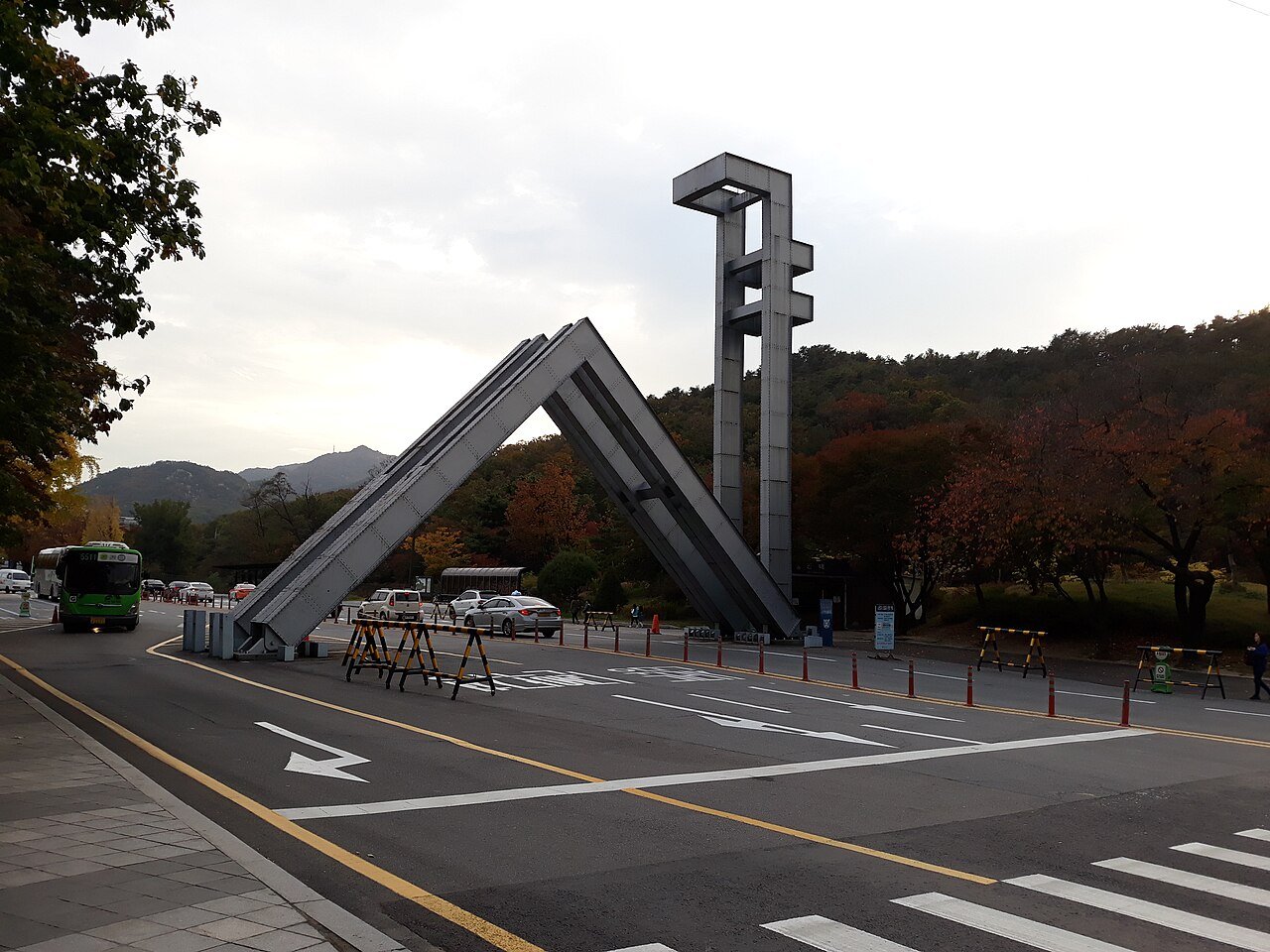
Featured photo: The main gate of Seoul National University’s Gwanak campus in Seoul, October 2017. Photo: H. Y. Shin 000, via Wikimedia Commons, CC0.
In 1987, Shin Jeong-soon got into Seoul National University and nearly gave it up because he couldn’t pay the 580,000-won entrance fee, about $700 at the time. Today he is a executive vice president at LG Energy Solution, leading next-generation battery cell development. Over 37 years, three hands held on to him. A Korean Air president paid his tuition, Samsung made him a battery engineer, and LG took him from its rival.
In this story
A Seoul National University acceptance, delivered to a one-room rental
Born in 1969, Shin scored 306 on the 1987 haknyeok gosa, the national college entrance exam Korea used before today’s Suneung, and was admitted to Seoul National University (iNews24, November 7, 2026). In Korea, SNU is the top national university, the kind of school where simply getting in is a family event. But that acceptance letter was delivered to a sagulset-bang, the cheapest kind of rented room, paid for with months of rent up front, about 10 square meters (roughly 100 square feet).
A few numbers tell you everything about the family. His father had died in an accident ten years earlier, and his mother earned about $180 a month working in a restaurant. After about $120 in rent, there was barely enough for his mother and younger siblings to live on. The SNU entrance fee of about $700 was what you’d reach by saving every cent left after rent for close to a year (iNews24).
Also read: A Mongolian Mover Shouted to a Korean Hanging From the 14th Floor: "Please Trust Me"
One broadcast, and a Korean Air president’s promise
It was a broadcast that opened the way. When the boy’s story was reported, Cho Choong-kun, then president of Korean Air, promised to pay four years of college tuition and the cost of studying abroad. A former governor of the Lions Club added about $1,200 (iNews24). Sisa Journal-e wrote that President Cho helped not only with tuition but also with the family’s housing (Sisa Journal-e reporter’s notebook, October 27, 2026). Cho left one line about it: “I didn’t help him to show off.”
Abroad, Korean Air’s owning family is better known for the 2014 “nut rage” incident (Wikipedia: Nut rage incident). Cho Choong-kun is the younger brother of Korean Air founder Cho Choong-hoon (Shindonga). Twenty-seven years before the world came to know this family’s name through “nut rage,” a different member of the same family took responsibility for four years of college for a boy from a one-room rental. Four years later, in 1991, the Hanjin Group set up the Ilwoo Foundation, which had supported 13,808 scholarship students with about $20 million by the end of 2024 (iNews24).
The battery engineer Samsung raised
After SNU, Shin went to Samsung SDI. He became an executive in charge of cell development for small batteries that go into phones and mid-to-large batteries that go into electric cars, and in 2018 he received the government’s Industrial Service Medal for his contribution to battery technology (iNews24, Sisa Journal-e). From late 2021, he ran STM, a cathode materials company wholly owned by Samsung SDI (Kukmin Ilbo, March 27, 2024). Cathode material is the core material that decides much of a battery’s performance and cost.
Inside Samsung, the boy who couldn’t pay his entrance fee became an engineer who had worked through both the cells and the materials at the heart of Korean batteries.
The executive vice president LG took from its rival
In March 2024, LG Energy Solution named him executive vice president and head of advanced cell development. Kukmin Ilbo read the move as the battery industry’s “counterpunch.” In January that year, Samsung SDI had hired a researcher from LG Chem as a vice president, and LG Energy Solution answered by bringing in the head of a Samsung SDI subsidiary (Kukmin Ilbo, March 27, 2024).
LG Energy Solution and Samsung SDI, Korea’s two battery makers, are rivals supplying batteries for electric cars and energy storage systems (ESS) around the world. In the year those two companies were poaching each other’s people, the name LG picked was the boy who, 37 years earlier, couldn’t pay a 580,000-won entrance fee.
1987, watched again by 3.6 million people
The story exploded again in the fall of 2026 on YouTube Shorts. A Short posted by one channel on October 1, “The miracle that came when he despaired after getting into SNU in ’87 with no money for tuition,” had 3.61 million views and an estimated 54,000 or so likes when I checked on November 7. Shorts about the same story followed on several channels, and iNews24 reported that “some videos passed 3 million views.” It was about 20 days before the Suneung, Korea’s college entrance exam (Sisa Journal-e).
The comments didn’t stop at a feel-good story. Of the 36 comments on the iNews24 article, the top one (64 likes) was, “This is what a world where people live together feels like.” But the second (44 likes) said this: “The real irony is that people who made it back when times were hard are the ones now removing the ladder for people who are struggling today.” The third (34 likes) was sharper: “Thank goodness this isn’t a story from today, where it would end with ‘he dropped out, got into a medical school in the provinces and became a plastic surgeon.'” In Korea, top science and engineering students at SNU dropping out to retake the entrance exam for medical school has become a widely discussed social problem.
The poor SNU admit of 1987 became a man who builds batteries. In 2026, the third most-liked comment under his story was relieved that he didn’t become a doctor.
Read next

Trending on Seol Notes
- Ae-sun Left the Baeksang Empty-Handed. Then She Spoke: IU
- 85,000 Fans in São Paulo Sang 'Arirang,' and BTS Put Down Their Microphones
- K-pop News Today (Nov 4, 2026): RESCENE's 'With' Hits No. 1 on Melon, TWS Sell 630,000 on Day One, AND2BLE's Career-High Week
- Teachers Get Reported for It. Korean Folk Village Ghosts Get Cheered.
- AI Will Reverse Human Aging, Even If Musk Says We Need Death: Reverse Aging
Sources
- iNews24, November 7, 2026: “He almost gave up SNU for lack of 580,000 won… the boy of 39 years ago today”
- Sisa Journal-e, October 27, 2026, reporter’s notebook: “The lesson left by the boy who cried because he couldn’t pay his SNU entrance fee”
- Kukmin Ilbo, March 27, 2024: “Big Tech, rivals, it doesn’t matter… conglomerates go all-out to recruit talent”
- Shindonga: “Can the Hanjin Group rebuild its dream of ‘serving the nation through transport’ with the Asiana merger?”
- Wikipedia: Nut rage incident
- YouTube Short yfIrS9MHUyg (posted October 1, 2026; views checked November 7, 2026)
- Currency conversion: 1987 amounts at the 1987 average rate of about 826 won per dollar (Federal Reserve monthly averages via FRED, series EXKOUS): entrance fee 580,000 won ≈ $700, mother’s monthly income 150,000 won ≈ $180, rent 100,000 won ≈ $120, Lions Club 1 million won ≈ $1,200. The Ilwoo Foundation’s 27 billion won is converted at 1,364 won per dollar (November 6, 2026) ≈ $20 million.
Discover more from Seol Notes
Subscribe to get the latest posts sent to your email.