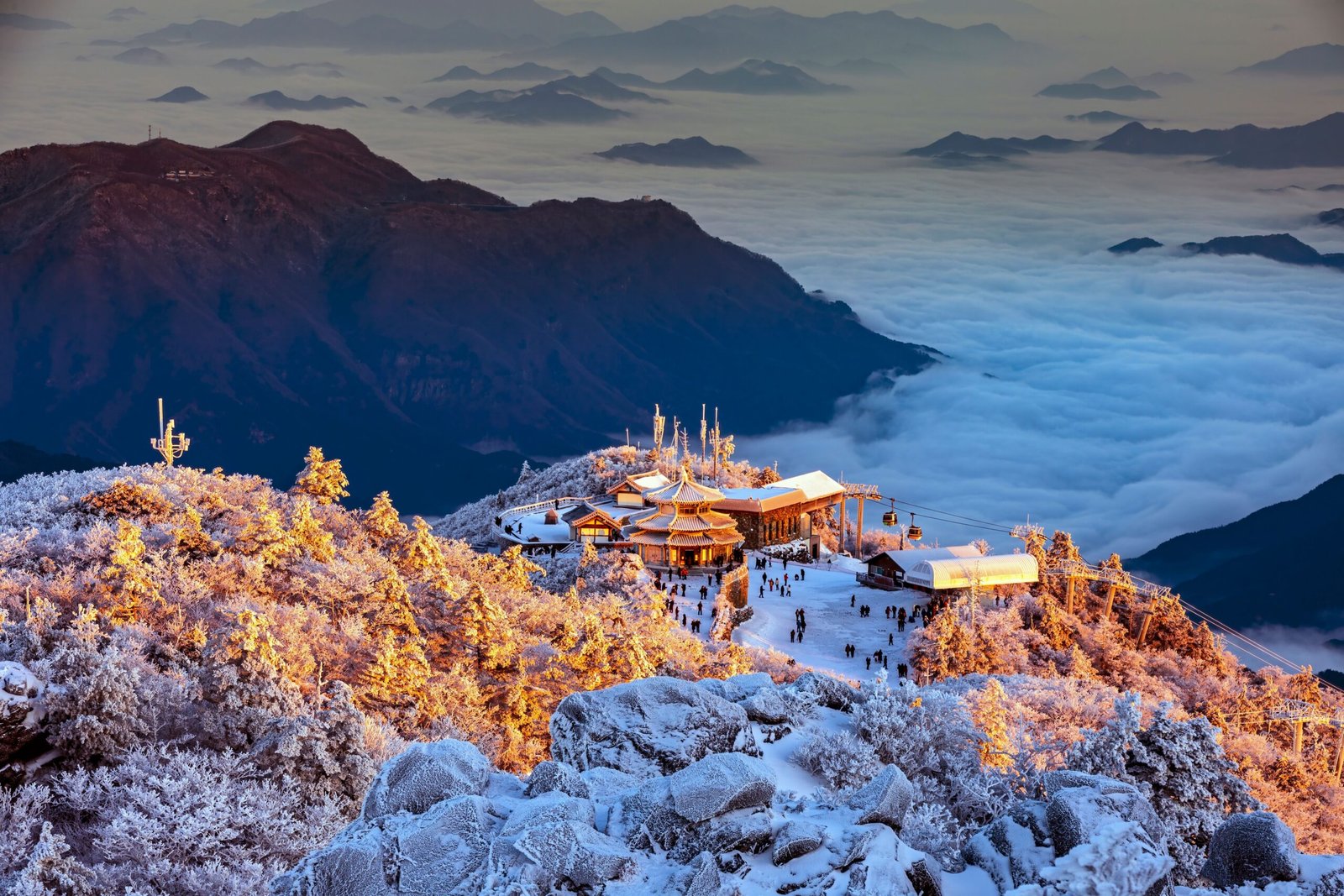
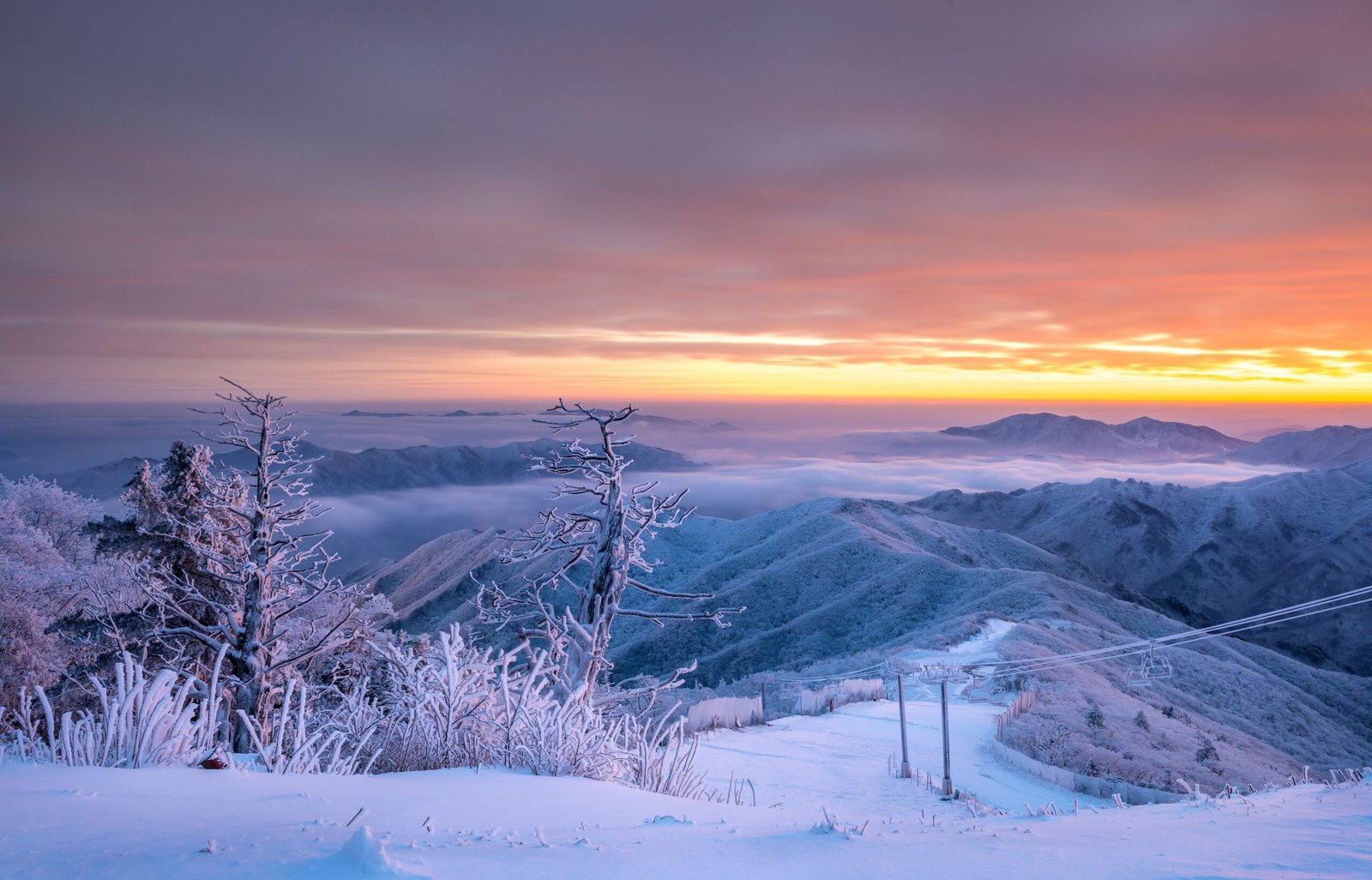
Featured photo: Hikers walking the snowy path by the gondola station on Seolcheonbong at sunrise, with the rime ice glowing gold and a sea of clouds below. Photo: Kim Bu-jin / KTO Photo Korea, KOGL Type 1 (January 2024).
On Muju’s Deogyusan, you sit in a gondola for 15 to 20 minutes to reach Seolcheonbong at 1,520 m, then walk a wooden boardwalk for 20 minutes to Hyangjeokbong (1,614 m), the fourth-highest peak in South Korea, where every branch is crusted with white ice flowers. Starting this winter, the gondola needs a reservation on weekends and holidays, so lock in one ticket first and you spend your time in front of the frost, not in line.
In this story
At a glance
- What you’ll see: Rime ice (sanggodae) forms when fog droplets hit branches in subzero air and freeze on the spot (YTN). Unlike snow that falls and piles up, it grows like feathers on the side facing the wind.
- When to go: This year’s first rime ice was spotted on Hyangjeokbong on October 22, five days earlier than last year. That morning, Seolcheonbong was at -2.7°C (27°F) with 99 percent humidity (YTN, October 22, 2026). Midwinter (December to February), when rime ice and snow come together, is the safest bet; in November it appears only briefly on cold, damp mornings. On clear days it starts melting once the sun is up, so go in the morning.
- Gondola reservations: From October 1 to February 28, only people who booked online in advance can ride on weekends and public holidays. On weekdays, you still buy tickets on site. Before the reservation system, waits of more than two hours at the lower station were routine in winter and foliage season (TTL News, November 7, 2026, citing Muju Deogyusan Resort).
- Fares: Gondola round trip adults 22,000 won (about $16.60), children 17,000 won (about $12.80), one way adults 17,000 won (about $12.80) (Korea Trip Tips, Korea Tourism Organization data updated March 2026). The Hyangjeokbong trail is free. Check this winter’s fare on the booking screen.
- Operating hours: The gondola stops in strong wind or heavy snow. Call the resort (+82-63-322-9000) before you set out to check it’s running.
- From Seoul: Intercity buses run from Seoul Nambu Terminal to Muju Bus Terminal four times a day (7:40 a.m., 10:05 a.m., 2:35 p.m., 5:05 p.m.), 2 hours 24 minutes, $18 (23,800 won) for a premium seat. The 7:40 a.m. bus goes straight to the Gucheondong stop in 3 hours 16 minutes for $23.60 (31,200 won) (Asamaru bus timetable, updated November 7, 2026). From Muju Terminal or Gucheondong, take a county bus or taxi to the gondola base (Seolcheon House). By car, exit the Daejeon–Tongyeong Expressway at Muju IC or Deogyusan IC.
- What to bring: Around Hyangjeokbong, midwinter days often drop to around -10°C (14°F) (GoKorea, citing Korea National Park Service data). The boardwalk between Seolcheonbong and Hyangjeokbong gets slippery under snow, so bring microspikes, gloves and a hat that covers your ears.
Top 10 things to do on a Deogyusan rime ice trip
1. Ride the gondola straight up to Seolcheonbong (experience)
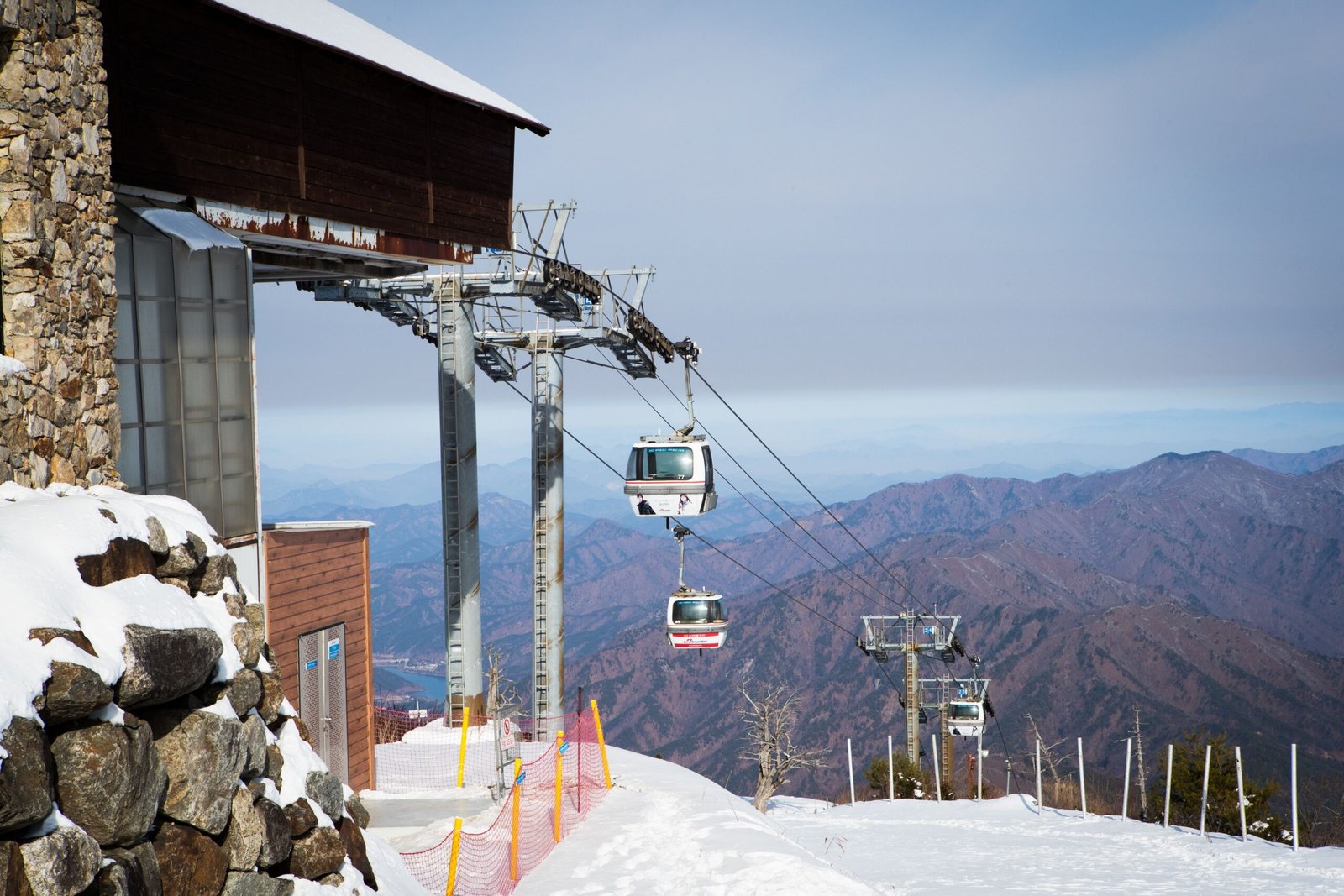
Eight-person cabins glide over the ski slopes all the way to Seolcheonbong. A climb that takes half a day on foot from Gucheondong takes 15 to 20 minutes sitting down, so families with older or younger members can stand on a winter summit too (TTL News, Korea Trip Tips). On the way up, you can see the exact height where the trees outside turn from gray to white.
- Price: Round trip adults 22,000 won (about $16.60), children 17,000 won (about $12.80).
- Booking: Online reservations required on weekends and holidays (October 1 to February 28); on weekdays, on-site tickets are sold as well. Reservations are split by time slot (TTL News).
- Tip: If rime ice is the point, book the first time slot.
- Sources: TTL News, gondola advance reservation system (November 7, 2026), Korea Trip Tips: Seolcheonbong (gondola fares)
2. Walk the 600 m rime ice boardwalk from Seolcheonbong to Hyangjeokbong (see)
From the gondola, the summit is a little over 600 m away on a gently sloping wooden boardwalk; kids and older travelers get up in about 20 minutes (Korea Trip Tips, TTL News). Both sides of this short path are where the rime ice grows thickest. White, feathery ice sprouts from every branch on the windward side, glitters when the sun hits it, and starts dropping off in little clumps as noon approaches.
- Time: 20 minutes one way, about an hour round trip with photo stops.
- Tip: Off the boardwalk is a vegetation protection zone. Don’t snap or shake the frosted branches.
3. The summit stone photo on Hyangjeokbong (photo spot)
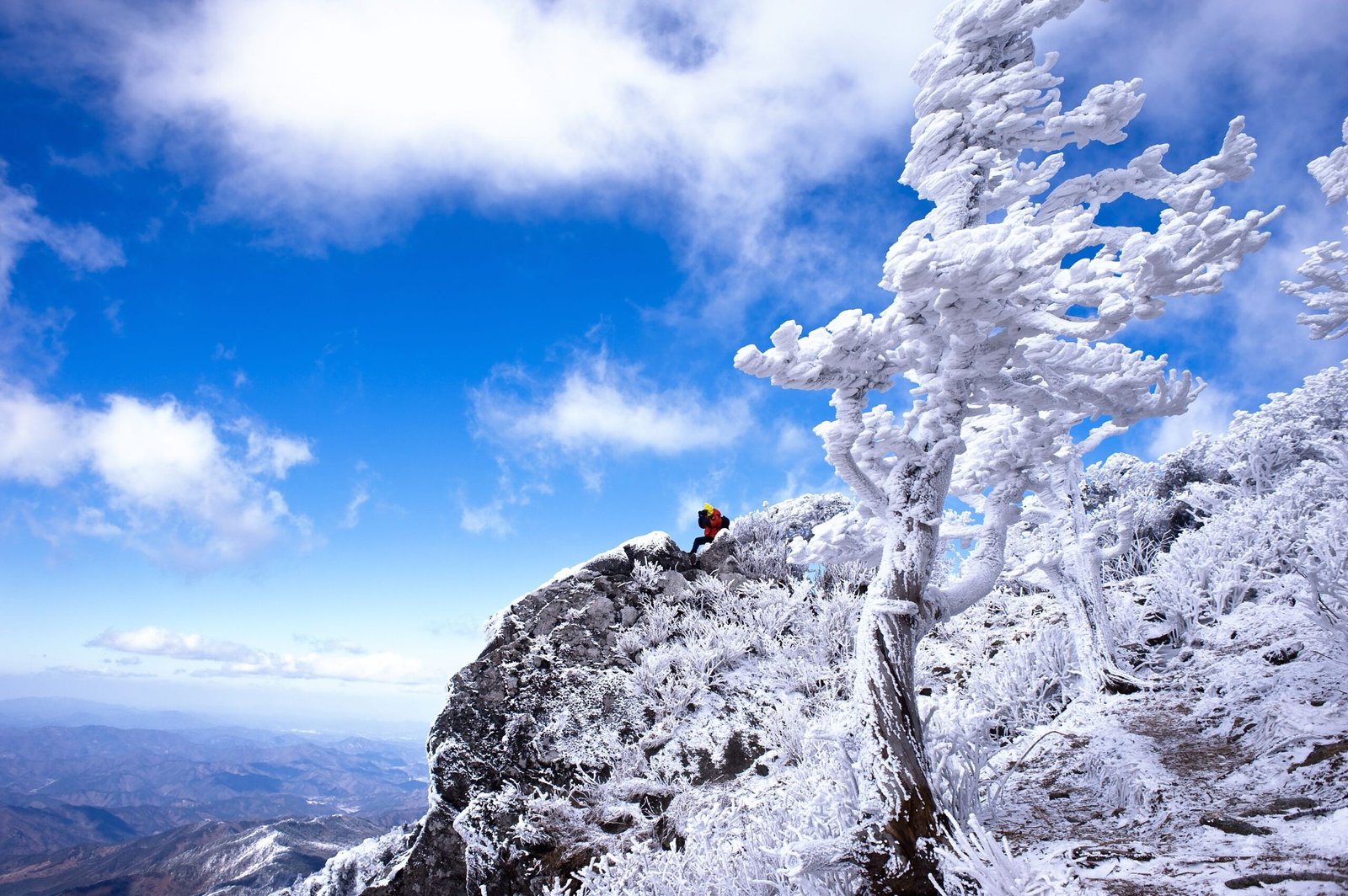
At 1,614 m, Hyangjeokbong is South Korea’s fourth-highest peak, after Hallasan, Jirisan and Seoraksan (TTL News). The line for the summit stone is the longest line on the mountain. On a clear day, Deogyusan’s main ridge runs endlessly south in a single frame.
- Tip: On weekend mornings, the summit stone line gets long. If it is, skip the stone and shoot in front of a frosted yew a little below the top: fewer people, more winter.
- Note: The summit takes the full force of the wind and the wind chill drops hard, so don’t linger.
4. Push on to Jungbong for the snowy Deogyu Plateau (experience)
Keep going south along the ridge from Hyangjeokbong and you reach Jungbong. Most gondola riders turn back at Hyangjeokbong, so the crowd thins out fast, and hikers who’ve done the full Deogyusan ridge name this stretch the best view on the mountain (Naver blog, 2026). When the broad Deogyu Plateau (Deogyu Pyeongjeon) below Jungbong is covered in snow, it looks less like a mountain and more like a snowfield.
- Gear: Parts of it are regular trail, not boardwalk, so microspikes are a must.
- Tip: Work backward from your gondola ride down to set your turnaround time before you start.
5. Find the frosted yew and Korean fir forest (see)
Near Deogyusan’s summit, high-altitude conifers like yew and Korean fir grow together (TTL News). Ice clings to each of their needles, which makes these trees the stars of Deogyusan’s winter photos. Snow-covered yew groves are counted among the mountain’s signature winter scenes (GoKorea). Their old, twisted trunks under a coat of white ice look nothing like rime ice on broadleaf trees.
-
Tip: The Korean fir is vulnerable to climate change and protected. Don’t grab the branches for a pose.
-
Sources: TTL News (subalpine Korean fir colony), GoKorea, snow-flower spots
6. Clouds and sunrise in front of Sangjeru on Seolcheonbong (photo spot)
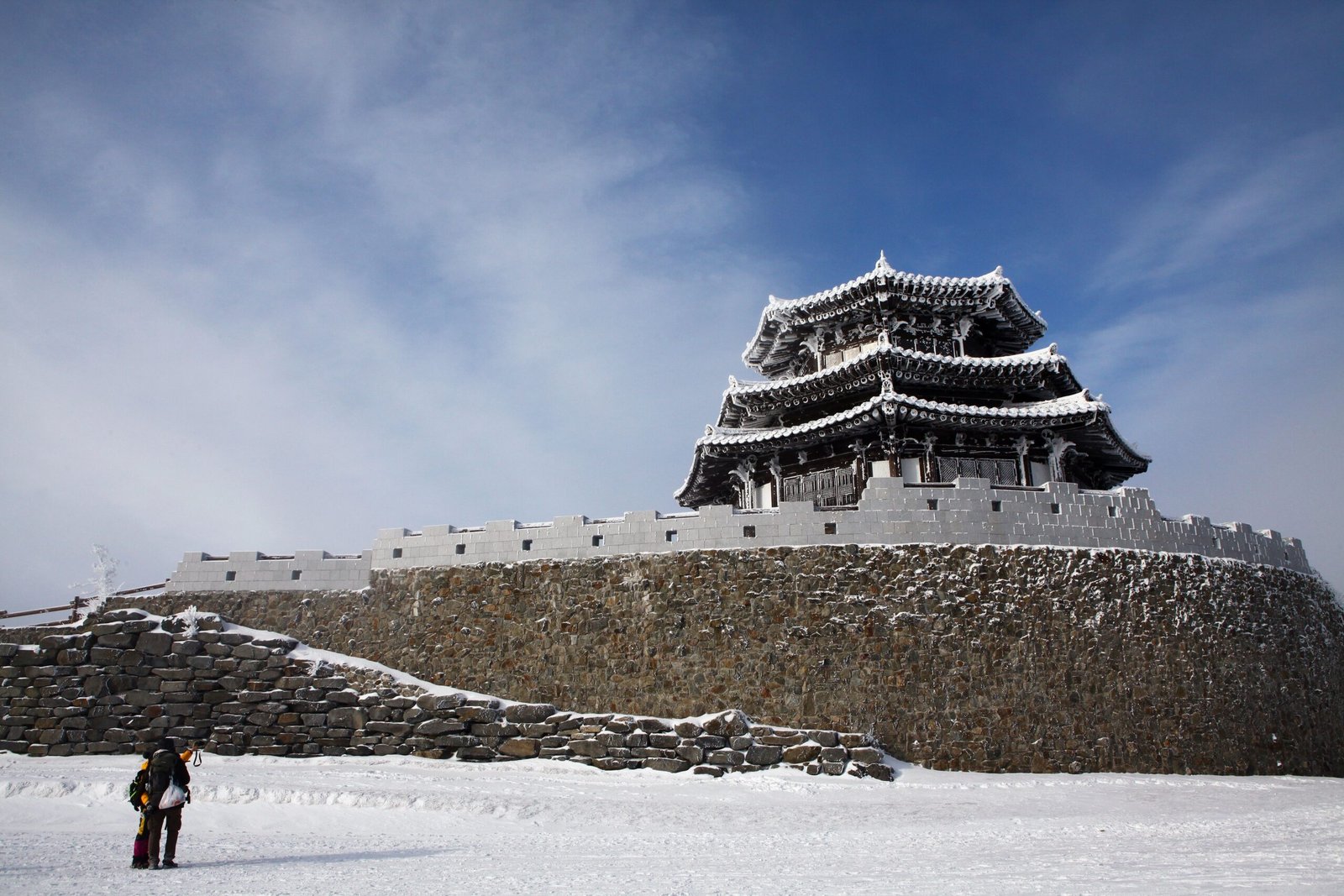
Sangjeru, the three-story pavilion on top of Seolcheonbong, was built ahead of the 1997 Muju Winter Universiade (Korea Trip Tips). Some mornings, as in the photo at the top, the sun turns the rime ice gold while clouds settle in the valleys like a sea. The frozen-white pavilion and its stone wall are a photo spot on their own.
7. First runs on the slopes at Muju Deogyusan Resort (experience)
The slopes under the gondola are the ski resort. Muju Deogyusan Resort has said it plans to open the upper Seolcheon slopes about two weeks earlier than usual, though the exact date isn’t out yet (Jeolla Ilbo and Saejeonbuk Sinmun reports, checked November 7). You can see the rime ice in the morning and ski in the afternoon.
- Passes: Season passes went on sale at special prices in September and October (Asia Economy, September 28, 2026).
- Tip: Only some slopes open early in the season.
- Sources: Asia Economy, second season-pass sale (September 28, 2026), Daily Hankook, ski resort opening preparations (November 7, 2026)
8. A wine foot bath in the Meoru Wine Cave (experience)
A tunnel dug when a pumped-storage power plant was built, turned into a wine cellar by Muju County in 2007. With no light and a steady temperature, it’s ideal for aging meoru (wild Korean grape) wine, and your ticket gets you a tasting and a soak in warm water mixed with wine (Korea Trip Tips). After a cold summit, it’s the best way to thaw your feet.
- Price: 2,000 won (about $1.50) per person, tasting included (Korea Trip Tips).
- Hours: November to March, cave 10 a.m. to 4:30 p.m., foot bath 10 a.m. to 4 p.m. (closed noon to 1 p.m. for maintenance), closed Mondays and on Lunar New Year’s Day and Chuseok (same source).
- Tip: You drive up a mountain road on the slopes of Jeoksangsan. After snow, check road conditions.
9. The monorail and demonstration show at Taekwondowon (experience)
In the same township as the gondola, Seolcheon-myeon, Taekwondowon is a park that brings together taekwondo training, performances and a museum. Entry is free, and the monorail up to the observatory gives you the whole park and the ridges of the Baekdudaegan range below (Korea Trip Tips). The regular demonstration show is held at the T1 Arena (Korea Trip Tips, English).
- Price: Free entry; monorail adults 4,000 won (about $3), teens and children 2,000 won (about $1.50); the Yap! experience hall costs 4,000 won for taekwondo, 6,000 won for VR/AR, or 8,000 won (about $6) for both (Korea Trip Tips).
- Hours: 10 a.m. to 6 p.m. (last entry 5 p.m.), monorail 10 a.m. to 5 p.m. (last ride 4:30 p.m.), closed Mondays (same source).
- Tip: On days when wind shuts the gondola down, this is the best plan B.

10. Warm up with sanchae bibimbap in Gucheondong (eat)
Restaurants and lodgings cluster in the Muju Gucheondong Special Tourist Zone in Deogyusan’s northern valley (Korea Trip Tips). This is where hikers coming off the mountain sit down to sanchae bibimbap and set meals topped with wild greens from Deogyusan.
Nearby
- Gucheondong Eosa-gil: A 4.9 km path along the valley from Inwoldam, No. 16 of Gucheondong’s 33 scenic spots, to Baengnyeonsa, No. 32. It was completed in four sections in 2020, and the first, “Sup Nadeulgil,” is the gentlest (Jeonbuk Ilbo, 2025). On a day the gondola is shut, an icy valley walk here is a good substitute.
- Muju Bandiland Astronomical Science Center: An insect museum and observatory in Muju, a town famous for its fireflies. Winter sunsets come early, so the evening stargazing window is long.

- Anguksa on Jeoksangsan: Drive farther up the mountain road past the Meoru Wine Cave and you reach Anguksa, near the top of Jeoksangsan, the mountain of red cliffs.
Where to stay
Rime ice is a morning game, so sleeping next to the gondola base gives you the biggest edge.
| Stay | Location | Price per night (approx.) | Why |
|---|---|---|---|
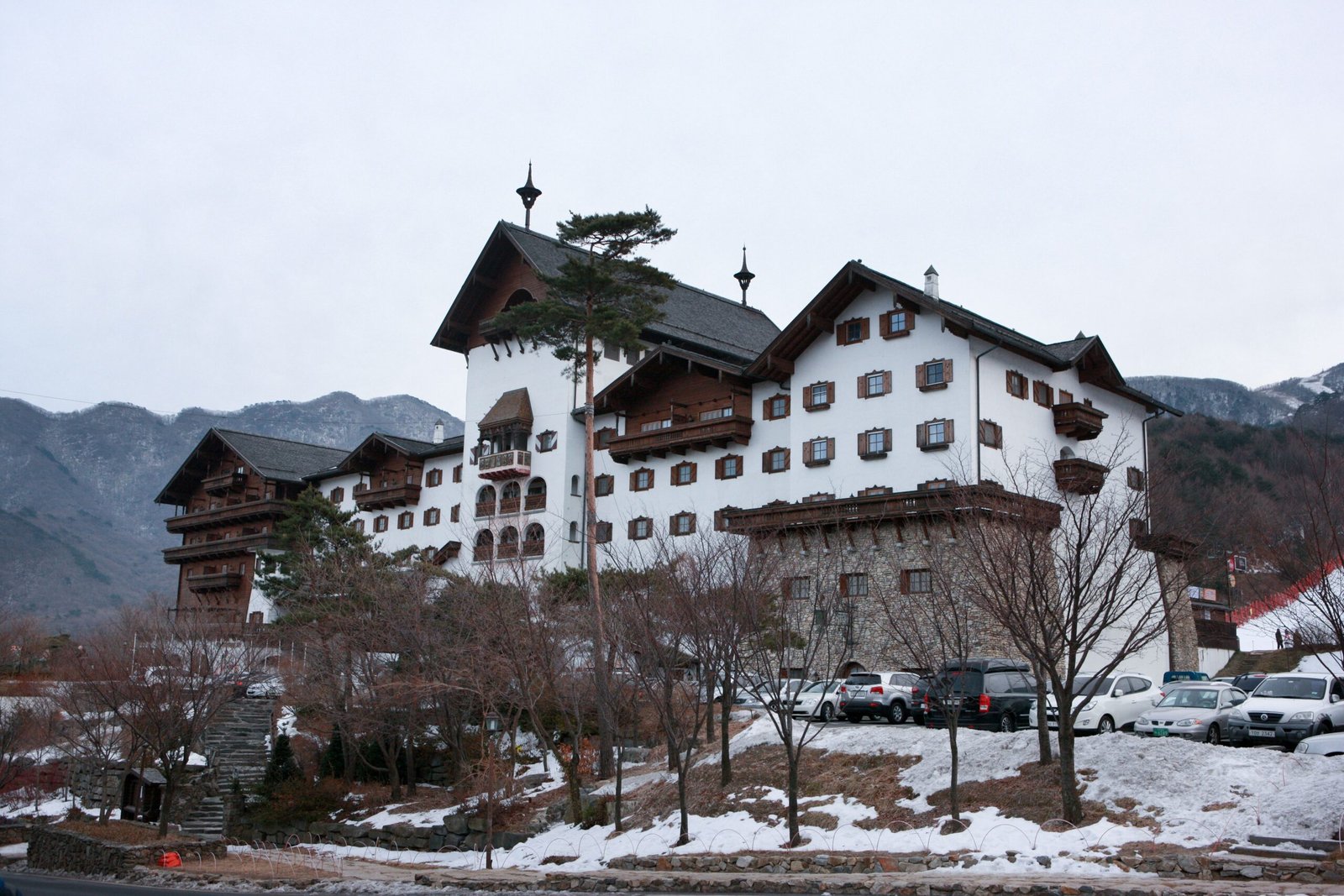
| Tirol Hotel | Inside Muju Deogyusan Resort | Check booking sites | Austrian chalet-style hotel, first in line for the first gondola |
| Muju Deogyusan Resort condos and family hotel | Inside the resort complex | Check booking sites | Kitchens, good for families and groups |
| Gucheondong pensions and guesthouses | Gucheondong, Seolcheon-myeon | Check booking sites | Restaurants nearby, right by Eosa-gil |
| Muju-eup hotels and motels | Around Muju Bus Terminal | Check booking sites | For bus travelers, close to the wine cave |
- Room rates weren’t checked for specific dates; look them up before you book.
A sample overnight (by bus from Seoul)
- Day one, 7:40 a.m.: Seoul Nambu Terminal to the Gucheondong stop, arriving 10:56 a.m. (one direct bus a day)
- Noon–1 p.m.: Sanchae bibimbap lunch in Gucheondong (No. 10)
- 1:30–3:30 p.m.: The Inwoldam section of Eosa-gil, or Taekwondowon (No. 9, closed Mondays)
- Evening: Stay at the resort or in Gucheondong; double-check your first-gondola booking for the morning
- Day two, 9 a.m.: First gondola to Seolcheonbong (Nos. 1 and 6), then Hyangjeokbong (Nos. 2 and 3), and Jungbong if your legs allow (No. 4)
- Noon: Ride down, then afternoon skiing (No. 7, once the slopes open) or the wine foot bath at the Meoru Wine Cave (No. 8, closes 4 p.m.)
- 4:35 p.m.: Last bus from Muju Bus Terminal to Seoul Nambu Terminal (four return buses a day, first 9:35 a.m., last 4:35 p.m., Asamaru)
The reservation system took away the two-hour wait. The rime ice still gives you only the few hours before the sun reaches the summit.
Read next
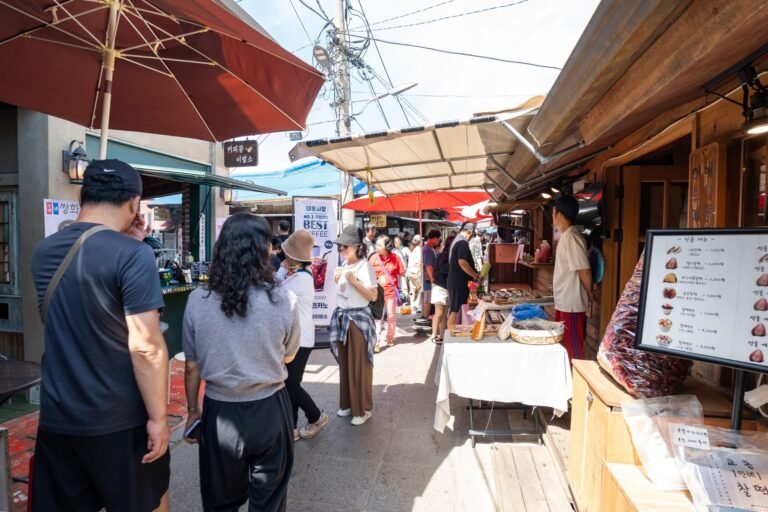 The Yellow Sea Sunset Happens Inside a 51°C Outdoor Bath: Seongmodo Mineral Hot Spring and Bomunsa Temple, Ganghwa
 Rained Out, Then Bumped by an Election, Pohang's Fireworks Finally Burst Over a November Sea: Pohang International Fireworks Festival and the Space Walk Sunset
 Busan Hotel Rooms Cost Six Times More Tonight, but the Best Fireworks View Is Free on a Hill: Busan Fireworks Festival 2026 at Gwangalli
Trending on Seol Notes
- Ae-sun Left the Baeksang Empty-Handed. Then She Spoke: IU
- 85,000 Fans in São Paulo Sang 'Arirang,' and BTS Put Down Their Microphones
- K-pop News Today (Nov 4, 2026): RESCENE's 'With' Hits No. 1 on Melon, TWS Sell 630,000 on Day One, AND2BLE's Career-High Week
- AI Will Reverse Human Aging, Even If Musk Says We Need Death: Reverse Aging
- Teachers Get Reported for It. Korean Folk Village Ghosts Get Cheered.
Sources
- TTL News: Muju Deogyusan Resort gondola advance reservations (November 7, 2026), YTN: Deogyusan’s first rime ice (October 22, 2026), GoKorea: Korea’s winter snow-flower spots, Daily Hankook: ski resort opening preparations (November 7, 2026), Asia Economy: Muju Deogyusan Resort season passes (September 28, 2026)
- Korea Trip Tips: Seolcheonbong, Taekwondowon, Muju Meoru Wine Cave, Muju Gucheondong Special Tourist Zone, Jeonbuk Ilbo: Gucheondong Eosa-gil
- Asamaru: Seoul Nambu to Muju intercity bus, Seoul Nambu to Gucheondong, Deogyusan ridge hike review (Naver blog)
- Photos: KTO Photo Korea, KOGL Type 1 (photographer credited on each photo)
- Currency conversion: 1,324.6 won per dollar (Seoul FX market base rate, October 23, 2026). Won prices come from Korea Trip Tips (Korea Tourism Organization data), the bus timetable site and news reports (2026) and may change.
Discover more from Seol Notes
Subscribe to get the latest posts sent to your email.