
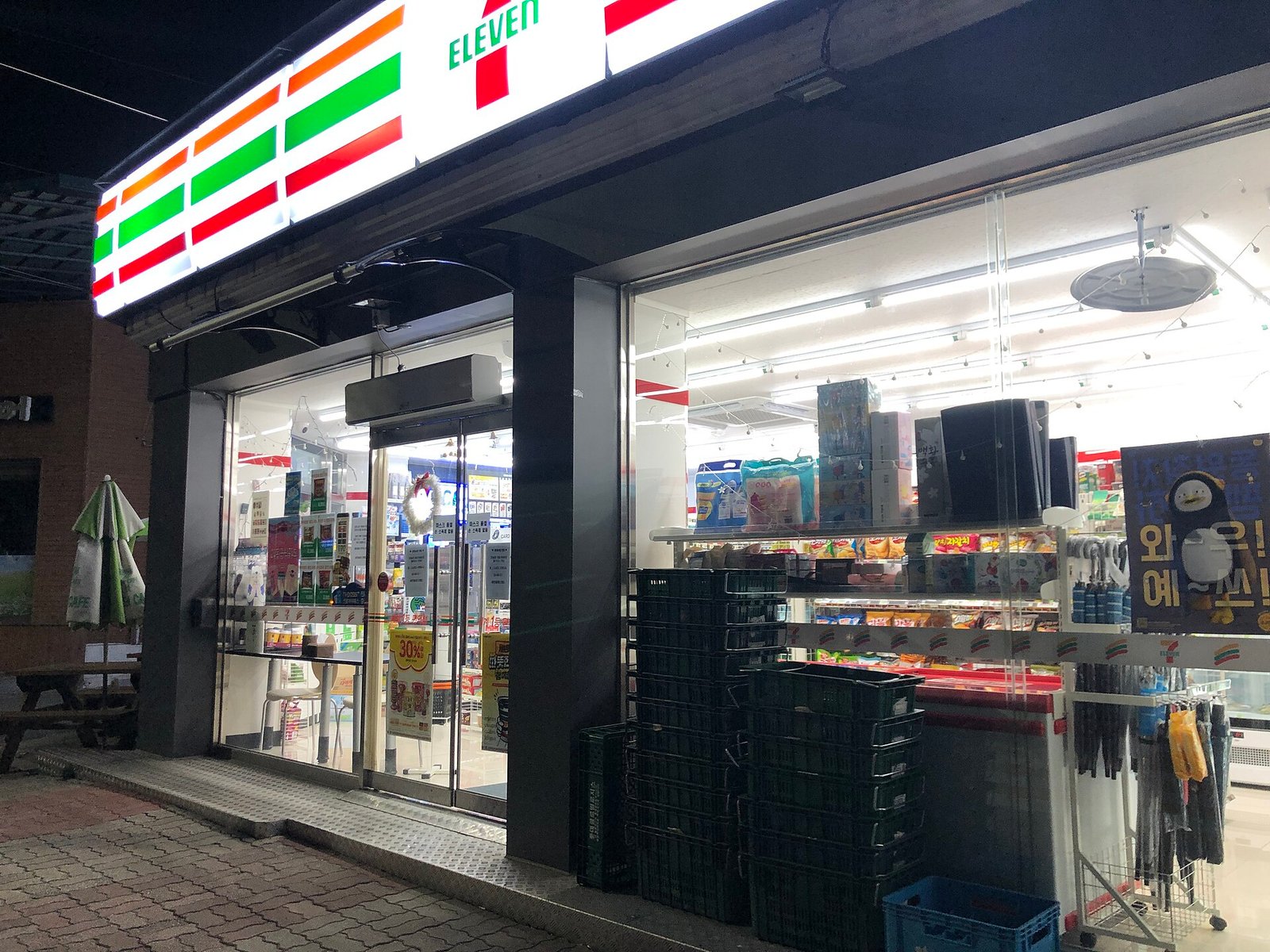
Featured photo: A Korean convenience store at night, the kind of workplace where Dead-End Job’s first shift begins. Photo: MatthieuRicard / Wikimedia Commons, CC0.
Netflix’s Dead-End Job is about a part-time job that pays 50 times the minimum wage and then demands your life. For young Koreans, that premise is not fantasy. It is the news. On October 26, four days before the series drops, Korea’s Financial Supervisory Service named job ads reading “kkul alba, urgent hiring” as bait for criminal rings.
In this story
“Kkul alba” used to be a brag
Kkul alba joins kkul (honey) and alba (a part-time job, from the German Arbeit). In Korean slang kkul works like “sweet” or “awesome,” as in kkul-jaem (super fun) or kkul-tip (a great tip), so a kkul alba is an easy job with generous pay. College students used it lightly, bragging that “working at the campus library is a honey job.” That word has now become the most dangerous phrase in Korean job ads.
Also read: IU, DAY6 and Squid Game All Brought Him Back. Who Was Shin Hae-chul?
A staffing agency that pays 50 times the minimum wage
Dead-End Job (Korean title Kkul Alba) releases all eight episodes on Netflix on October 30. Hyuk-jun (Lee Jae-wook), a young man cornered by debt, sees a strange flyer and walks into Geomi Staffing, which offers him work starting at 50 times the minimum hourly wage. There is one rule: never talk about what happens at work. His first job looks like an ordinary convenience store, until swarms of moths attack, and the more dangerous the job he survives, the higher the day rate climbs (Netflix announcement; Maeil Shinmun, October 20). In the main trailer, the boss of Geomi Staffing offers the same condition: “Work one day and you get paid that day” (Wikitree, October 18). That is word for word dangil jigeup, “same-day pay,” a stock phrase of Korean job ads.
The names behind it tell you how seriously to take it. It is directed by Kim Da-min, who wrote A Killer Paradox, with Han Jun-hee, director of D.P. and Weak Hero, as creative director. Lee Jae-wook plays Hyuk-jun; Go Min-si plays Yeon-ju, an investigator with the workers’ compensation agency who digs into Geomi Staffing’s accidents; Kim Min-ha plays Hyuk-jun’s sister Ji-yun; and Lee Hee-joon is the Geomi boss who makes offers that are hard to refuse. Episodes 1 to 4 screened first at the Busan International Film Festival as an adults-only horror, and Kim Min-ha said she watched the finished cut “with my eyes covered” (Wikitree, October 18).
Where to watch: Dead-End Job premieres worldwide on Netflix on October 30, 2026, at 5 p.m. KST (4 a.m. ET) — Netflix (US and Korea, checked October 28, 2026).
Korea’s minimum wage for 2026 is 10,320 won an hour, about $7.80. Fifty times that is roughly $390 an hour. Korean viewers do not laugh at that number. They have seen ads like it already.
The real “kkul alba, urgent hiring” the regulator warned about
The scheme the Financial Supervisory Service published on October 26 looks a lot like episode one. Ads go up on job sites and social media: “Kkul alba, urgent hiring, same-day pay. Up to 400,000 won (about $300) for cash delivery and fund transfers.” Once hired, people are told to “collect loan payments or sales proceeds,” pick up cash, or send money to a particular account (Kyunghyang Shinmun, October 26). One job seeker answered a “kkul alba, urgent hiring” ad and was offered 400,000 won a day simply to move money that arrived in his own account to a designated one. He became an accomplice in a voice-phishing ring’s money laundering (Munhwa Ilbo, October 26).
The easy-looking work is the trap. The regulator said that receiving and moving or withdrawing someone else’s money is itself a crime as a voice-phishing accomplice, and that handing over a bank account or debit card can bring up to five years in prison or a fine of up to 30 million won (about $22,600) (Munhwa Ilbo). Foreigners living in Korea were on the warning list too, because more of them are being pulled into laundering through account sales and person-to-person currency deals (Kyunghyang Shinmun).
The “kkul alba” that crossed borders
The far worse version is in Southeast Asia. A ring busted by the Seoul Metropolitan Police in June used high-paying part-time jobs as bait, covering flights and meals to bring young people to Cambodia. Victims were locked in crime compounds in Sihanoukville for two to six weeks, beaten and threatened, and had their bank accounts taken. The ring sold each account to overseas phishing groups for 10 million to 20 million won (about $7,500 to $15,100) (Herald Business, June 23).
All of Korea watched where that road ends. On October 18, 2025, 64 Koreans who had been detained in Cambodia after joining scam operations were flown home on a government charter plane, while an autopsy was underway for a Korean college student tortured to death by a local crime ring (Kyunghyang Shinmun, October 20, 2025). On January 23 this year, 73 more were sent back at once (YTN, February 5). Half of the returned suspects were college students and job seekers in their 20s (EBS). Whether they are perpetrators or trafficking victims is still being argued.
Korean horror starts with debt
A hero driven by debt into work that could kill him is the formula Korean drama has sold best to the world. The players in Squid Game entered the game because of debt too. Dead-End Job moves that stage from an island arena to a neighborhood convenience store and a staffing office. Employment among Koreans aged 15 to 29 has fallen for 47 straight months through September (JoongAng Daily, October 16), and two words, “same-day pay,” slip in through exactly that gap.
In the drama, Hyuk-jun is trapped in a system where the day rate rises the more dangerous the job he pulls off. The Cambodian ring worked the same way. It paid its members 2 million to 4 million won (about $1,500 to $3,000) a month, plus another 1 million to 2 million won (about $750 to $1,500) for every young person they brought in as an account holder (Herald Business). The real “kkul alba” paid a bonus to whoever brought in the next Hyuk-jun.
Read next



Trending on Seol Notes
- Kim You-jung Cracked Japan Despite the 'Anti-Japan Drama' Label
- The Emperor of K-pop Came Back, and Korea Flipped
- K-pop News Today (Oct 27, 2026): IVE's EP Drop, ILLIT 'You're Under Arrest', LISA's 59M
- His First Film Never Opened. His First Role Had No Name. Then Korea Called Him "Sam-sik"
- The No. 1 Korea Doesn't Want to Believe: Why Fans Doubt A2O
Sources
- Netflix: Dead-End Job Sets October 30 Premiere
- Maeil Shinmun, October 20, 2026, Wikitree, October 18, 2026
- Kyunghyang Shinmun, October 26, 2026, Munhwa Ilbo, October 26, 2026
- Herald Business, June 23, 2026
- Kyunghyang Shinmun, October 20, 2025, YTN, February 5, 2026, EBS News
- JoongAng Daily, October 16, 2026
- 2026 minimum wage of 10,320 won an hour: Korea’s Ministry of Employment and Labor. Dollar figures at 1,324.6 won per dollar (October 23, 2026).
Discover more from Seol Notes
Subscribe to get the latest posts sent to your email.