Part 18 of 27 in Homo Conspirans: The Humans Who Come After Us
Homo Conspirans · Musk’s dream: “connection anywhere on Earth” → a humanity for which connection is a basic condition
Musk’s Starlink will erase the last person on Earth not connected to AI. In the desert, at sea, deep in the jungle, the phone in your hand links to a satellite overhead. Being connected becomes a condition every person is assumed to have, like being able to read, and the unconnected end up outside the world, the way people who cannot read do.
Before dawn on August 5, 1914, hours after Britain declared war on Germany, the British Post Office cable ship Alert lowered grappling hooks into the Strait of Dover and cut five undersea cables linking Germany to the far side of the Atlantic. With its own lines gone, Germany had to borrow other people’s, and those lines ran through Britain. In January 1917, when German Foreign Secretary Arthur Zimmermann sent a secret telegram proposing an alliance with Mexico, the British naval codebreakers of “Room 40” intercepted and decoded it.[1] The telegram was made public in March 1917, and a little over a month later the United States entered the war. The side that lost its lines lost its voice.
In this story
A line that comes down from the sky
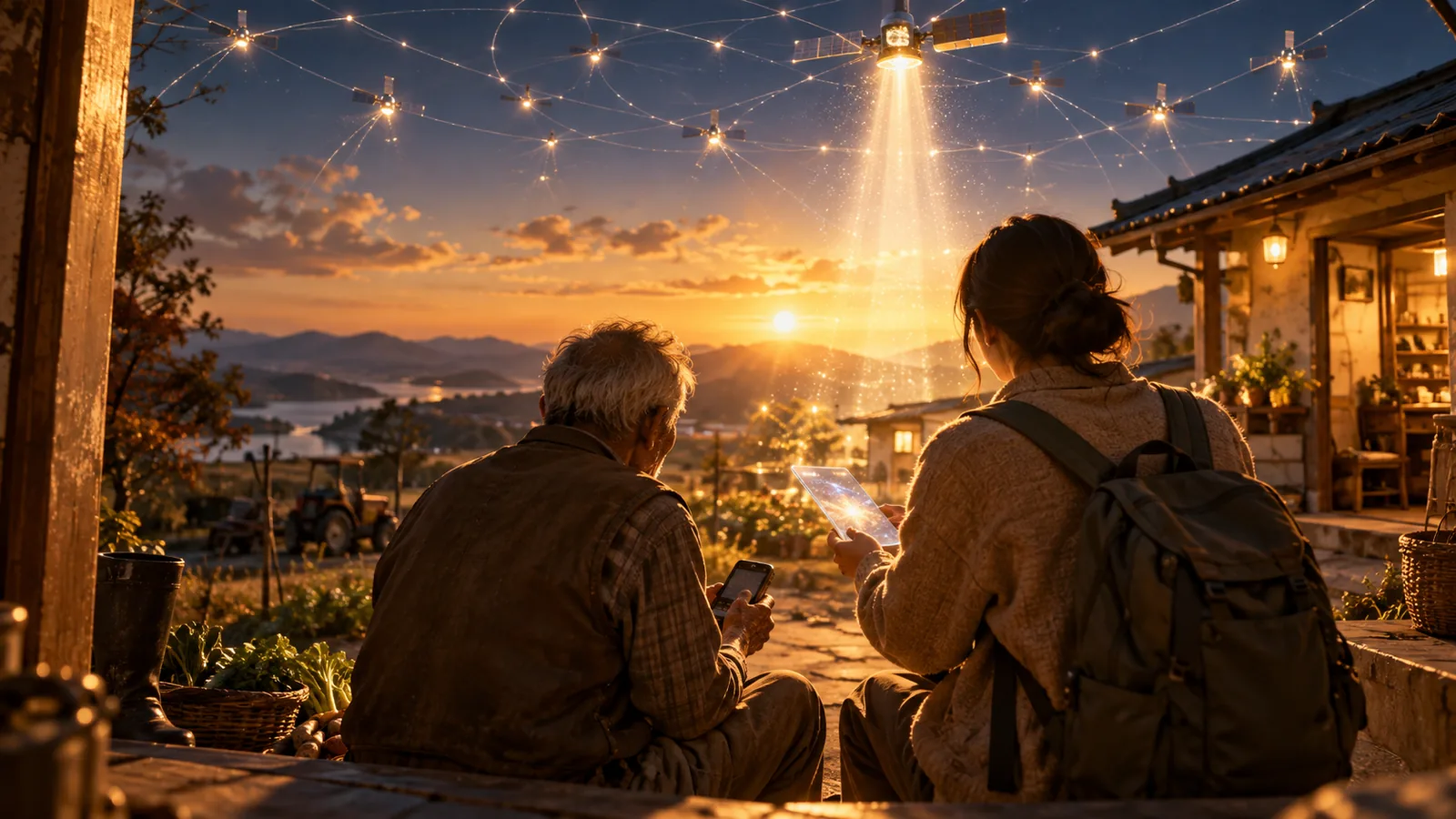
On July 23, 2025, the American carrier T-Mobile launched its “T-Satellite” service with Starlink. No special satellite phone was needed. The ordinary phones people already owned could send texts through more than 657 Starlink satellites from mountains, deserts and seas with no cell towers. In October data followed.[2] The sky itself became a cell tower.
Many people are still beyond the line. In November 2025 the International Telecommunication Union reported that 6 billion people, three-quarters of the world, use the internet, while 2.2 billion remain unconnected. Ninety-six percent of them live in low- and middle-income countries.[3] Those 2.2 billion are Musk’s next customers. And whoever holds that line can flip a switch that decides the outcome of wars.
The antenna in the Amazon
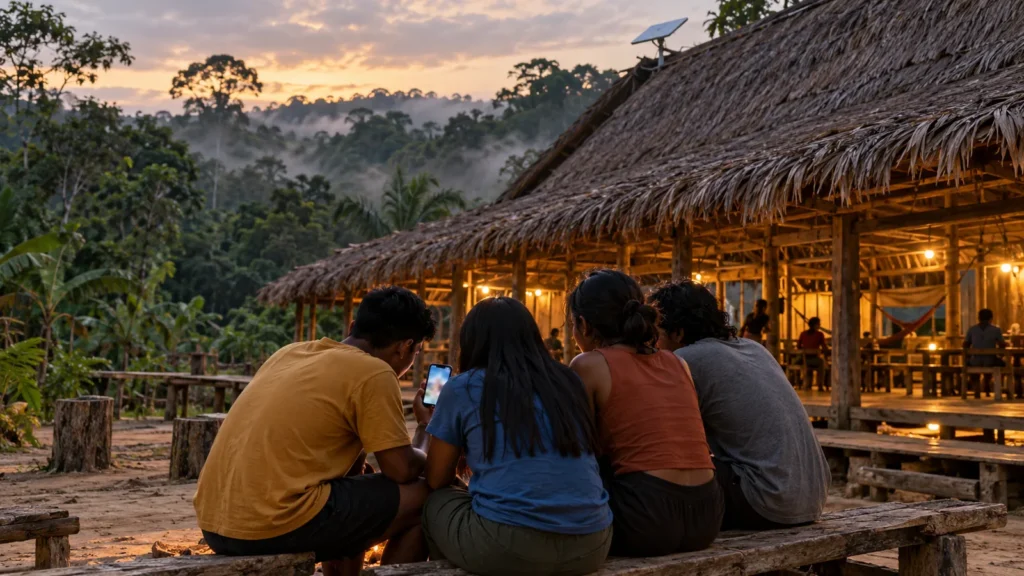
One place shows what happens where connection arrives last. The Marubo, about 2,000 people living deep in Brazil’s Javari Valley in the Amazon, received Starlink antennas in September 2023. When The New York Times visited in June 2024, villagers spoke first about emergencies. Calls for help that once went by radio, relayed from village to village, now got through at once, and the connection had already helped save people bitten by venomous snakes.
There was another side as well. Elders worried that young people would not put their phones down. Village leaders set a rule limiting the internet to two hours in the morning, five hours in the evening and all day Sunday.[4] The Marubo later sued the Times, saying the story portrayed them as a community unable to handle the internet. What no one disputes is the rule they wrote for themselves. Connection saved lives, and at the same time it rewrote the village’s daily schedule.
Like a brain that reads
Connection rewires the brain, and writing is the precedent. In 2010 a team led by the French neuroscientist Stanislas Dehaene compared the brains of adults who could not read, people who learned to read as adults and people who learned as children. Learning to read carved out a new region that responds to written letters, and part of that territory had once been used for recognizing faces. Even when readers listened to speech, their brains called up letters.[5] A single invention, writing, redrew the map of the human brain.
Writing took thousands of years to spread. In 1820, 12 percent of the world’s people could read and write. Today it is 87 percent.[6] Connection does the same in a few decades. Children linked to the sky from birth wire their brains on the assumption that they can ask AI anything, anytime. To them, an unconnected person is as strange as someone who cannot read.

February 2044: in a ger in the Gobi
February 2044, a ger, the round felt tent of Mongolian herders, in the Gobi Desert. Outside it is 30 degrees below zero. Ten-year-old Temujin interprets for his grandmother what the AI on his phone is saying. The AI still struggles with the dialect she has spoken all her life. It warns that in ten days a brutal cold disaster, a dzud, will hit the region. In the dzud of 2010, this family lost half its herd.
That night the father talks it over with five neighboring herding families by satellite text, and at dawn the next day he drives the animals south. The grandmother peers at the screen her grandson holds up and murmurs to herself, “So now the sky talks to people.”

Data everywhere by 2027, the last island by 2060
This is the order in which the unconnected disappear from the Earth.
- 2027: Direct-to-satellite data works on ordinary phones in more than 100 countries.
- 2030: The number of people offline falls below 1 billion.
- 2036: Every new phone, car and appliance connects to satellites by default. The phrase “dead zone” disappears.
- 2045: People outside the network, counting those who disconnected by choice and uncontacted tribes, number fewer than 50 million.
- 2050: The United Nations adds “connection literacy” to its basic education indicators, alongside reading.
- 2060: An international convention protects the “right not to be connected” for communities that refuse outside contact, like the people of North Sentinel Island in the Indian Ocean. Unconnected people remain only inside protected areas.
What the Alert cut in 1914 was five strands of copper. The next century’s lines run through the sky, and only a handful of people hold hooks that can cut them. One of them is Musk.
Next in the series · After Albania’s AI Minister, Musk’s Dream of AI Government Comes Next: Diella
In 2025 Albania became the first country to make an AI a government minister, and its prime minister said the AI was “pregnant with 83 children.” Rule passed from chieftains to states, and now it passes to algorithms.
Homo Conspirans: The Humans Who Come After Us · Part 18 of 27
Part 19 arrives Nov. 16.
← Part 17: Musk's AI Solar Empire Will Lift Humanity to a Type I Civilization: The Kardashev Scale
Read next
- Frogs Jump Out of Boiling Water, but Humanity Won't Leave AI's Warm Bath: Boiling Frog Syndrome
- The Mars Settlers Musk's AI Picks Will All Carry the Gene That Can't Stop: The Explorer Gene
- After the Weight-Loss Drug Musk Took, the Next Step Will Be an AI Brain Chip That Replaces Willpower: The Ozempic Effect
Trending on Seol Notes
- 85,000 Fans in São Paulo Sang 'Arirang,' and BTS Put Down Their Microphones
- A Cat With a Gun Made $260,000 in a Day
- Young K Just Won Grand Artist at KGMA 2026. Five Trophies, One Bass Player, and the Summer He Wrote Every Song Himself
- K-pop News Today (Nov 4, 2026): RESCENE's 'With' Hits No. 1 on Melon, TWS Sell 630,000 on Day One, AND2BLE's Career-High Week
- AI Will Reverse Human Aging, Even If Musk Says We Need Death: Reverse Aging
Sources
- Imperial War Museums, “Before Bletchley Park: The Codebreakers of the First World War.” https://www.iwm.org.uk/history/before-bletchley-park-the-codebreakers-of-the-first-world-war
- Broadband Breakfast, “T-Mobile and Starlink Satellite Service to Officially Launch July 23,” June 2025. https://broadbandbreakfast.com/t-mobile-and-starlink-satellite-service-to-officially-launch-july-23/
- International Telecommunication Union, “Facts and Figures 2025,” press release, November 17, 2025. https://www.itu.int/en/mediacentre/Pages/PR-2025-11-17-Facts-and-Figures.aspx
- Jack Nicas, The New York Times, June 2, 2024. https://www.nytimes.com/2024/06/02/world/americas/starlink-internet-elon-musk-brazil-amazon.html (on the tribe’s lawsuit: AP, “Indigenous Amazon tribe says New York Times story led to its members being smeared,” May 23, 2025, https://www.news4jax.com/news/national/2025/05/23/indigenous-amazon-tribe-says-new-york-times-story-led-to-its-members-being-smeared-as-porn-addicts/)
- Stanislas Dehaene et al., “How Learning to Read Changes the Cortical Networks for Vision and Language,” Science 330(6009), 1359–1364, 2010. https://doi.org/10.1126/science.1194140
- Our World in Data, “Literacy.” https://ourworldindata.org/literacy
Discover more from Seol Notes
Subscribe to get the latest posts sent to your email.