
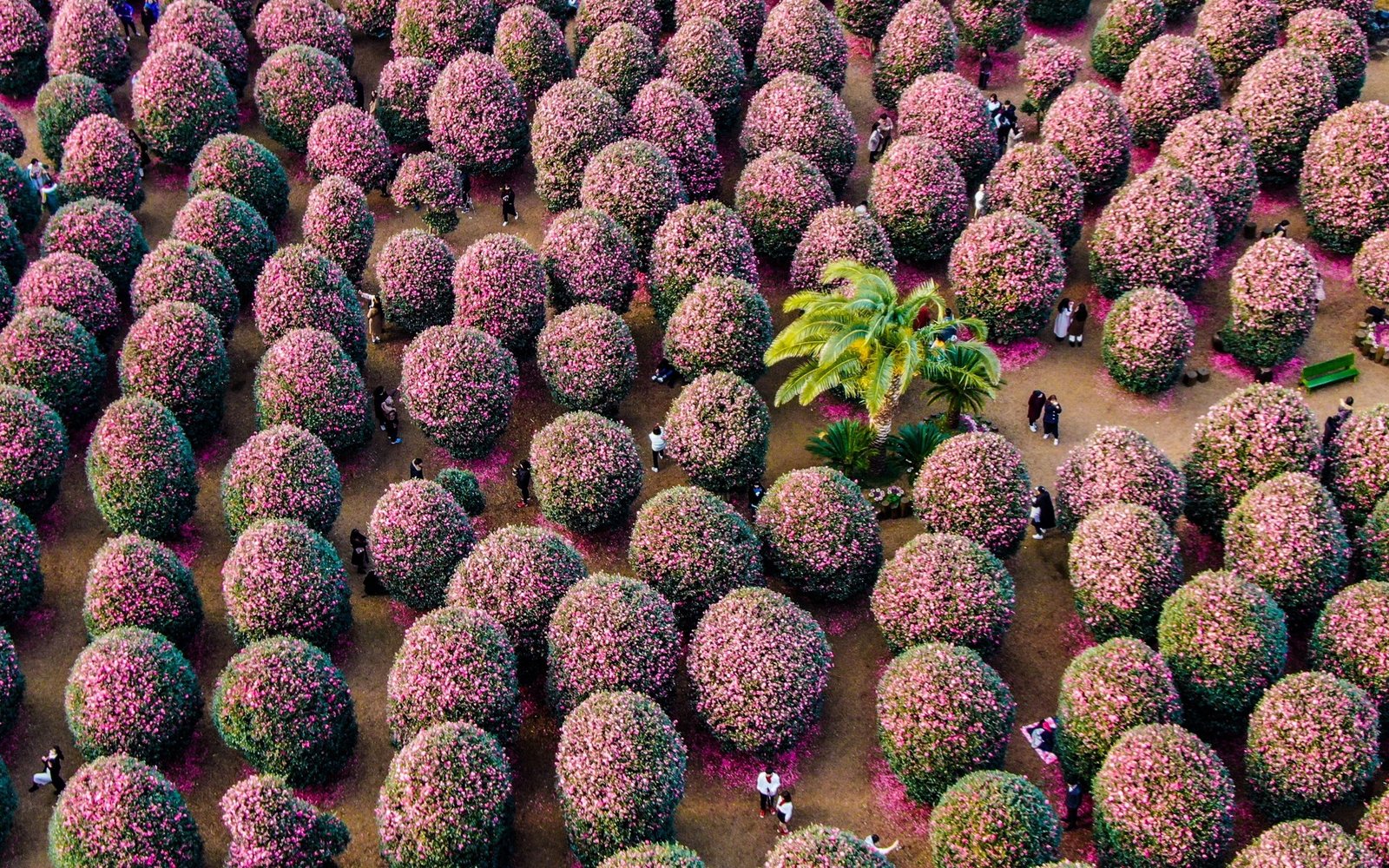
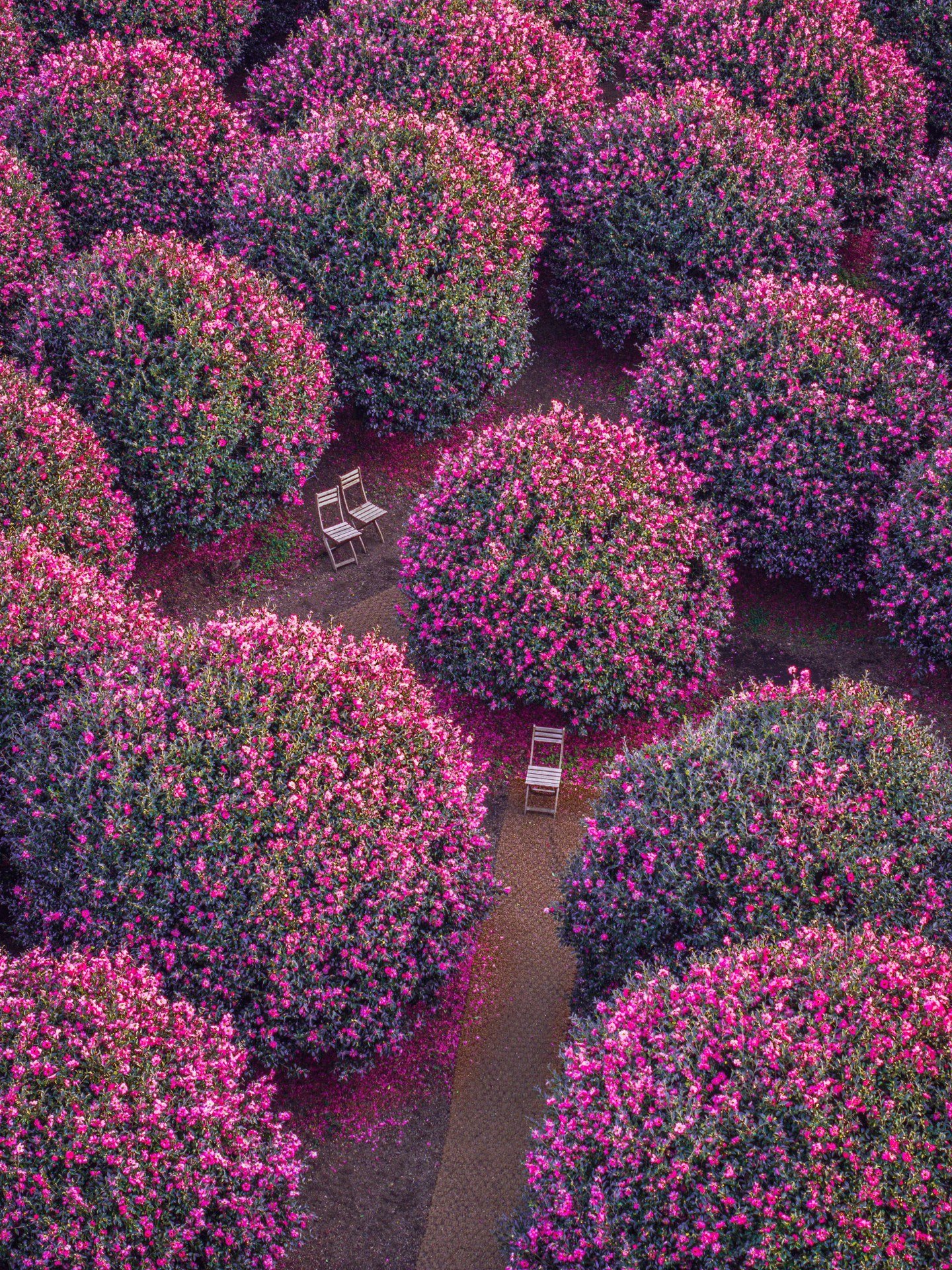
Featured photo: Travelers walking and taking photos between round, pink-flowering camellia trees at the Jeju Camellia Arboretum, seen from above. Photo: Kwon Yong-ui / KTO Photo Korea (2021 Korea Tourism Photo Contest), KOGL Type 1.
In December in Seogwipo, on the south side of Jeju, pink petals spread like a carpet under your feet as you walk between hundreds of camellia trees trimmed into neat balls. The same afternoon, within an hour’s drive, you find red native camellias in a village windbreak more than 100 years old, stone mortars floating with blossoms for photos, and a bag of tangerines you picked yourself.
In this story
At a glance
- When to go: Pink sasanqua camellias start blooming in late November and peak from mid-December to January. Red native camellias peak in January and February (Naver blog guide to the 2026–27 season). The pink-carpet scene happens most after mid-December, when sasanqua petals scatter as they fall. Early November is too soon: a Camellia Hill visit in the first week of November noted “it’s not camellia season yet” (Naver blog, November 2026).
- Festival dates: As of November 5, the official 2026–27 dates for the Camellia Hill and Hueree camellia festivals hadn’t been announced. Over the past two seasons, the Hueree Camellia Festival ran November 16, 2024, to January 31, 2025, and November 15, 2025, to January 31, 2026, starting around a mid-November Saturday (telltrip). Check the official sites before you go.
- Entry fees at a glance: Camellia Hill adults 12,000 won (about $9.10), Jeju Camellia Arboretum 8,000 won (about $6), Dongbaek Forest about 7,000 won (about $5.30). The Wimi Camellia Forest and Jeju Dongbaek Village are free (sources under each item).
- From Jeju Airport: The camellia spots are in Seogwipo on the south side of the island, so a rental car from the airport is by far the easiest way. By bus, take an airport express bus toward Seogwipo and transfer to a local bus; the three Wimi camellia spots are all within walking distance of the “Dongbaek Sumogwon” (Camellia Arboretum) stop on bus 201 (jeju.com camellia guide). Check current routes in Kakao Map or Naver Map.
- Route rule: Camellia Hill (Andeok-myeon, west) and the Wimi spots (Namwon-eup, east) are on opposite sides of Seogwipo. To do both in a day, go west in the morning and east in the afternoon, in one direction only.
- Short days: Most winter gardens stop letting people in at 5 p.m. Three camellia spots a day is the realistic limit.
Top 10 things to do on a Seogwipo camellia trip
1. Walk the pink camellia forest at the Jeju Camellia Arboretum (see)
From above, it looks like someone spilled pink marbles. Paths run between hundreds of sasanqua camellias trimmed into round shapes, and at peak the dirt under the trees turns pink with fallen petals. This is the place in the photo at the top of this post. On a clear day you see Hallasan and the sea beyond the trees together (Naver blog, 2026).
- Price: Adults 8,000 won (about $6), children 5,000 won (about $3.80), with separate discounts (Naver blog, 2026, citing the official website). Buy on site, no reservation.
- Hours: 9 a.m. to 6 p.m., last entry 5 p.m. It opens only in camellia season, from mid-November to the end of February (ktriptips).
- Tip: The parking lot has its own navigation address, “Wimi-ri 931-1.” Weekend afternoons at peak bring a photo line at every tree, so arrive at the 9 a.m. opening for shots without people. The Wimi Camellia Forest (No. 2) is a five-minute walk.
- Sources: Jeju camellia spots 2026–2027 (LumiTo, Naver blog), Camellia Arboretum fees and hours review (Naver blog), ktriptips: Jeju Camellia Arboretum
2. The Wimi Camellia Forest, a red windbreak planted by one woman (see)
In the late 19th century, Hyeon Maeng-chun married into Wimi-ri and began planting camellias to protect her fields from the sea wind. They grew into a forest, now Jeju Monument No. 39. These aren’t pink garden camellias trimmed into balls: tall native camellias stand along the stone walls, and red flowers that drop whole stay on the path.
- Price: Free (Naver blog, 2026). Some areas are private land, so check the signs for where you can go.
- When: As native camellias, they’re reddest from mid-January to February. In December, think of it as a walk in a deep green forest that contrasts with the pink of the arboretum next door.
- Tip: Its name is close to the arboretum’s and confuses navigation apps, so enter “Wimi Dongbaek Namu Gunrak” exactly. Villagers live along these lanes, so stay out of yards.
- Sources: LumiTo 2026–2027 guide (Hyeon Maeng-chun, Monument No. 39), Wimi-ri camellias and sea (Naver blog)
3. A loop through the Camellia Hill garden (see)
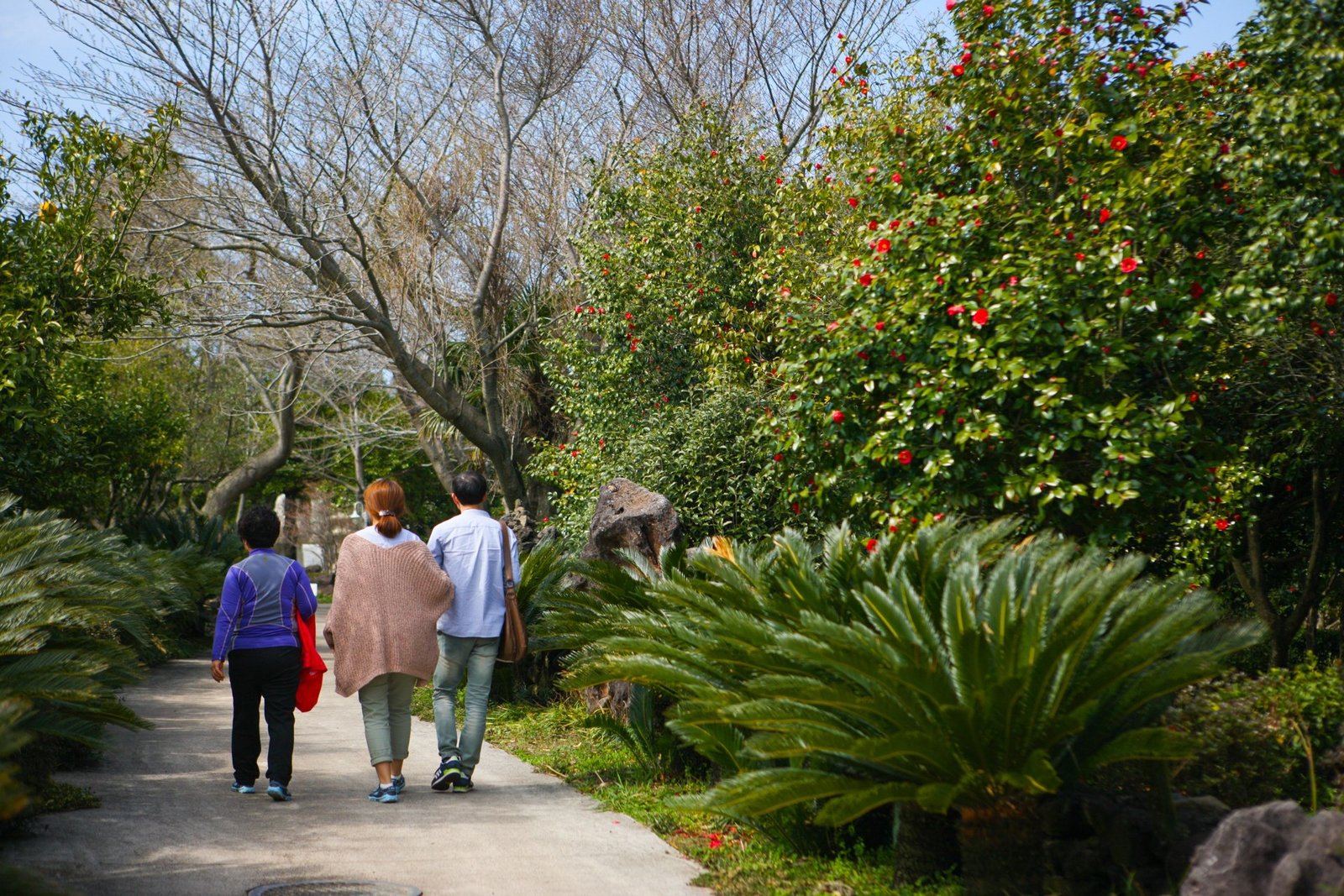
Camellia Hill is a camellia arboretum on a hillside in Andeok-myeon, Seogwipo. It gathers about 500 varieties and some 6,000 trees, each blooming at a different time, so early flowers open one by one from November and the garden gets more spectacular into winter (Naver blog, November 2026). For a first look at Jeju camellias, it’s the safest pick.
- Price: Adults 12,000 won (about $9.10), teens, seniors and soldiers 10,000 won (about $7.50), children 9,000 won (about $6.80) (Naver blog, November 2026, citing Jeju’s official tourism information). Reviewers say mobile tickets from the official website are about 1,000 won (about $0.80) cheaper for adults (Naver blog, 2026).
- Hours: Winter (November to February) 8:30 a.m. to 6 p.m., last entry 5 p.m., open every day (same source).
- How long: 40 minutes to 1 hour 20 minutes for one loop, longer if you take lots of photos (Naver blog, 2026).
- Tip: There are hills, so wear comfortable shoes. It’s quiet before 10 a.m.
- Sources: Camellia Hill in November, sights and fees (Naver blog, November 2026), Jeju in November: silver grass, camellias, tangerines and fees (Naver blog), Camellia Hill mobile discount tickets (Naver blog)
4. Camellia Hill’s petal paths and stone mortar photo spots (photo spot)
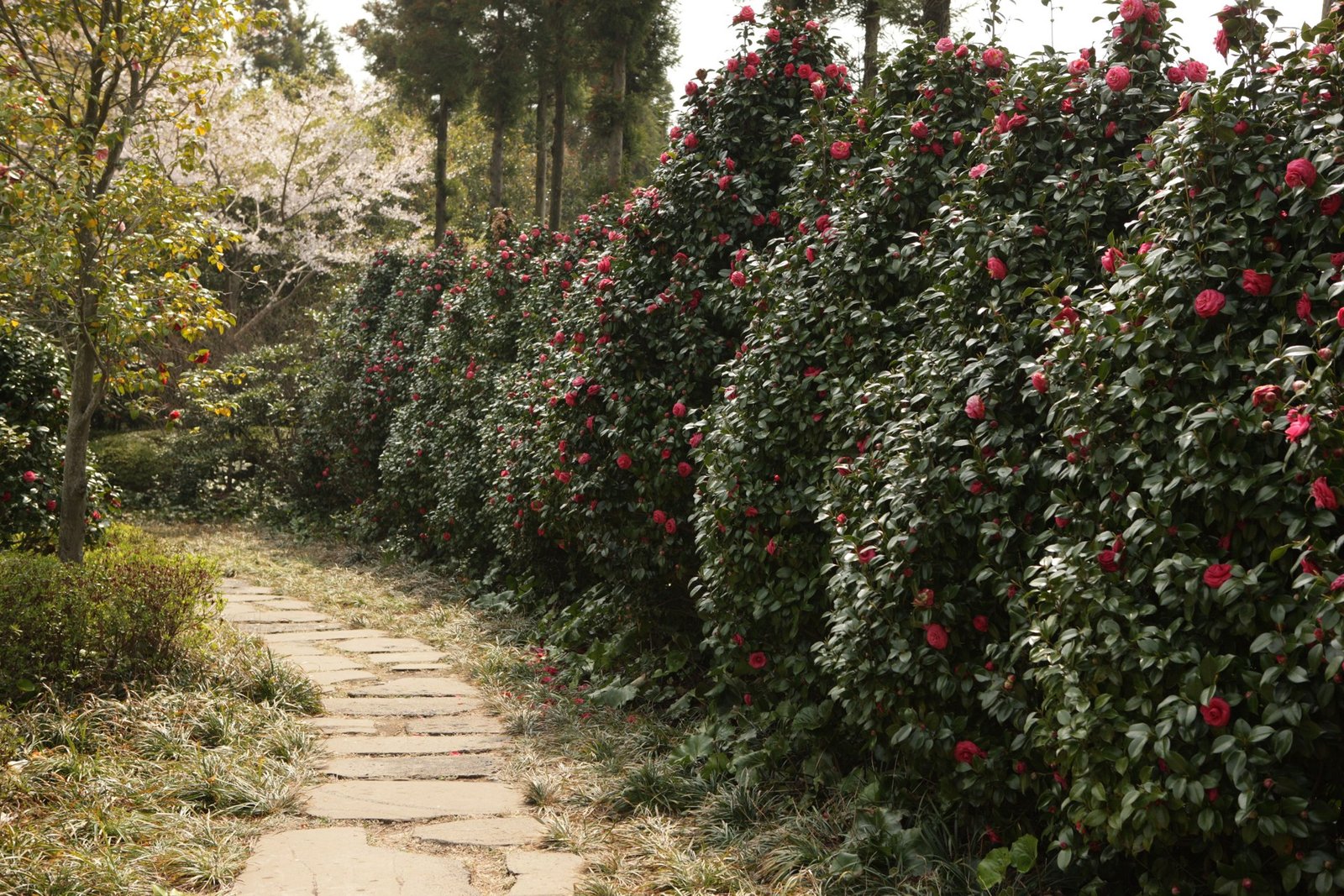
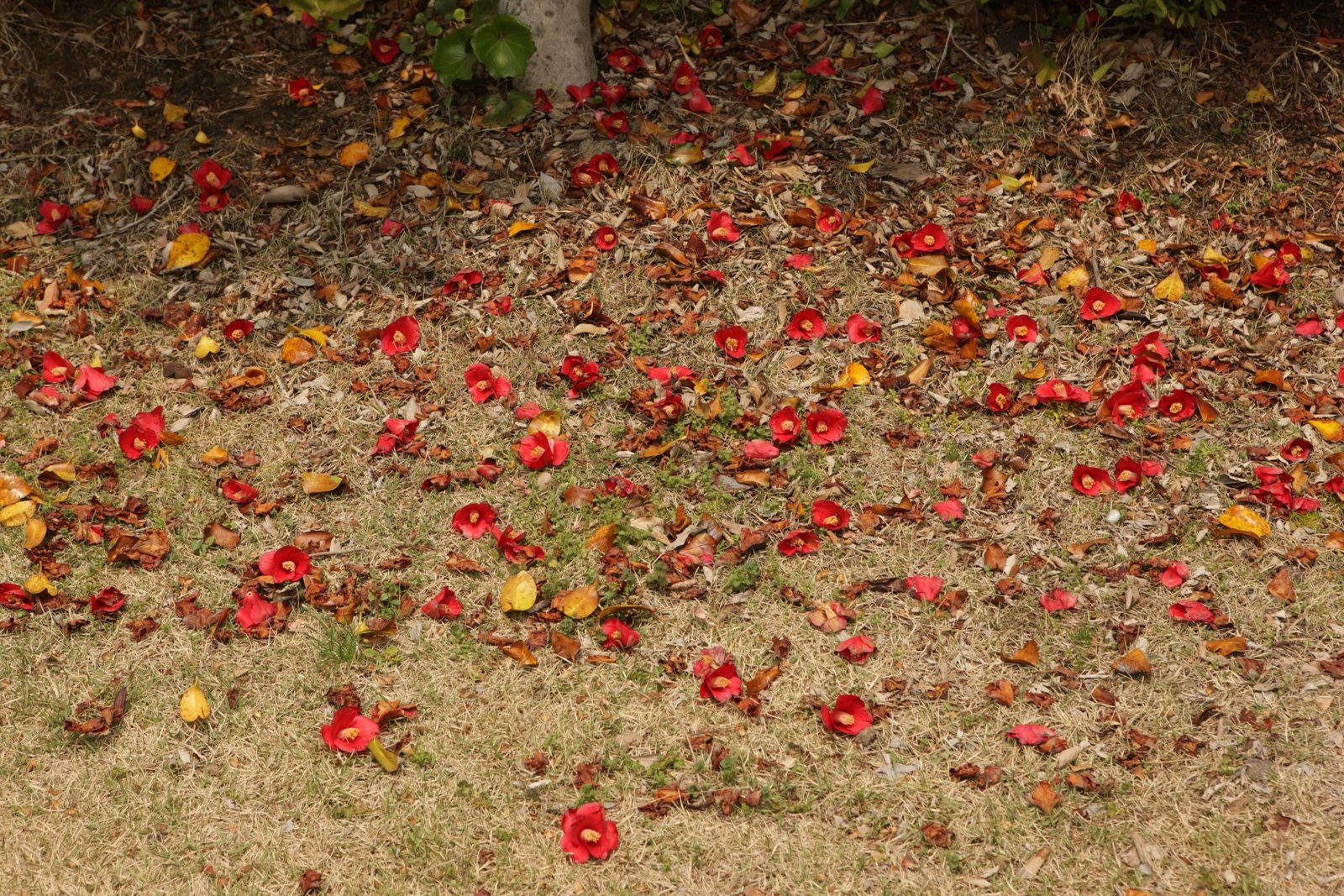
Half the photos from Camellia Hill are of the ground. The paths covered in fallen camellia petals are photo spots in themselves (Naver blog, 2026), and around the garden you pass basalt stone mortars with blossoms floating in them, dol hareubang stone statues standing among the camellias, and a forest path hung with “LOVE YOU” flags.
- Tip: Lots of visitors say calm colors like ivory and beige go well with the red flowers (Naver blog, 2026). Don’t step into flower beds or protected planting areas. Photo spots you saw online may have moved, so check on site.
Walk a little farther along the same path and you reach spots where the petals cover the ground entirely.
- Sources: Jeju in November: camellias and fees (Naver blog), Wimi-ri camellia photo tips (Naver blog)
5. Pink sasanqua photo spots at Dongbaek Forest (photo spot)
A private camellia garden in Namwon-eup, where paths wind between round sasanqua trees. It’s the place that shows up most when Koreans search for the “pink camellia photo of a lifetime.” It opens only in camellia season.
- Price: About 7,000 won (about $5.30) for adults and about 5,000 won (about $3.80) for teens and children (Naver blog, 2026, listed as approximate). Check this season’s fee at the gate.
- Hours: 9 a.m. to 5 p.m., open November to February (same source).
- Tip: On weekends at peak, the morning right after opening is best. Photos and real bloom conditions can differ, so look at recent visitors’ photos before you go.
6. Hueree’s camellia trail and animal feeding (experience)
Hueree is a nature park on the slopes of Hallasan in Namwon-eup. Its camellia garden and camellia trail come with feeding mini pigs, rabbits and goats, so with kids this is where you’ll spend the longest. In November it’s switching from autumn pink muhly grass to winter camellias (Naver blog, November 2026).
- Festival: Last season’s camellia festival ran November 15, 2025, to January 31, 2026, with a 30 percent discount on Naver reservations and tangerine picking during the festival (telltrip). Check hueree.com for this season’s dates and fees.
- How long: 1 to 2 hours (Naver blog, November 2026).
- Tip: Feeding times change with on-site operations, so read the board at the entrance first.
- Sources: Hueree camellia festival, 30% off on Naver reservations (telltrip), Hueree in November (Naver blog)
7. Make camellia soap in Jeju Dongbaek Village (experience)
In Sinheung 2-ri, Namwon-eup, native camellia trees said to be 300 to 400 years old still stand around the village. Villagers run soap-making with camellia oil and camellia forest programs (Naver blog, 2026).
- Price: Free entry and parking; programs cost extra (see the village website).
- Hours: Listed as 9 a.m. to 6 p.m., closed Wednesdays, Saturdays, Sundays and holidays (same source). On a weekend trip this won’t fit, so check before you go.
8. Pick tangerines in camellia season (experience)
Camellia season overlaps with the tangerine harvest. Farms offering picking cluster around Wimi, Namwon and Hyodon, so it’s easy to slot one in between camellia spots.
- Price: Roughly 7,000 won (about $5.30) for 1 kg to 20,000 won (about $15.10) for 3 kg, depending on the farm (Naver blog, November 2026).
-
Tip: Farms lend you scissors and a basket, and you take home a set amount. The day after rain the fields get muddy, so bring shoes you don’t mind dirtying.
-
Sources: Jeju in November: silver grass, camellias, tangerines (Naver blog), Nine Jeju tangerine farms compared (Naver blog)
9. Dinner at Seogwipo Maeil Olle Market (eat)
A permanent market in downtown Seogwipo, handy on the way back to your hotel after a day of camellia walks. Seasonal fruit like tangerines and hallabong, raw fish and snack stalls all sit under one roof. If you’re staying downtown, you can walk there.
10. The green tea fields at Osulloc Tea Museum (see)
Tea fields and a tea museum on the same west side of Seogwipo as Camellia Hill. If you did Camellia Hill in the morning, it’s an easy stop before lunch in the same direction. The tea fields stay green in winter, so you get one photo in a color other than camellia red.
Nearby
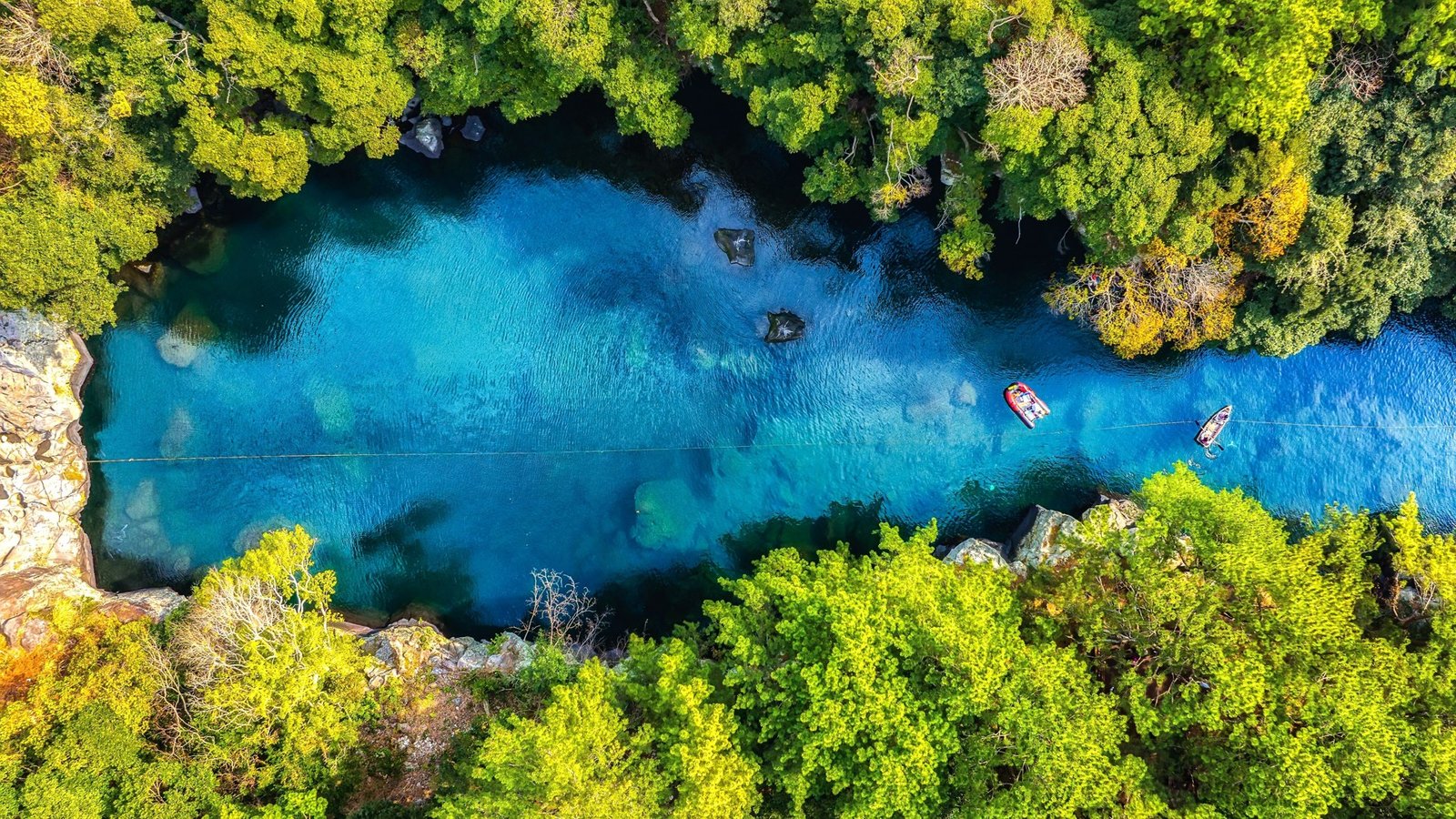
- Clear kayaks at Soesokkak: At the end of a valley in Hahyo-dong, where water from Hallasan meets the sea, you ride clear kayaks and taewoo rafts on jade-green water. It’s on the way from Wimi to downtown Seogwipo.
- Sanbangsan and Yongmeori Coast: Head down to the south coast from Camellia Hill and you reach bell-shaped Sanbangsan and the wave-carved rock path of Yongmeori Coast. Yongmeori closes depending on tides and waves, so check whether it’s open that day.
Where to stay
The camellia spots are split between the west (Andeok) and the east (Namwon), so with two days it’s easiest to stay in downtown Seogwipo or Jungmun and do one side each day.
| Stay | Location | Why |
|---|---|---|
| Jungmun Resort hotels (Parnas, Lotte, Shilla and others) | Jungmun, Seogwipo | West-side route, sea-view resorts |
| Downtown Seogwipo hotels | Around Maeil Olle Market | Close to the market and Soesokkak, easy bus transfers |
| Haevichi Hotel & Resort Jeju | Pyoseon-myeon | For the east-side route (Camellia Arboretum, Hueree) |
| Wimi and Namwon pensions and guesthouses | Namwon-eup coast | Right next to the camellia forests, first in at opening |
- Check room rates by date on booking sites; prices jump on weekends at camellia peak.
A sample day (from Jeju Airport, by rental car)
- 8:00 a.m.: Pick up a rental car at Jeju Airport, then take Pyeonghwa-ro to Andeok-myeon in Seogwipo
- 9:00–10:30 a.m.: Camellia Hill (Nos. 3 and 4), petal-path photos right after opening
- 10:45–11:30 a.m.: Osulloc tea fields (No. 10)
- 12:30–1:30 p.m.: Lunch in downtown Seogwipo
- 2:00–3:30 p.m.: Jeju Camellia Arboretum (No. 1), then walk to the Wimi Camellia Forest (No. 2)
- 3:45–4:30 p.m.: Tangerine picking at a nearby farm (No. 8) or Dongbaek Forest (No. 5, last entry 5 p.m.)
- 5:30 p.m. on: A sunset walk at Soesokkak, dinner at Seogwipo Maeil Olle Market (No. 9), then your Seogwipo hotel
- Day two: Hueree (No. 6), Dongbaek Village (No. 7, weekdays only), then back to the airport
The trees Jeju people planted to block the sea wind now bring in more people than wind every winter.
Read next
 Oysters Pop Open Over the Coals: Boryeong Cheonbuk Oyster Festival, Two Days of Grilled and Steamed Oysters
 The Yellow Sea Sunset Happens Inside a 51°C Outdoor Bath: Seongmodo Mineral Hot Spring and Bomunsa Temple, Ganghwa
 Skip the 2-Hour Line to Korea's Frost-Flower Summit: Muju Deogyusan Gondola and Hyangjeokbong Rime Ice Hike
Trending on Seol Notes
- K-pop News Today (Nov 4, 2026): RESCENE's 'With' Hits No. 1 on Melon, TWS Sell 630,000 on Day One, AND2BLE's Career-High Week
- Ae-sun Left the Baeksang Empty-Handed. Then She Spoke: IU
- 85,000 Fans in São Paulo Sang 'Arirang,' and BTS Put Down Their Microphones
- AI Will Reverse Human Aging, Even If Musk Says We Need Death: Reverse Aging
- "By the Start of 2027, Together": IU Now
Sources
- Jeju camellia spots 2026–2027 (LumiTo official blog), Camellia Hill in November (November 2026), Jeju in November: fees, Camellia Arboretum review, Jeju camellia spots Best 3, Wimi-ri camellias and sea, Hueree in November
- telltrip: Hueree Camellia Festival, jeju.com camellia spots, ktriptips: Jeju Camellia Arboretum
- Photos: Korea Tourism Organization, KTO Photo Korea, KOGL Type 1 (photographer credited on each photo)
- Currency conversion: 1,324.6 won per dollar (Seoul FX market base rate, October 23, 2026). Won prices come from Naver blogs and travel sites (2026) and may change.
Discover more from Seol Notes
Subscribe to get the latest posts sent to your email.