
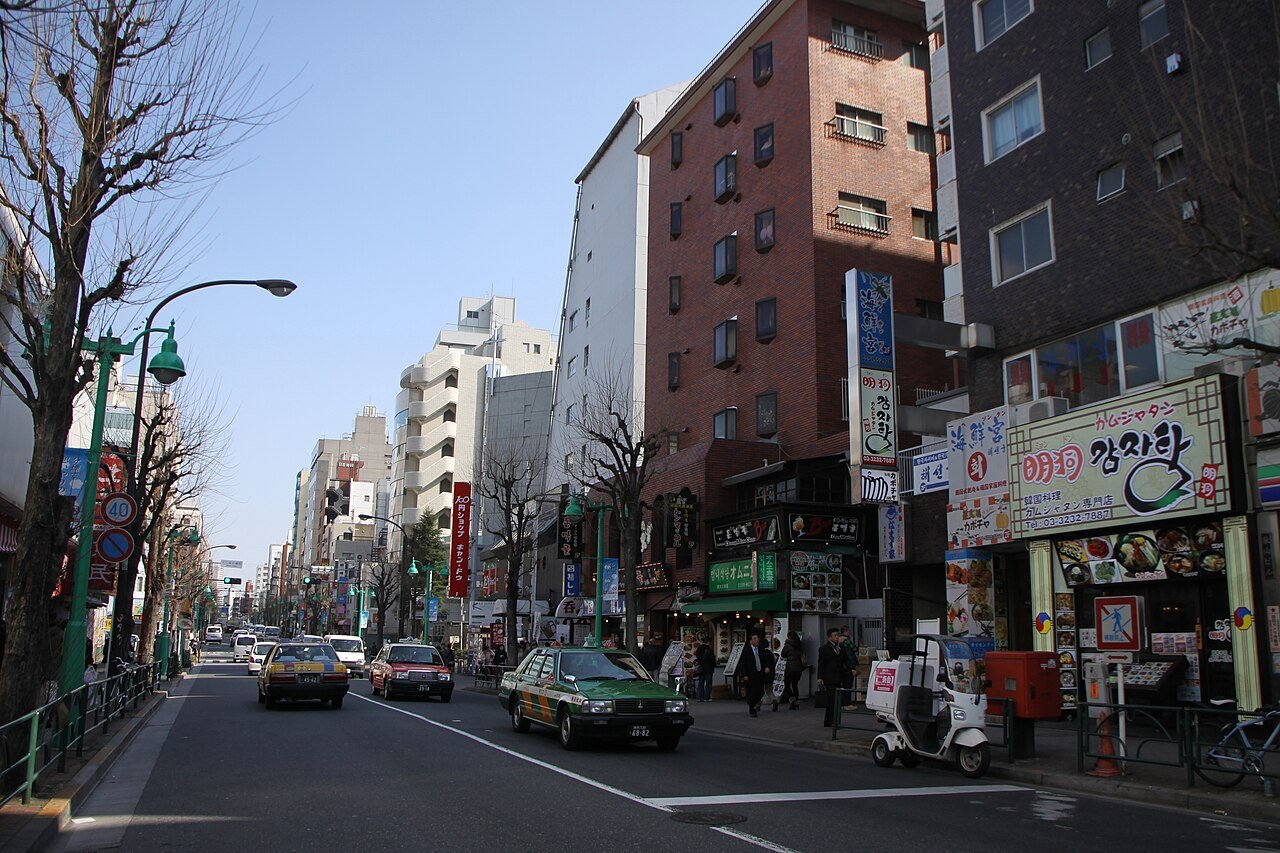
Featured photo: A street in Tokyo’s Ōkubo, Japan’s best-known Koreatown, lined with Korean shop signs. Photo: 多摩に暇人, via Wikimedia Commons, CC BY-SA 3.0.
These days, what Japanese teens and twenty-somethings say to a friend who’s just tripped up isn’t the Japanese “daijobu.” It’s the Korean “gwaenchana,” “it’s okay,” pronounced the Japanese way: “kenchana” (ケンチャナ). The New York Times introduced the trend on November 1 under the name “Hanbongo” (Korean-Japanese), and it means Korean words have entered the speech of young Japanese people and started bending like Japanese.
In this story
From “kenchana” to “shikiru”: a Hanbongo dictionary
Hanbongo is a way of talking that drops Korean words into Japanese sentences or reshapes them to fit Japanese grammar (The New York Times, as quoted by News1 and Asia Economy). Here’s what young people in Japan actually say:
- Kenchana (gwaenchana): “It’s okay,” “don’t worry about it.” The signature Hanbongo word.
- Chincha (jinjja): “Really?” “No way.” Used in place of the Japanese “maji?” when surprised.
- Mianhae: a light apology between friends.
- Onni (eonni) and hyon (hyeong): Japanese has no exact word for “a close older woman or man,” so the Korean terms came over as they are (The New York Times).
- Joa (joa): “I like it,” when something catches your eye.
- Maji gomawo: a hybrid of Japanese “maji” (really) and Korean “gomawo” (thanks) (Asia Economy).
- Shikiru: ordering delivery food, from the Korean verb “sikida” (to order) plus the Japanese verb ending “-ru” (Korea JoongAng Daily). Proof that Korean has started to conjugate inside Japanese.
- Ashatchu: Korean cafe shorthand for “iced tea with an added espresso shot.” This one became a product name outright (below).
Also read: Koreans Cried to Melon's No. 2 Song. Then They Learned AI Singer Meomuru Isn't Human
A Korean word in high schoolers’ top three
“Kenchana” isn’t a word a few friends use. In a spring 2025 survey of Japanese high school boys and girls on trending words, “kenchana” tied for third with 4.9 percent. First place went to “○○ kaiwai” (the ○○ crowd) and “honma ni” (really). The survey pointed to K-pop idols dancing to TikTok sounds as the spark (FUN! JAPAN, May 9, 2025). A 21-year-old university student in Tokyo told The New York Times, “I don’t know anything about Korea, but because it’s trending on social media, I say ‘gwaenchana’ pretty often” (as quoted by Kyunghyang Shinmun).
Companies bought the word first. In May 2026, Suntory launched “Bishoku Kancha,” a tea drink sold only at 7-Eleven, with an ad titled “Kenchana! Baby.” In it, BABYMONSTER’s Japanese member Asa shouts “Kenchana!” with a simple message: even when things don’t go your way, pick yourself up with that one word. The 15-second spot passed 1.91 million plays on Suntory’s official YouTube channel (checked November 3, 2026).
The same month, Coca-Cola’s coffee brand Georgia launched “Ashatchu” (アシャッチュ) at 7-Eleven (Nihon Shokuryo Shimbun, May 26, 2026). It’s peach iced tea with espresso, and the brand calls it “a cafe menu item popular in Korea” (Korea JoongAng Daily). Shorthand Korean twenty-somethings used at the cafe counter is now a product name in Japanese convenience store fridges.
What gets lost in translation
Japanese has its own word for “it’s okay.” So why say it in Korean?
Because one Korean word is a badge of taste. Professor Choi Eun-kyung of Kansai University said “using Korean itself is a way of showing you like K-pop or Korean culture,” and that it “has become something anyone uses easily, even without Korean heritage” (The New York Times, as quoted by News1). Say “daijobu” and it’s just comfort. Say “kenchana” and the comfort carries a second message: “I listen to the same songs.” Translate it and that second meaning disappears.
The starting point is clear too. Professor Hiroko Sasa of Cyber Hankuk University of Foreign Studies says the habit of using Korean untranslated grew noticeably around 2018, when BTS released “LOVE YOURSELF 轉 ‘Tear'” and BLACKPINK played Tokyo and Osaka. During COVID-19, more teens watched K-pop videos at home and terms like “hyeong” and “eonni” spread, helped by the two languages’ similar sound systems that make imitation easy (The New York Times, as quoted by Electronic Times). Korean entered not as “foreign language study” but as “the way fans talk to each other.”
In Korea, “gwaenchana” does everything
One thing to add for readers abroad: for Koreans, “gwaenchana” is far broader than comfort. To a friend who fell, it’s “Gwaenchana?” (Are you hurt?). When someone offers more food, it’s “Gwaenchanayo” (No thanks, I’m fine). To a junior who made a mistake, it’s “Gwaenchana, gwaenchana” (Don’t worry about it). That’s why the word shows up in almost every episode of a Korean drama. It’s no accident that the word Japanese teens picked is this all-purpose one. With one word, you can worry, decline and comfort.
If you want to try it, here’s how: – When a friend bombs a test: “Gwaenchana, you’ll do better next time.” – When you hear amazing news: “Jinjja? Daebak.” (Really? Awesome.) – When you get a gift you love: “Joa! Jinjja gomawo.” (I love it! Thank you so much.)
Korean that was once a secret code
The person The New York Times focused on most in this trend was a 64-year-old Zainichi Korean, an officer of the Korean Residents Union in Japan. He remembered that in high school, Zainichi Korean friends used Korean words like “tambae” (cigarette) and “bakchigi” (headbutt) only among themselves, “as a kind of secret slang” (The New York Times, as quoted by Electronic Times). About 100 years ago, Japan shut down Korean-language newspapers in Korea, and in 1942 it arrested scholars of the Korean Language Society who studied Hangeul.
The Korean that Zainichi high schoolers half a century ago whispered for fear of being caught, Japanese high schoolers now shout out loud over TikTok sounds. Kenchana.
Read next
Trending on Seol Notes
- Ae-sun Left the Baeksang Empty-Handed. Then She Spoke: IU
- 85,000 Fans in São Paulo Sang 'Arirang,' and BTS Put Down Their Microphones
- K-pop News Today (Nov 4, 2026): RESCENE's 'With' Hits No. 1 on Melon, TWS Sell 630,000 on Day One, AND2BLE's Career-High Week
- AI Will Reverse Human Aging, Even If Musk Says We Need Death: Reverse Aging
- Teachers Get Reported for It. Korean Folk Village Ghosts Get Cheered.
Sources
- The New York Times, “New Slang in Japan Has an Unlikely Source: Korea” (November 1, 2026), as quoted by News1, November 2, Kyunghyang Shinmun, November 2, Electronic Times, November 2, Asia Economy, November 2, Kukmin Ilbo, November 2
- Korea JoongAng Daily, October 9, 2026: “Kenchana takes hold”
- FUN! JAPAN, May 9, 2025: spring 2025 high school trend survey
- Suntory official YouTube: “Kenchana! Baby” (views checked November 3, 2026)
- Nihon Shokuryo Shimbun: Georgia “Ashatchu (Peach),” released May 26, 2026
Discover more from Seol Notes
Subscribe to get the latest posts sent to your email.