Part 4 of 27 in Homo Conspirans: The Humans Who Come After Us
Homo Conspirans · Musk’s dream: “robots for everyone” → a humanity that chooses its body
In a world where AI robot bodies are as common and cheap as refrigerators, the people who choose to age and die in the body they were born with become a minority. They form communities to protect their bodies, pass down their own language and customs, and demand protected land. Humanity becomes, for the first time, a species that chooses what kind of body to live in.
In 1977 the Japanese manga artist Leiji Matsumoto began the story of Tetsuro Hoshino, a poor boy in a world where the rich buy machine bodies and live forever while the poor grow old, fall sick and die. After losing his mother to a machine man, Tetsuro boards Galaxy Express 999, bound for a planet said to hand out machine bodies for free. The story became a TV anime and a 1979 feature film and stayed with a whole generation across Japan and Korea. At the end of the long journey, Tetsuro turns the machine body down. He has learned that a day is precious only in a body that ends.[1]
Matsumoto died in February 2023 at 85. The machine body he drew has been turning, in the meantime, from fantasy into a product with a price tag.
In this story
The price tag on a machine body
At Saudi Arabia’s Future Investment Initiative in October 2024, Musk said that by 2040 there will be more than 10 billion humanoid robots, more than there are people, and that a robot able to do anything will cost $20,000 to $25,000. Earlier that month, at a Tesla event, he had put Optimus’s long-term price at $20,000 to $30,000.[2] The price of a car becomes the price of a human-shaped body.
Swapping parts of the body for machines has already begun. In November 2024, at a hospital in Sydney, Australia, a man in his 40s received the BiVACOR, a total artificial heart made of titanium. In February 2025 he became the first person in the world to leave the hospital with one, living at home for more than 100 days until he received a donor heart.[3] The heart is the organ people once believed housed the soul. With a spinning metal rotor in its place, one that has no beat at all, the man was still the man.
Also read: Anna: The Role That Made Korea Stop Talking About Suzy's Face
A second body outside the body
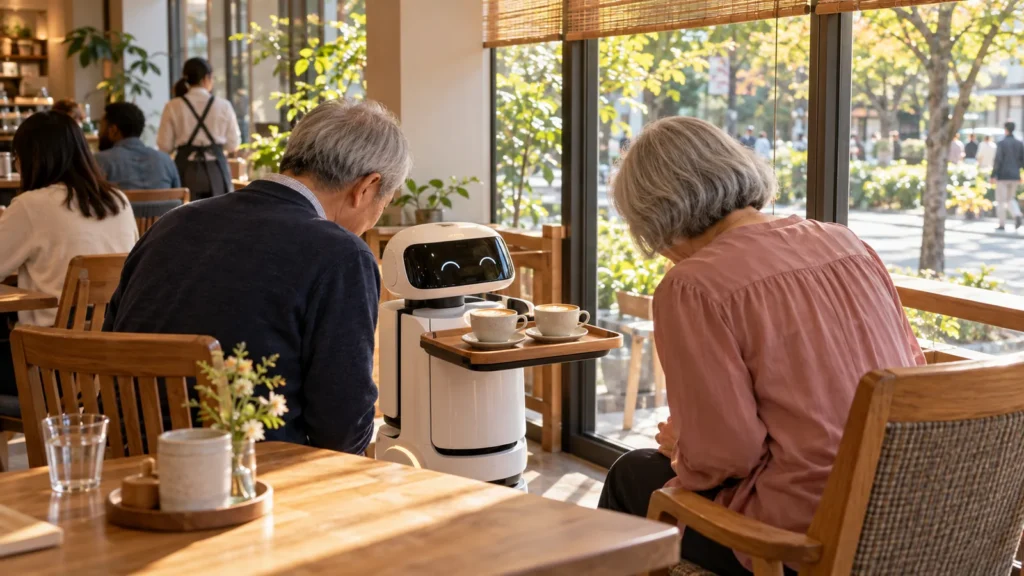
Before people trade in the whole body, they borrow a second one. In Nihonbashi, Tokyo, a café called DAWN opened in June 2021. Coffee is carried to the tables by OriHime, white robots 120 centimeters tall. The people running the robots are not in the café. They are patients with diseases that freeze the muscles and caregivers who cannot leave home, steering from their beds with the movement of their eyes or a single finger. The body is in bed. The working body is in the café.[4]
Today the link is a screen and an eye tracker. Brain chips change that channel. A person with a chip already moves a robotic arm by thought alone. And the moment an Optimus costs as much as a car, the most rational choice for someone old and sick stops being repairing the worn-out body and becomes owning one more. First a body for commuting, then a body for travel, and in the end a body that keeps going after the original one stops. When an AI copy of a mind moves into that body and claims to be the person, the courts get involved.
The Pale Blue Dot and a body that ends
On February 14, 1990, Voyager 1, on its way out of the solar system, turned around and photographed the Earth from about 6 billion kilometers away. In the picture the Earth is a dot of 0.12 pixels floating in a sunbeam. In his 1994 book Pale Blue Dot, the astronomer Carl Sagan pointed at it and wrote: “That’s here. That’s home. That’s us.”[5]
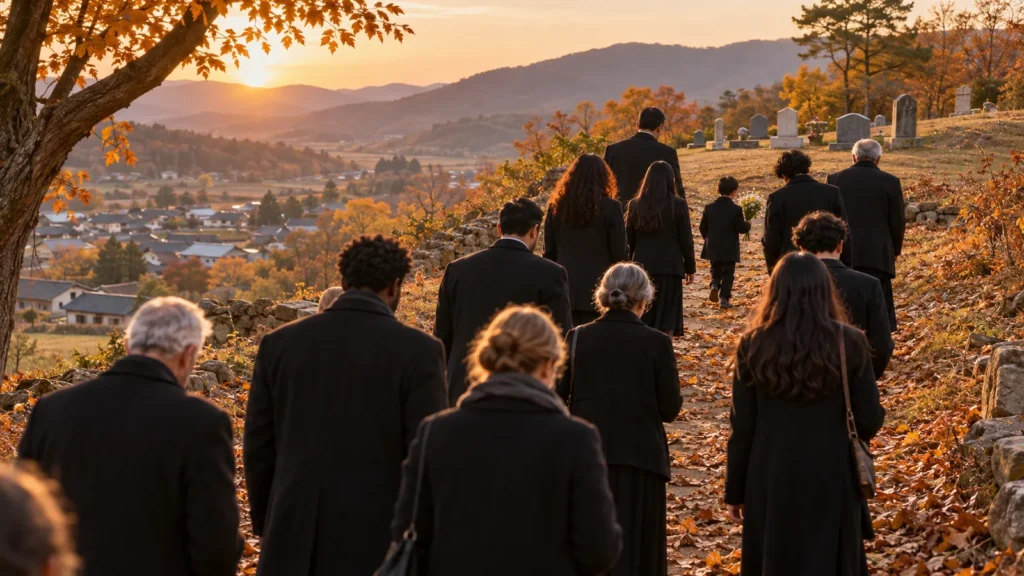
What Sagan saw was a boundary. Outside that tiny dot, nobody is coming to save us, and that is why the time inside it is precious. It is the same reason Tetsuro turned down the machine body. If an ending is what makes life precious, then in a world of people who have erased their endings, the people who keep theirs will build a culture of their own. A culture of growing old in the body you were born with, holding death as a family rite, and having and raising children. As the Amish today do not drive cars, they will not change bodies.
February 13, 2079: a refusal at 91
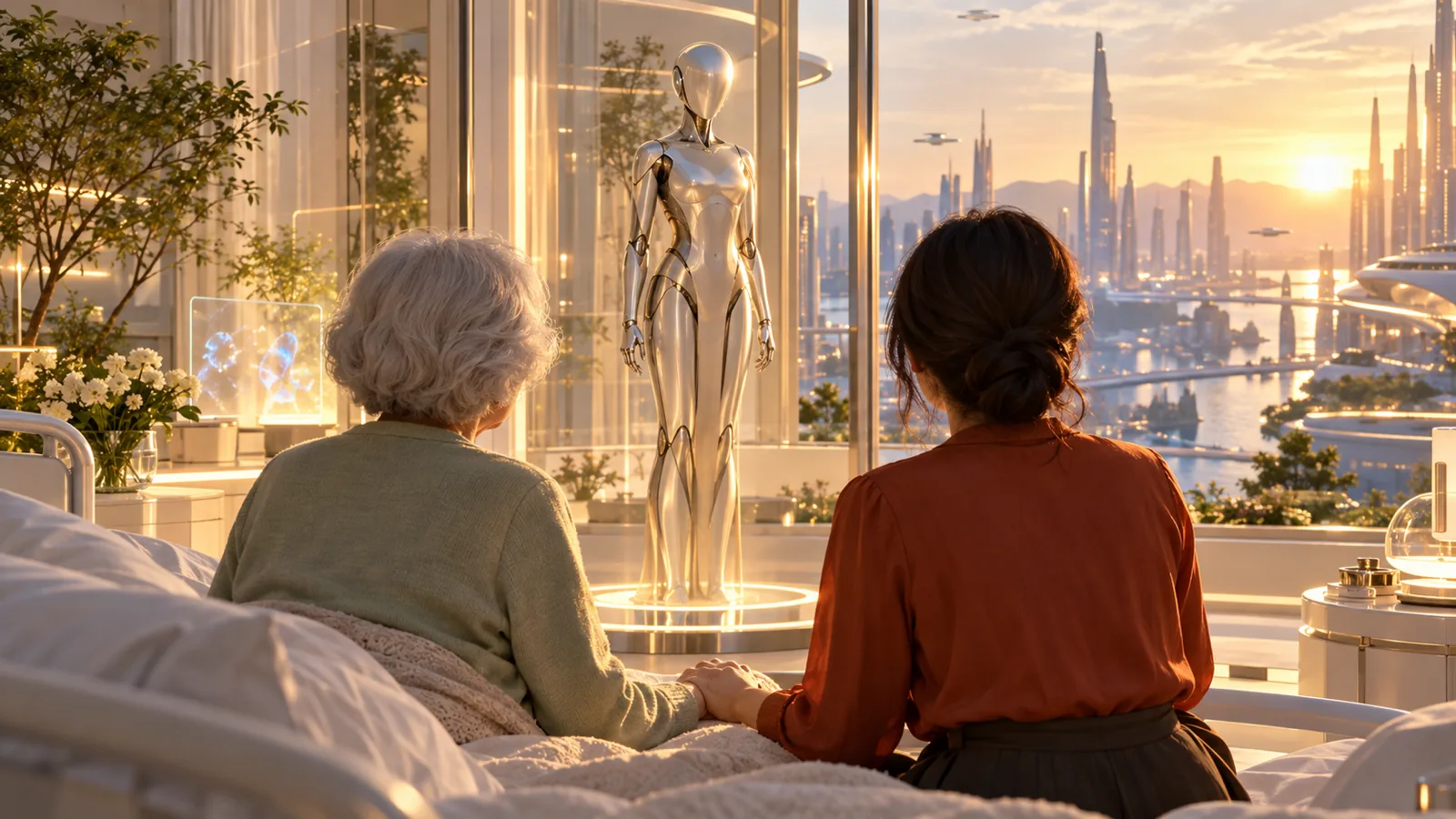
Fifty-six years to the day after Leiji Matsumoto died, in a nursing hospital in Busan, South Korea, a grandson sits beside the bed of 91-year-old Kim Jeong-sun. More precisely, his robot body does. His biological body is at home in Seoul. For five years he has used this body to go to work and to travel.
He has brought a consultation file: an AI copy trained on his grandmother’s memories and turns of phrase, and a quote for the robot body the copy would use. National insurance will cover 80 percent of the cost. She does not look at the papers. She takes the robot’s hand, which has been warmed to body temperature. “I’ll go in this body. I sent your grandfather off in the body he was born with, too.” That year the “natural body community” in her neighborhood counts 1,200 residents. The next month it applies to city hall to expand the village cemetery.
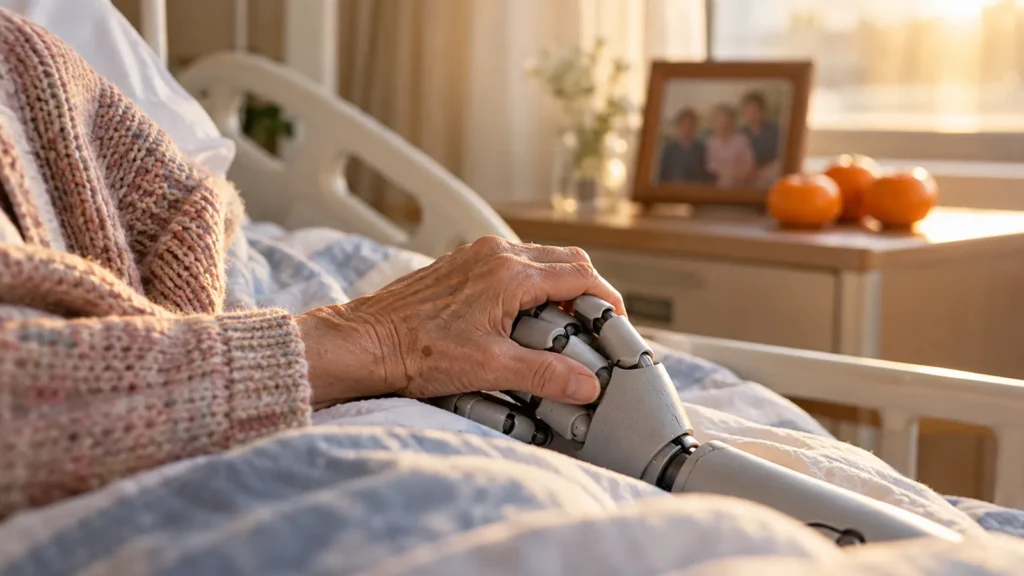
10 billion robots by 2040, 20 percent natural bodies by 2090
This is the order in which the mortal body becomes a minority.
- 2028: Humanoid robots go on sale for homes. The first customers are households caring for elderly parents.
- 2035: More than a million people with disabilities and older adults worldwide go to work through avatar robots. “Remote body labor” enters labor law for the first time.
- 2040: Humanoid robots outnumber humans. One costs about as much as a used car.
- 2050: More than 10 million people own a “second body,” a robot they steer through a brain chip.
- 2065: In rich countries, more than 5 percent of the people who die go on living as an AI copy in a robot body after their biological body stops.
- 2079: “Natural body communities,” pledged never to change bodies, form an international federation and demand that their cemeteries and birthing centers be recognized as protected areas.
- 2090: People who live their whole lives in the body they were born with fall to 20 percent of the population in rich countries. The United Nations takes up, for the first time, whether its declaration on the rights of minorities applies to them.
Tetsuro stepped off the 999 and refused the machine body. In 2090, one person in five makes the same choice. Their children introduce themselves at school this way: I come from a family that lives in its first bodies.
Next in the series · AI Will Reverse Human Aging, Even If Musk Says We Need Death: Reverse Aging
Musk said death was necessary, then four years later called aging a very solvable problem. With AI now designing proteins that turn cells young again, humanity is on its way to becoming a 150-year species.
Homo Conspirans: The Humans Who Come After Us · Part 4 of 27
Part 5 arrives Oct. 31.
Read next
 AI Will Wire 8 Billion Brains Into One Superorganism, Like an Ant Colony: The Global Brain
 Homo Sapiens Will End in Musk's AI Age, and Homo Conspirans Will Begin: The Next Stage of Human Evolution
 K-pop News Today (Oct 31, 2026): BTS's 'Arirang' Night in Brazil, JISOO's 'ADDICTED' Tops iTunes, NMIXX Win Music Bank
Trending on Seol Notes
- Kim You-jung Cracked Japan Despite the 'Anti-Japan Drama' Label
- The Emperor of K-pop Came Back, and Korea Flipped
- K-pop News Today (Oct 27, 2026): IVE's EP Drop, ILLIT 'You're Under Arrest', LISA's 59M
- His First Film Never Opened. His First Role Had No Name. Then Korea Called Him "Sam-sik"
- The No. 1 Korea Doesn't Want to Believe: Why Fans Doubt A2O
Sources
- Leiji Matsumoto, Galaxy Express 999, manga serialized 1977–1981; animated film directed by Rintaro, Toei Animation, 1979.
- Quartz, “Elon Musk says Tesla’s Optimus robots will outnumber humans by 2040,” October 2024 (Future Investment Initiative, Riyadh; Optimus long-term price of $20,000–30,000 at “We, Robot,” October 10, 2024). https://qz.com/elon-musk-tesla-optimus-robots-outnumber-humans-1851683997
- Scientific American, “Man Survives with Titanium Heart for 100 Days—A World First,” March 2025. https://www.scientificamerican.com/article/man-survives-with-titanium-heart-for-100-days-a-world-first
- Tokyo Metropolitan Government, Tokyo Updates, “An Experimental Café in Nihombashi where Avatar Robots Facilitate Human Connections.” https://www.tokyoupdates.metro.tokyo.lg.jp/en/post-785
- Carl Sagan, Pale Blue Dot: A Vision of the Human Future in Space, Random House, 1994; NASA, “Voyager 1’s Pale Blue Dot,” image taken February 14, 1990. https://science.nasa.gov/resource/voyager-1s-pale-blue-dot/
Discover more from Seol Notes
Subscribe to get the latest posts sent to your email.