

Part 3 of 27 in Homo Conspirans: The Humans Who Come After Us
Homo Conspirans · Musk’s dream: “a city of a million on Mars” → bodies that cannot bear the Earth
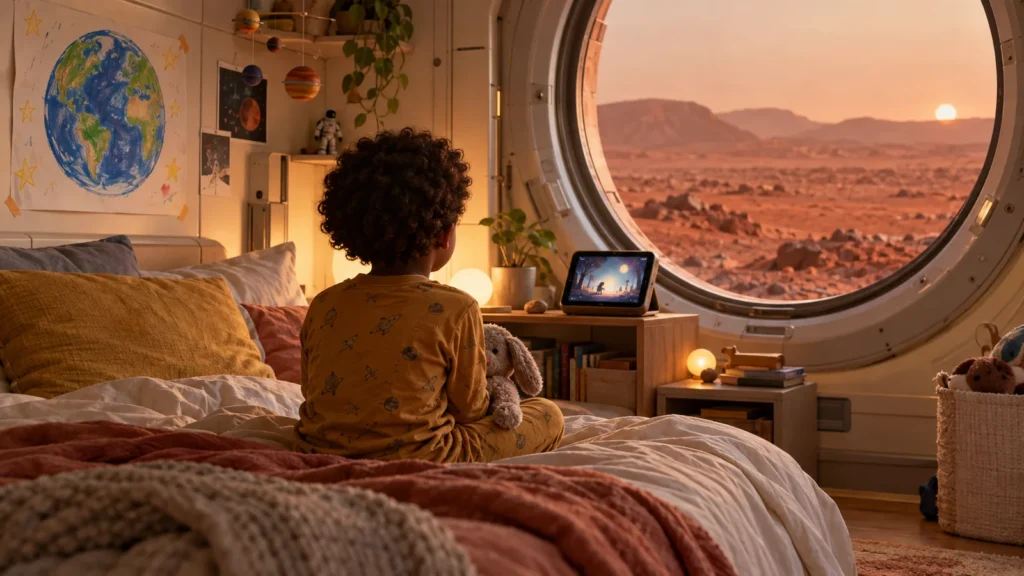
The first children born on Musk’s Mars and raised by AI will never come back to Earth. Gravity nearly three times what they grew up in is a weight their bones and hearts cannot carry. For the first time, humanity will have descendants who can never visit home.
The last chapter of Ray Bradbury’s The Martian Chronicles has a date for a title: October 2026. A family that has fled an Earth collapsing in nuclear war lands on Mars and heads out on the canals for what the father calls a fishing trip. He burns a map of Earth and promises the children he will show them real Martians. Then he points at the still water of the canal. What looks back is the family’s own faces.[1]
The month this 1950 book chose as the birthday of the Martians is the month we are living in now. Bradbury’s Martians had no wings and no powers. They were just people with nowhere left to go back to.
In this story
What one year in space did to a body
Starting in March 2015, the American astronaut Scott Kelly lived aboard the International Space Station for 340 days. His identical twin, Mark Kelly, stayed on Earth. NASA’s Twins Study, which compared two bodies with the same genes, was published in Science in April 2019. In space, Scott’s telomeres, the caps at the ends of his chromosomes, actually got longer, then shortened quickly after he came home. The expression of thousands of genes changed, and some of those changes had still not reverted six months after his return. The structures at the back of his eyes changed too.[2]
It was not just Kelly. Eighty-one percent of NASA astronauts who flew long missions showed at least one sign of spaceflight-associated neuro-ocular syndrome, a flattening of the eyeball or swelling of the optic nerve. In some, it had not healed years after they got home.[3] In weightlessness, the bones of the legs and hips lose 1 to 1.5 percent of their mass every month.[4] Mars has 38 percent of Earth’s gravity. That is not zero, but by the standards of a body grown on Earth, it falls far short. Radiation on the surface of Mars is several times what we get on Earth, and it is already measured.
Also read: Teachers Get Reported for It. Korean Folk Village Ghosts Get Cheered.
Adult bodies endure; children’s bodies adapt
There is one crucial difference. Kelly went to space in an adult body that finished growing on Earth, and then he came back. A child born on Mars builds bones, grows a heart and forms eyes for 38 percent gravity from day one. The body builds only what it uses. Bones and a heart that have never once lifted Earth’s weight do not grow strong enough to lift it.
What guards those children’s days is not a human doctor but AI. A signal between Mars and Earth takes up to 44 minutes for the round trip, and bringing a doctor takes half a year. The base AI measures the children’s growth curves, bone density and blood pressure every day, prescribes exercise and medicine, and reads them stories at night. And one of the first judgments this AI will make is this: this child must not be sent to Earth.
Twenty people decide an island’s genes
It is not only bodies. Genes split too. On Pingelap, a tiny atoll in Micronesia, only about 20 people survived a typhoon around 1775. One of them carried a gene for complete color blindness. Elsewhere this kind of color blindness strikes about one person in tens of thousands. On Pingelap today it affects close to one in ten.[5] When a small number of people carry on the line in a new land, their genes become that land’s destiny. Biologists call it the founder effect.
In his 2016 book Future Humans, the evolutionary biologist Scott Solomon wrote that if Mars settlers rarely travel back and forth to Earth, the founder effect and a different environment together make Mars the most likely stage for humanity to split into a new species.[6] In his 2022 TED interview, Musk said the number of people who both want to go to Mars and are able to go needs to reach “a million or so.”[7] A million is far more than Pingelap’s 20. But that million will be the slice of Earth’s 8 billion who enjoy risk and are ready never to come back. From the very start, Mars is an island of the self-selected.

October 2066: the centrifuge at eighteen
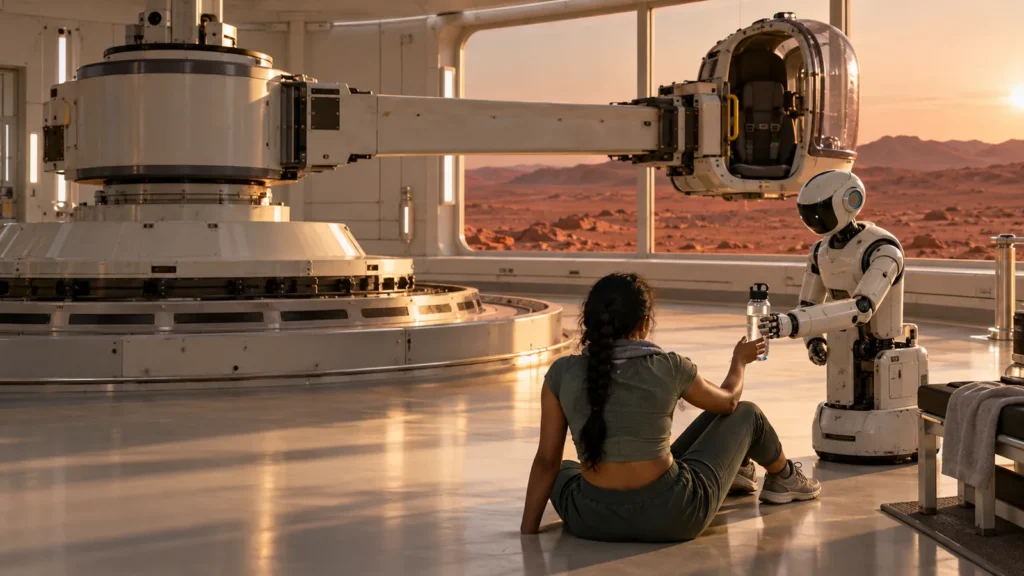
October 2066, the medical wing of the largest city on Mars. Ara, 18, born on Mars, is in her third month of training inside a centrifuge 20 meters across. She has been accepted to a university on Earth and plans to meet her grandmother, who lives on Earth, for the first time. When the centrifuge spins, her body grows as heavy as it would be on Earth.
When today’s session ends, the base AI puts up the results. At 0.8 g her heart rate passed 160 beats a minute. At 1 g her vision narrowed after four minutes. Her leg bone density is 68 percent of the average for an Earth teenager her age. The AI sends the results to the university and to her grandmother at the same time. Her admission switches to remote study, and her first meeting with her grandmother becomes a video call that has to bear a 22-minute delay between Mars and Earth. Instead of a canal, Ara looks at her own face reflected in the base’s water tank.
First birth in 2048, first measurable split in the 2090s
This is the order in which Martians appear.
- 2034: The first people set foot on Mars. All of them are adults who grew up on Earth.
- 2048: The first baby is born on Mars. The base AI handles the birth and newborn care, taking delayed advice from doctors on Earth.
- 2060: In a Martian city of more than 10,000, the number of children born there passes 300. They are taller than Earth children of the same age, with lower bone density.
- 2066: The first generation born on Mars comes of age. The base AI enters its first official medical finding of “unfit for Earth travel.”
- 2075: Universities on Earth and Mars create remote degree programs just for the Mars-born. Instead of touring Earth, they take “virtual visits.”
- 2090s: The gene frequencies of third-generation Martians are measured, for the first time, as statistically different from Earth’s population.
The scene Bradbury set in October 2026 does not stay in a novel. Forty years later, the children of Mars will look at their own faces in the water and say exactly what his father said: there are the Martians.
Next in the series · When AI Robot Bodies Become Free, People Who Keep Mortal Bodies Will Become a Minority: Galaxy Express 999
In Galaxy Express 999, Tetsuro boards the train to win a free machine body and ends up choosing a body that dies. In a world where robot bodies cost around $20,000, the people who make his choice become a minority.
Homo Conspirans: The Humans Who Come After Us · Part 3 of 27
← Part 2: AI Will Wire 8 Billion Brains Into One Superorganism, Like an Ant Colony: The Global Brain
Read next



Trending on Seol Notes
- Kim You-jung Cracked Japan Despite the 'Anti-Japan Drama' Label
- The Emperor of K-pop Came Back, and Korea Flipped
- K-pop News Today (Oct 27, 2026): IVE's EP Drop, ILLIT 'You're Under Arrest', LISA's 59M
- His First Film Never Opened. His First Role Had No Name. Then Korea Called Him "Sam-sik"
- The No. 1 Korea Doesn't Want to Believe: Why Fans Doubt A2O
Sources
- Ray Bradbury, The Martian Chronicles, Doubleday, 1950, “October 2026: The Million-Year Picnic” (first published in Planet Stories, 1946).
- Francine E. Garrett-Bakelman et al., “The NASA Twins Study: A multidimensional analysis of a year-long human spaceflight,” Science 364(6436), eaau8650, April 12, 2019. https://doi.org/10.1126/science.aau8650
- The Ophthalmologist, “Standardizing SANS in Spaceflight,” August 2026 (consensus paper: at least one SANS feature in 81% of NASA astronauts after long-duration flight). https://theophthalmologist.com/issues/2026/articles/august/standardizing-sans-in-spaceflight/
- NASA, “The Human Body in Space,” February 2, 2021 (astronauts lose 1% to 1.5% of bone mass per month in weight-bearing bones). https://www.nasa.gov/humans-in-space/the-human-body-in-space/
- Olof H. Sundin et al., “Genetic basis of total colourblindness among the Pingelapese islanders,” Nature Genetics 25(3), 289–293, 2000. https://doi.org/10.1038/77162 ; Oliver Sacks, The Island of the Colorblind, Knopf, 1996.
- Scott Solomon, Future Humans: Inside the Science of Our Continuing Evolution, Yale University Press, 2016.
- TED, “Elon Musk: A future worth getting excited about,” interview with Chris Anderson, recorded April 6, 2022, transcript. https://www.ted.com/talks/elon_musk_a_future_worth_getting_excited_about/transcript
Discover more from Seol Notes
Subscribe to get the latest posts sent to your email.