
Part 27 of 27 in Homo Conspirans: The Humans Who Come After Us
Homo Conspirans · Musk’s dream: “a future where no job is needed” → a humanity that introduces itself by something other than work
When AI takes all the jobs, children will stop introducing themselves by their jobs. The question “What do you want to be when you grow up” disappears, and so do adults’ business cards. People whose work was their name for hundreds of years learn, for the first time, to say who they are through something other than work.
In the 2010 U.S. Census, the most common surname was Smith, shared by 2,442,977 people.[1] A smith is someone who works metal, a blacksmith.[2] Taylor was a tailor, Miller ran a mill, Baker baked bread. When surnames began passing down in England 600 to 700 years ago, people were called by the work they did, and the work became the name that survives today. Korea goes further. Koreans still address each other as Department Head Kim, Driver Park or simply “Boss.” The job is the form of address.
In this story
The point where no job is needed
November 2023, Lancaster House in London, after Britain’s first AI Safety Summit. Sitting across from Prime Minister Rishi Sunak before about 300 business leaders, Musk said, “There will come a point where no job is needed. You can have a job if you want to have a job for sort of personal satisfaction, but the AI will be able to do everything.” He added that he did not know whether that made people comfortable or uncomfortable. Sunak pushed back right away, saying that work gives people meaning.[3]
Two years later Musk got more specific. At the U.S.-Saudi Investment Forum in Washington on November 19, 2025, he predicted that within 10 or 20 years, work would be optional.[4] And AI will take women’s jobs first.
Also read: When AI Makes Things Free, People Will Compare Themselves Even More Fiercely: The Status Game
The real problem of the grandchildren
The first person to take this question seriously was the British economist John Maynard Keynes. In 1930, as the Great Depression began, Keynes wrote in “Economic Possibilities for our Grandchildren” that in a hundred years people would work three hours a day, 15 hours a week. Then, he said, “for the first time since his creation man will be faced with his real, his permanent problem,” how to use his freedom from pressing economic cares.[5] The hundred years Keynes spoke of end in 2030.
Twenty-eight years later, the German-born philosopher Hannah Arendt painted a darker picture in the prologue to The Human Condition. Just as automation was about to free people from labor, she wrote, society had become a society of laborers who knew no other activity. She called it “a society of laborers without labor” and wrote that nothing could be worse.[6]

Losing a job costs more than money
Arendt’s fear has numbers behind it. In 1998 the German economists Liliana Winkelmann and Rainer Winkelmann analyzed data that tracked working-age men in West Germany from 1984 to 1990. Life satisfaction fell sharply among those who lost their jobs, and the drop was far larger than lost income could explain.[7] Unemployment took something bigger than money: a place to go in the morning, a title others call you by, a way to say in one sentence who you are.
So for Musk’s dream to come true, people have to change first. They have to find other words to describe themselves instead of a job, to introduce themselves by what they care for, what they are learning, and what they make and with whom. That change starts not with adults who lost their jobs but with children who grew up never expecting one.
March 2062: the first self-introduction
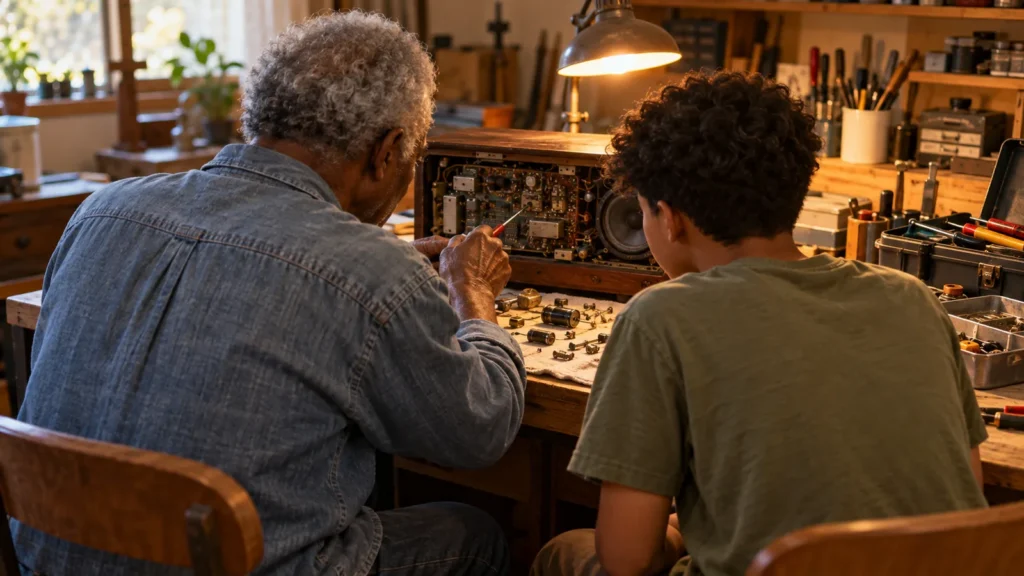
March 2062, a first-grade classroom at an elementary school in Sejong, South Korea. On the second day of school, the teacher asks the children to introduce themselves one by one. The first child stands up: “I’m Ha-yoon, and every morning I go to the Geum River with my grandma to count birds.” The next says he is Do-yoon, who knows how to change his little brother’s diaper, and the one after that is Seo-a, who has finished a dinosaur skeleton puzzle of 3,000 pieces. Not one child mentions what their mom or dad does for work.
None of the parents standing at the back of the classroom has a business card either. The teacher, who grew up in the 2030s, remembers her own introduction in first grade: “My dad works at a company, and my mom is a nurse.” Back then, that was a self-introduction.

Keynes’s year in 2030, no more “dream job” box by 2060
This is the order in which a species whose jobs were its names becomes one that introduces itself in other ways.
- 2030: The year of Keynes’s grandchildren. AI handles more than half of office work, and South Korea’s largest companies make the four-day week standard.
- 2035: Social networks built around job histories peak in users and start to shrink.
- 2040: In the U.S., adults with income they do not work for outnumber those who earn their income by working, for the first time.
- 2045: Statistics Korea replaces the unemployment rate with a “participation rate,” a new national indicator that measures time spent on caregiving, learning, creating and volunteering.
- 2060: The “dream job” box disappears from South Korean school records.
Seven hundred years ago an English blacksmith earned his name by hammering iron, and that name still belongs to more than 2.4 million Americans. Children of the AI age will decide, for the first time, for themselves what they hammer to earn their names. Those children are Homo conspirans.
Next · Before Homo conspirans, there was a contract. The prequel series Homo Contractus opens with Part 1: Kids Will Get Musk’s AI Shares, and Envious Adults Will Sign: The SpaceX Share Giveaway
In October 2026 Musk said every American child would get SpaceX shares next year. The children got the stock. The parents got the envy, and then the contract.
Homo Conspirans: The Humans Who Come After Us · Part 27 of 27
That’s the end of the series.
← Part 26: Behind Your AI Assistant Will Be a Worker Paid $2 an Hour: AI Data Labelers
Read next
Trending on Seol Notes
- Yim Si-wan's Strange Voice in Love in Disguise Was Armor All Along
- Seol In-ah Won Boxing Gold in Four Months, Then Became the Cross-Dressing Cop of Love in Disguise
- BTS and ENHYPEN Just Took the First Two Grand Prizes of MAMA 2026, and Sunghoon Couldn't Stop Crying
- The First Korean Actress Ever Nominated for an International Emmy Failed 100 Auditions First
- The Emperor of K-pop Came Back, and Korea Flipped
Sources
- U.S. Census Bureau, “Frequently Occurring Surnames from the 2010 Census.” https://www.census.gov/topics/population/genealogy/data/2010_surnames.html
- Patrick Hanks (ed.), Dictionary of American Family Names, Oxford University Press, 2003, “Smith.”
- Holyrood, report on Musk’s conversation with Rishi Sunak at Lancaster House after the AI Safety Summit, November 3, 2023. https://www.holyrood.com/news/view,elon-musk-tells-rishi-sunak-ai-will-reach-a-point-where-no-job-is-needed
- Reuters via SRN News, report on the U.S.-Saudi Investment Forum at the Kennedy Center, November 19, 2025. https://srnnews.com/us-saudi-tout-new-business-deals-at-investment-forum/
- John Maynard Keynes, “Economic Possibilities for our Grandchildren,” 1930 (Essays in Persuasion, 1931).
- Hannah Arendt, The Human Condition, University of Chicago Press, 1958, Prologue.
- Liliana Winkelmann & Rainer Winkelmann, “Why Are the Unemployed So Unhappy: Evidence from Panel Data,” Economica 65(257), 1–15, 1998. https://doi.org/10.1111/1468-0335.00111
Discover more from Seol Notes
Subscribe to get the latest posts sent to your email.