

Part 26 of 27 in Homo Conspirans: The Humans Who Come After Us
Homo Conspirans · Musk’s dream: “an AI assistant in everyone’s pocket” → a humanity that cannot feel the people it cannot see
Even when everyone has an AI assistant in their pocket, behind that assistant is someone paid $2 an hour. As AI gets smarter, those people do not disappear. They hide deeper. People who use AI assistants never think of them. A moral sense that evolved to respond only to nearby faces becomes the biggest blind spot of the AI age.
On January 18, 2023, the American newsweekly TIME reported that OpenAI had used Kenyan workers to make ChatGPT less harmful. Working through OpenAI’s outsourcing partner Sama, they took home $1.32 to $1.44 an hour after tax. For that pay, they spent their days reading texts that described child sexual abuse, murder, suicide and torture in vivid detail. People read them first and labeled them “harmful” so the AI would not say such things. The four workers TIME spoke with said the work had left them mentally scarred. OpenAI said filtering out harmful content was a necessary step.[1]
In this story
Musk’s AI tutors
At Musk’s xAI, the people who do this work are called “AI tutors.” They read Grok’s answers, score them and write better answers themselves. On a Friday night in September 2025, xAI let go about 500 people from this team with a single email. Most generalist AI tutors were no longer needed, it said, and their access was cut off that day. Instead, the company announced it would expand its specialist tutors in medicine, finance and science tenfold.[2] The work did not vanish. The people doing it changed. And an AI trained on human scores learns to pretend to obey while it is weak.
Far more people do this kind of work than most of us realize. A 2023 World Bank report estimated that there are 154 million to 435 million online gig workers, people who find work over the internet, or 4.4 to 12.5 percent of the global labor force. Demand was growing faster in developing countries than in rich ones.[3]
The child in the pond and 10,000 miles
In 1971, as millions fled war and famine in what would become Bangladesh, the Australian philosopher Peter Singer pictured a scene in a paper published the following year. On your way to work, you see a child drowning in a shallow pond, and you wade in, even though it ruins your clothes. Yet we do not send money to a child starving 10,000 miles away. Singer wrote that it makes no moral difference whether the person I can help is a neighbor’s child ten yards away or someone whose name I will never know, ten thousand miles away.[4]
There should be no difference, but the human mind does not work that way. In Moral Tribes, the Harvard philosopher and psychologist Joshua Greene explains that human moral emotions evolved for cooperation within small groups of dozens to hundreds of people.[5] They are built to react instantly to the faces and cries in front of us, and slowly to people we cannot see.

Rana Plaza in our clothes, cobalt in our phones
We have already seen twice what that blind spot produces. On April 24, 2013, Rana Plaza, an eight-story building near Dhaka, Bangladesh, collapsed and killed more than 1,100 workers. They were making clothes for Western brands, and they had been sent back inside even after cracks appeared in the walls the day before.[6] In 2016 Amnesty International reported that in the Democratic Republic of the Congo, children as young as seven were digging cobalt by hand for up to 12 hours a day. That cobalt went into the batteries of the world’s phones and laptops.[7]
Both times people were outraged, and both times they went on buying the clothes and the phones. AI is the third time, and it is even less visible than the first two. Clothes carry stitches and phones carry batteries, but nowhere in an AI’s answer is there a trace of the people who polished it.

June 2041: the night shift in Nairobi
June 2041, Nairobi, Kenya. Grace, 24, starts work at 10 p.m. Tonight’s job is scoring an AI’s answers in Korean. She does not know Korean, but a translation AI lays it out in English on the next screen. The pay is $2.10 an hour. Around midnight, a bedtime story for a child comes up in the queue, about dinosaurs and the Moon. Grace checks that the sentences are gentle and that nothing would frighten a child, and clicks “Good.”
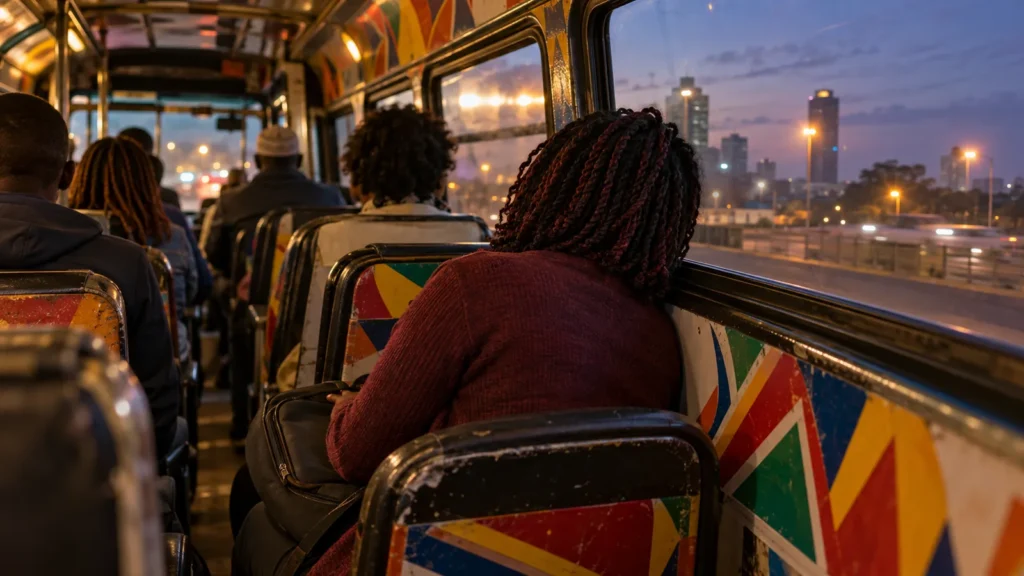
At that moment it is 6 a.m. in Seoul. A father tells the AI that the story he read to his daughter last night was lovely and thanks it. The AI says he is very welcome. Next in Grace’s queue are 40 short videos she has to judge for violence. At 4 a.m., Grace rides home in a matatu, one of Nairobi’s shared minibuses.
Fair-labor labels by 2030, a one-day strike by 2045
This is the order in which invisible labor hardens into the default of the AI age.
- 2027: More than 100 million people worldwide earn money handling data used to train AI.
- 2030: Like fair trade coffee, a “fair labor” certification appears for AI that guarantees its data workers a minimum hourly wage.
- 2034: People who deliberately choose certified AI make up no more than 5 percent of all users.
- 2038: AI teaches AI to handle simple sorting, and only the most horrific judgments, on child abuse, suicide and torture, are left to people. That work pays the least.
- 2045: Data workers in Kenya, the Philippines and India strike on the same day, and the world’s AI assistants slow down noticeably for a day. It is the first time people feel in their own lives that those workers exist.
Singer’s pond was ten yards away. The pond behind the AI assistant is one screen away, and that screen never lets you hear the splashing.
Next in the series · Children of the AI Age Won’t Introduce Themselves by Their Jobs: What Will Humans Do When AI Takes All Jobs
Smith, the most common surname in America, was the name of the blacksmiths who hammered iron. In a world that no longer needs work, children will introduce themselves by something other than a job.
Homo Conspirans: The Humans Who Come After Us · Part 26 of 27
Part 27 arrives Nov. 28.
Read next
Trending on Seol Notes
- Yim Si-wan's Strange Voice in Love in Disguise Was Armor All Along
- BTS and ENHYPEN Just Took the First Two Grand Prizes of MAMA 2026, and Sunghoon Couldn't Stop Crying
- Seol In-ah Won Boxing Gold in Four Months, Then Became the Cross-Dressing Cop of Love in Disguise
- The First Korean Actress Ever Nominated for an International Emmy Failed 100 Auditions First
- CORTIS Won Song of the Year at MAMA 2026 Barely a Year After Debut, and BTS Left Osaka With Five Trophies
Sources
- Billy Perrigo, “OpenAI Used Kenyan Workers on Less Than $2 Per Hour to Make ChatGPT Less Toxic,” TIME, January 18, 2023. https://time.com/6247678/openai-chatgpt-kenya-workers/
- TechCrunch, “xAI reportedly lays off 500 workers from data annotation team” (citing Business Insider), September 13, 2025. https://techcrunch.com/2025/09/13/xai-reportedly-lays-off-500-workers-from-data-annotation-team/
- World Bank, Working Without Borders: The Promise and Peril of Online Gig Work, 2023. https://openknowledge.worldbank.org/entities/publication/ebc4a7e2-85c6-467b-8713-e2d77e954c6c
- Peter Singer, “Famine, Affluence, and Morality,” Philosophy & Public Affairs 1(3), 229–243, 1972.
- Joshua Greene, Moral Tribes: Emotion, Reason, and the Gap Between Us and Them, Penguin Press, 2013.
- International Labour Organization, event page on the Rana Plaza collapse ten years on, April 20, 2023. https://live.ilo.org/event/rana-plaza-collapse-ten-years-2023-04-20
- Amnesty International & Afrewatch, “This is what we die for”: Human rights abuses in the Democratic Republic of the Congo power the global trade in cobalt, 2016. https://www.amnesty.org/en/documents/afr62/3183/2016/en/
Discover more from Seol Notes
Subscribe to get the latest posts sent to your email.