
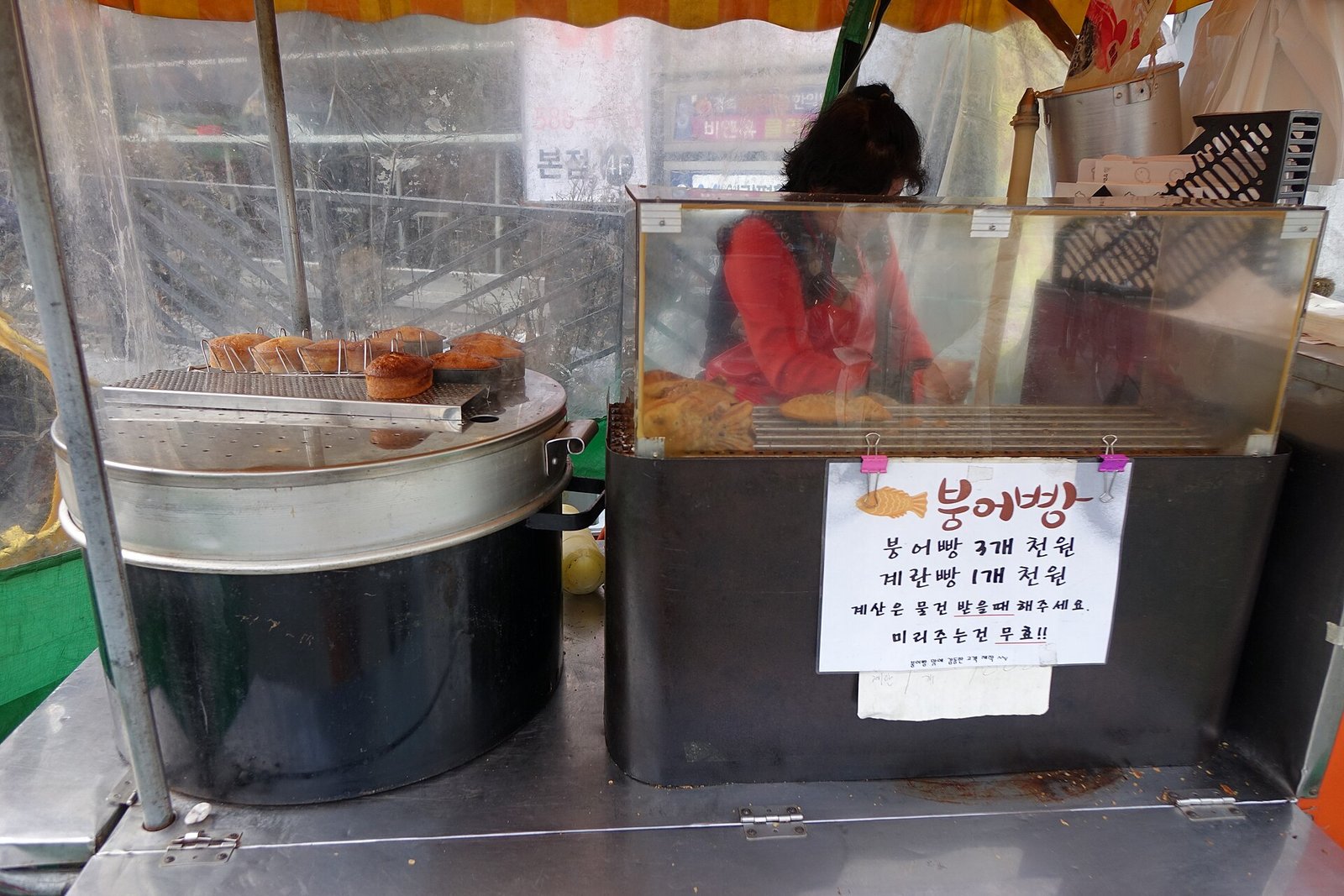
Featured photo: A Korean bungeoppang stall. The sign reads “Bungeoppang, three for 1,000 won” (about 75 cents). Photo: Choi Gwang-mo (최광모) / Wikimedia Commons, CC BY-SA 4.0.
Korea’s first internet star of winter 2026 has never been on TV. He is a young man who bakes bungeoppang (fish-shaped bread) at a street stall, and the internet calls him “Bung Eun-woo.” He sent back an offer to try out for a trot audition show with one line, “If I’m baking bungeoppang, when would I sing?”, and after he said no, he got more famous.
The line wasn’t really for the bungeoppang
Bungeoppang is a Korean winter street snack: batter and sweet red bean paste baked in a fish-shaped mold. When the weather turns cold, stalls pop up on neighborhood corners, and people buy a paper bag of them to warm their hands as they eat. “Bung Eun-woo” is short for “the Cha Eun-woo who sells bungeoppang.” Cha Eun-woo, the singer and actor of the K-pop group ASTRO, is so adored in Korea that his name works as everyday shorthand for a handsome face. In mid-October, word spread on social media that a young man baking bungeoppang at a stall in Gwangmyeong, just outside Seoul, resembled him, and the nickname stuck.
Soon the line was longer than the bungeoppang supply. One visitor posted that they “waited in line for about two hours.” Another shared a photo of people queuing with strollers and wrote, “This is fan-meeting level” (Dong-A Ilbo, Oct. 19). Swamped by crowds he never expected, he closed the stall for a day on October 18 and reopened on the 19th. He also works another job, he explained, and his body couldn’t keep up (News1, Oct. 26).
On October 22 he opened a Threads account and posted his first hello: “I’m the guy who bakes bungeoppang in Gwangmyeong. It’s getting cold, so watch out for colds.” The post passed 1.2 million views within a day, and he gained more than 3,000 followers (Money Today, Oct. 23). In the replies, people posted screenshots of their navigation apps showing a one-way trip of four to nine hours as proof they were coming (Newsis, Oct. 24).
“If I’m baking bungeoppang, when would I sing?”
The defining moment came the next day. When a user asked, “I heard you’re doing Miss (or Mister) Trot,” he replied: “I only got an offer. If I’m baking bungeoppang, when would I sing?” To a comment calling it “the calm before his entertainment debut,” he drew the line: “Sorry, but I started this business with no thought of debuting” (Money Today, Oct. 23). He did not say which show had approached him.
There’s a reason that answer hit so hard. In Korea, trot audition shows are the surest star factory there is. TV Chosun’s Mister Trot drew a 35.7% rating for its 2020 finale and turned Lim Young-woong into a national singer (Sports Chosun, March 27, 2020). For an ordinary person whose face has gone viral, going on TV is treated as the obvious next step. This young man turned down that step while standing at his bungeoppang mold.
The refusal became a megaphone. Before it, the coverage was about the stall closing for a day. From October 24, the day after he said no, Newsis, Financial News and The Korea Economic Daily put his answer in their headlines. On October 27, Yonhap News TV’s “Hot News Right Now” ranked “Gwangmyeong’s ‘Bung Eun-woo’ on entertainment rumors: ‘I have bungeoppang to bake'” No. 1 out of 20 stories. Under a Herald Business article, the most-liked comment, with 810 likes, was “He’s 100% debuting. I’d bet my hand on it.” The second, with 574, was “Broadcasters telling him to be a trot singer because he’s good-looking, without even knowing if he can sing.” On October 28, JTBC’s evening news went to the line, where a middle school student explained the nickname on camera: “Bungeoppang plus Cha Eun-woo, put together, makes Bung Eun-woo.”
The same day, News1 reported on a young man in China who sells chicken rice bowls at a night market in Ningbo, Zhejiang Province. His looks went viral, and his sales jumped from three or four bowls a day to as many as 130. News1’s headline called him “Bap Eun-woo,” bap meaning rice (News1, Oct. 28). In two weeks, a nickname born at one bungeoppang stall had become a template for naming someone in another country.
Bung-se-gwon, and why Koreans line up every winter
“Bung-se-gwon” blends bungeoppang with yeok-se-gwon, the word for a neighborhood near a subway station. Koreans call any neighborhood close to something good an “○-se-gwon,” and in winter, a neighborhood within walking distance of a bungeoppang stall is a bung-se-gwon. On October 23, First Lady Kim Hea-kyung, wife of President Lee Jae-myung, bought bungeoppang at an event and said that “the place I used to live was a bung-se-gwon” (News1, Oct. 23). Bungeoppang corners are only one stop on Korea’s street-food map, alongside Seomun Market’s night stalls in Daegu and the pocha tables of Seoul’s Jongno 3-ga after dark.
The Bung Eun-woo line is that winter habit stacked on top of Korea’s love of queuing as entertainment. In the same report, JTBC showed people who pitched tents and waited 11 hours outside a chapssaltteok (sweet rice cake) shop in Seoul’s Jamsil district, side by side with the bungeoppang line in Gwangmyeong. Lee Eun-hee, a consumer science professor at Inha University, explained that consumers look for “a story, an experience, fun” in the act of buying (JTBC, Oct. 28). One customer in the line said, “It’s the first time in my life an hour and a half has flown by this fast.” What you get at the end of a two-hour line is a bag of bungeoppang, plus the story that you bought it straight from the guy who said no to TV.
The stall became a star. The law has no place for it
The stall at the center of all this sits right on the edge of the law. A street stall that bakes and sells food has to clear two gates. Using the road requires an occupancy permit under Article 61 of the Road Act, and selling food requires a business report under Article 37 of the Food Sanitation Act. But the facility standards for that business report assume a regular shop, which a makeshift stall can hardly meet. Operating without a report can bring up to three years in prison or a fine of up to about $22,600 (30 million won) (iNews24, Oct. 26).
Seoul introduced a “street shop permit system” in 2019, but there is no nationwide rule, and every local government sets its own standards. Food trucks got their own tailored standards through a 2014 amendment to the enforcement decree, but bungeoppang stalls still have no such path (iNews24). The legal road to baking Korea’s signature winter snack is still this narrow.
People lined up to see a face that looked like Cha Eun-woo, but what they passed around was his answer that he’d rather bake bungeoppang.
Read next


Trending on Seol Notes
- Kim You-jung Cracked Japan Despite the 'Anti-Japan Drama' Label
- The Emperor of K-pop Came Back, and Korea Flipped
- Ae-sun Left the Baeksang Empty-Handed. Then She Spoke: IU
- K-pop News Today (Oct 27, 2026): IVE's EP Drop, ILLIT 'You're Under Arrest', LISA's 59M
- K-pop News Today (Oct 31, 2026): BTS's 'Arirang' Night in Brazil, JISOO's 'ADDICTED' Tops iTunes, NMIXX Win Music Bank
Sources
- Dong-A Ilbo, October 19, 2026
- Money Today, October 23, 2026
- News1, October 23, 2026: “bung-se-gwon”
- Newsis, October 24, 2026
- News1, October 26, 2026
- iNews24, October 26, 2026
- Herald Business, October 26, 2026 (comment likes checked early October 29, 2026)
- Yonhap News TV, October 27, 2026: Hot News Right Now
- JTBC, October 28, 2026: Close-Up Camera
- News1, October 28, 2026: “Bap Eun-woo”
- Sports Chosun, March 27, 2020: Mister Trot finale ratings
Discover more from Seol Notes
Subscribe to get the latest posts sent to your email.