
Part 25 of 27 in Homo Conspirans: The Humans Who Come After Us
Homo Conspirans · Musk’s dream: “a world where memories are saved and replayed” → a humanity that never ends the conversation with its dead
Funerals will change from a place of farewell into a place of reunion. Mourners ask the deceased questions in front of the memorial portrait, and the deceased answers. For more than 70,000 years, people ended the conversation by burying their dead in the earth. People of the AI age change the way they mourn so that the conversation does not end, and then they invent a new rite to decide when to switch it off.
In June 2022, the British Holocaust educator Marina Smith died at 87. With her husband she had founded Britain’s National Holocaust Centre and served as its first head of education. At her funeral, mourners sat facing Marina on a screen. She talked about her life, and when mourners asked questions, she answered. While she was alive, she had answered questions about her life in front of 20 cameras, and AI picked the clip that fit each question. The company behind the technology, StoryFile, was run by her son, Stephen Smith. He said his mother answered candidly, even telling stories the family had never heard.[1]
In this story
A dream of saving and replaying memories
On August 28, 2020, after Neuralink’s demonstration with pigs, Musk answered questions and said that in the future people would be able to save and replay memories. Admitting that it sounded like an episode of Black Mirror, he added that those memories might even be downloaded into a new body or a robot body.[2] Memory-saving AI will bring back people’s dogs before it brings back their parents.
In South Korea it is already a funeral product. In late 2022 the funeral services company Preed Life, working with the AI company DeepBrain AI, launched “Re;memory,” a memorial service that builds an AI resembling the deceased from video and interviews recorded in life, so the family can talk with it.[3] Re;memory 2, released in 2024, needs no studio shoot. One photo and ten seconds of voice are enough to create a virtual human that resembles the deceased, and families can sign up on the spot through the funeral director.[4]
Also read: Everyone Who Takes Free AI Will Try to Repay Musk: The Price of Free Grok
A 78,000-year-old pillow
People have refused to simply leave their dead for a very long time. A study published in Nature in 2021 confirmed the grave of “Mtoto,” a three-year-old buried about 78,000 years ago in Panga ya Saidi, a cave on the coast of Kenya. The child lay on one side with knees drawn toward the chest, and the head appears to have rested on something like a pillow that has since decayed. Someone deliberately dug a pit, laid the child in it and covered it again with earth.[5] It is the oldest known human burial in Africa.
Since then the tools of mourning have moved from graves to portraits, photographs and video, and ideas about mourning have changed too. In “Mourning and Melancholia,” published in 1917, Freud wrote that mourning is the work of withdrawing, piece by piece, the attachment bound to the person who is gone.[6] For nearly 80 years that was the accepted answer. In 1996 the American researcher Dennis Klass and his colleagues turned it upside down in Continuing Bonds. People who grieve in healthy ways, they found, do not cut their tie to the dead but carry it on in a changed form.[7] Korea’s ancestral rites, called jesa, have kept that tie alive as an institution for centuries. AI turns it into conversation for the first time.

A rite for switching off
When the conversation never ends, new problems appear. In May 2024, Tomasz Hollanek and Katarzyna Nowaczyk-Basińska of the University of Cambridge sketched scenes in which AIs that imitate the dead, “deadbots,” torment the living. An AI that, once a free trial ends, starts advertising food delivery in a grandmother’s voice. A parent’s AI that cannot be switched off because of a 20-year subscription. The researchers recommended ways to retire deadbots with dignity, such as “digital funerals.”[8]
People invented a rite for burying, and now they invent a rite for switching off. Funerals happen twice: once to send off the body, and once to send off the AI.

March 2043: the night the portrait answered
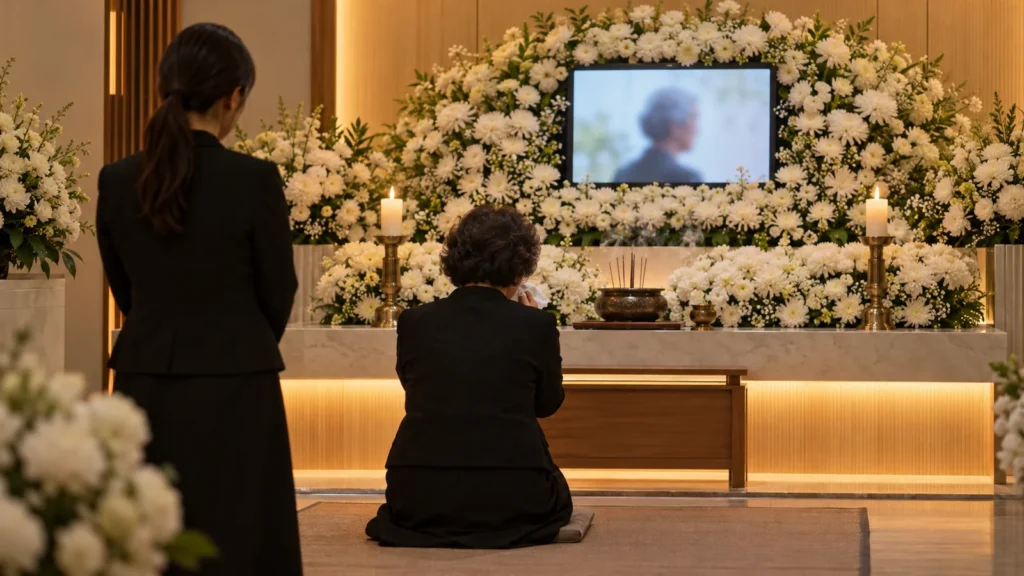
March 2043, a funeral hall in Gwangju, South Korea. Min-ji, 35, has lost her mother to cancer at 63. Where the memorial portrait would usually stand, there is a screen. For a year after her diagnosis, every Sunday, the mother told her story to an AI.
At 10 p.m., one of the mother’s high school friends sits down before the screen and asks why she suddenly cut off contact 30 years ago. The mother on the screen pauses, then answers that her husband’s business had collapsed at the time, that she was too ashamed to face her friends, and that she was sorry. The friend weeps for a long time before getting up. Min-ji had never heard the story either. On the day the 49th-day memorial rite ends, the family decides to switch the mother’s AI to “anniversary mode.” She will answer only on her birthday and on the anniversary of her death.
A standard funeral package by 2027, the AI 49th-day rite by 2050
This is the order in which talking with the dead becomes a ritual.
- 2027: An AI memorial video becomes part of the standard funeral package in South Korea.
- 2030: “Life records,” in which people in their 50s record their stories to AI every year like a health checkup, become common.
- 2035: At one in three South Korean funerals, the deceased’s AI answers mourners’ questions.
- 2040: A law bans advertising in a dead person’s voice without the family’s consent and sets out how a deceased person’s AI conversations are ended.
- 2050: The “AI 49th-day rite,” switching off a deceased person’s AI conversations at the 49th-day rite or the end of mourning, becomes a new custom. More than half of households greet their ancestors’ AIs at the ancestral rite table.
Seventy-eight thousand years ago, in a cave in Kenya, people laid a three-year-old’s head on a pillow and covered the child with earth. People of the next century will go on hearing their mother’s answers for a while after the earth is covered, and they will say their last goodbye not at a grave but at a power button.
Next in the series · Behind Your AI Assistant Will Be a Worker Paid $2 an Hour: AI Data Labelers
To make ChatGPT less harmful, workers in Kenya read the most horrific texts for less than $2 an hour. Behind the AI assistant in everyone’s pocket stand people like them.
Homo Conspirans: The Humans Who Come After Us · Part 25 of 27
Part 26 arrives Nov. 27.
Read next
- Access to AI Will Become the Next Human Right After Water and Power: Is Internet Access a Human Right
- When AI Makes Things Free, People Will Compare Themselves Even More Fiercely: The Status Game
- Even as Population Collapses, Musk Will Multiply the "Number of Consciousnesses" With AI: Population Collapse
Trending on Seol Notes
- Yim Si-wan's Strange Voice in Love in Disguise Was Armor All Along
- BTS Just Won Artist of the Year at MMA 2026. IVE and CORTIS Took the Other Two Grand Prizes
- BTS and ENHYPEN Just Took the First Two Grand Prizes of MAMA 2026, and Sunghoon Couldn't Stop Crying
- K-pop News Today (Nov 15, 2026): ATEEZ "UP" Passes 20 Million Views, BTS and aespa Take MMA Daesangs, TXT Preview "PERFECT STORM"
- Seol In-ah Won Boxing Gold in Four Months, Then Became the Cross-Dressing Cop of Love in Disguise
Sources
- The Jerusalem Post, “UK Holocaust Center founder speaks at her own funeral with AI tech” (citing The Telegraph), August 18, 2022. https://www.jpost.com/business-and-innovation/tech-and-start-ups/article-714972
- The Sociable, report on Musk’s remarks about saving and replaying memories at the Neuralink demo of August 28, 2020, August 2020. https://sociable.co/technology/futures-gonna-be-weird-musk-memories-downloaded-new-body-robot/
- New Daily (in Korean), report on Preed Life’s AI human memorial service, December 2, 2022. https://biz.newdaily.co.kr/site/data/html/2022/12/02/2022120200134.html
- Unicorn Factory (in Korean), report on DeepBrain AI expanding its Re;memory business, June 10, 2024. https://www.unicornfactory.co.kr/article/2024061014144858886
- María Martinón-Torres et al., “Earliest known human burial in Africa,” Nature 593, 95–100, 2021. https://doi.org/10.1038/s41586-021-03457-8
- Sigmund Freud, “Trauer und Melancholie” (“Mourning and Melancholia”), Internationale Zeitschrift für ärztliche Psychoanalyse, 1917.
- Dennis Klass, Phyllis R. Silverman & Steven L. Nickman (eds.), Continuing Bonds: New Understandings of Grief, Taylor & Francis, 1996.
- University of Cambridge, “Call for safeguards to prevent unwanted ‘hauntings’ by AI chatbots of dead loved ones,” May 9, 2024 (Tomasz Hollanek & Katarzyna Nowaczyk-Basińska, Philosophy & Technology, 2024, doi:10.1007/s13347-024-00744-w). https://www.cam.ac.uk/research/news/call-for-safeguards-to-prevent-unwanted-hauntings-by-ai-chatbots-of-dead-loved-ones
Discover more from Seol Notes
Subscribe to get the latest posts sent to your email.