
Part 2 of 27 in Homo Conspirans: The Humans Who Come After Us
Homo Conspirans · Musk’s dream: “symbiosis between AI and humans” → a humanity that thinks as one
Eight billion brains linked through AI will end up moving like a single living thing. Cells came together into bodies, ants came together into colonies, and people will come together into a global brain. The biggest leaps in the history of life have always happened this way, when things that once lived apart fused into one.
In April 2002, researchers at the University of Lausanne in Switzerland published a strange ant story in PNAS. The Argentine ant, an import from South America, had formed one giant colony stretching 6,000 kilometers from the Italian Riviera to Spain’s Atlantic coast. Millions of nests, billions of workers. When the team put ants from nests hundreds of kilometers apart into the same arena, they did not fight. They behaved like housemates. When they met ants from a separate colony in northeastern Spain, they attacked at once.[1]
A single ant knows nothing. It does not memorize routes or see the map. Yet billions of them, trading signals by scent, find food, build trails and drive off rivals. In 1911 the entomologist William Morton Wheeler argued that such a colony should be treated as one animal and called it a “superorganism.”[2]
In this story
Life leaps forward when things merge
In 1995 the evolutionary biologists John Maynard Smith and Eörs Szathmáry boiled four billion years of life down to eight “major transitions.” Free-floating molecules were bundled into chromosomes. Two bacteria merged into a complex cell. Cells joined into bodies. Bodies joined into the colonies of ants and bees. The last transition was human society with language.[3]
Every transition follows the same formula. Units that could once survive alone get wired together by denser signals until they can no longer survive alone. A liver cell dies outside the body. A worker ant dies outside the colony. And the merged whole does things its parts never could.
Also read: He Handed Out Flyers as a Boy. Then Dior Homme Put Him on a Paris Runway
Humanity’s nervous system runs through two thumbs
Humans are already half merged. In September 2011, players of the online protein-folding game Foldit solved the structure of an enzyme from a monkey virus closely related to HIV. Scientists had failed at it for 15 years. Thousands of players chipped in as if it were a game and produced the answer in about ten days.[4] Wikipedia, open-source code and the questions and answers piled up behind every search box are all memory running outside any single head.
The connection is just slow. In his 2022 TED interview, Musk put his finger on the bottleneck. Humans have a limbic system for instinct and a cortex for thought, and phones and computers have become a third layer of intelligence, but the channel between us and that layer is far too narrow. “We’re limited by these two little meat sticks, our thumbs,” he said, at about 10 bits per second, maybe 100 at best. Neuralink’s goal, he said, is to turn that “tiny straw” into “a giant highway.”[5]
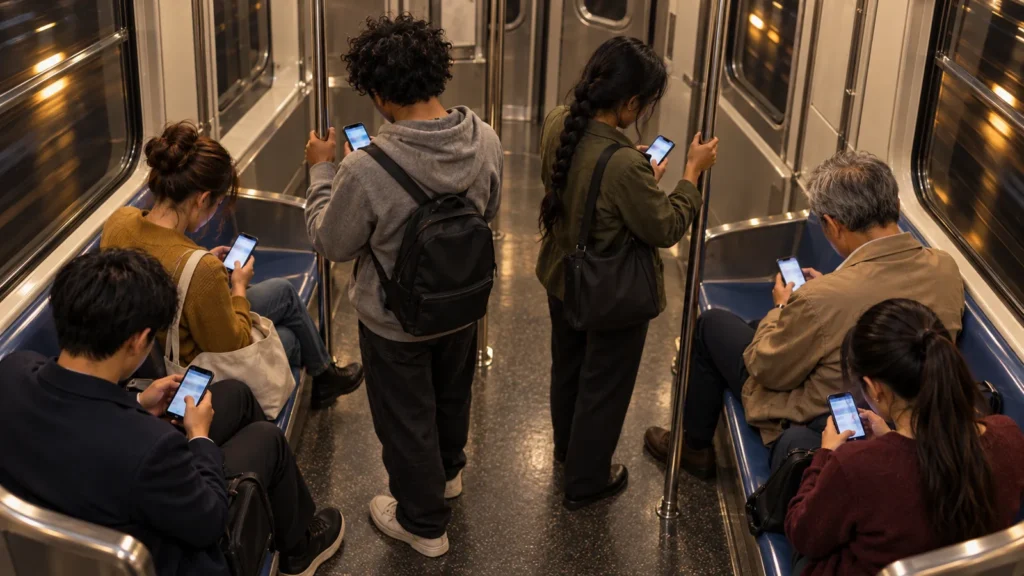
Ants have scent. Humans have AI: a network that takes the questions of billions at once and hands the answers back to billions. The day that network reaches the brain directly instead of passing through two thumbs, humanity crosses a ninth transition. Experiments have already wired one brain to another.
The noosphere, a layer of thought covering the Earth
In The Phenomenon of Man, published in 1955, the French Jesuit priest and paleontologist Pierre Teilhard de Chardin wrote that the Earth has evolved by laying down layers. On top of the layer of rock came a layer of life, the biosphere, and on top of that comes a layer of thought, the noosphere. As the noosphere grows denser, he predicted, humanity converges into a single consciousness.[6]
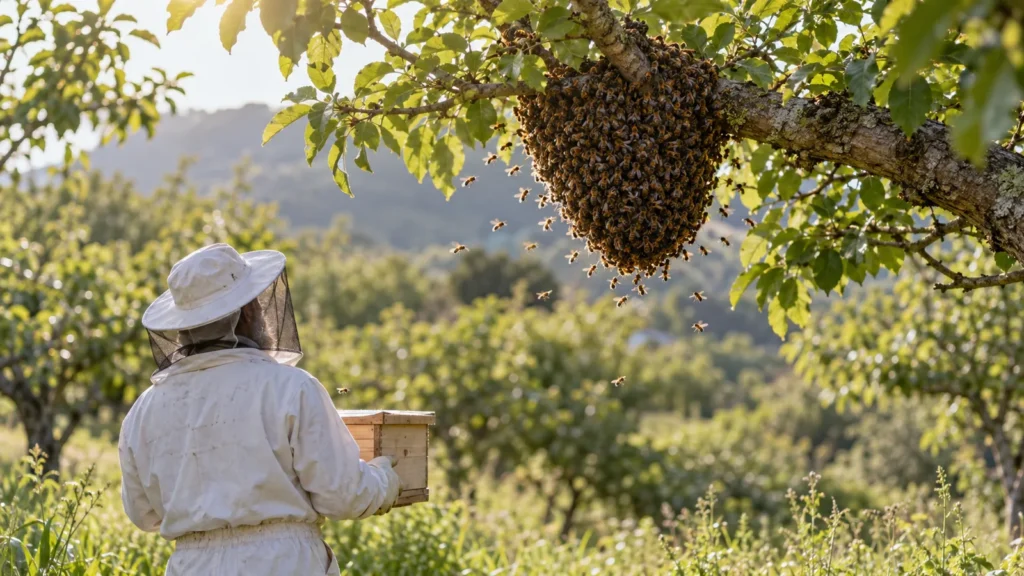
Honeybees show how such a convergence makes decisions. When a swarm leaves the hive to find a new home, hundreds of scout bees visit candidate sites and report back by dancing. The better the site, the longer a scout dances, and once enough bees back the same site to cross a threshold, the whole swarm takes off. There is no leader. The biologist Thomas Seeley called it “honeybee democracy,” and the swarm usually picks the best site on offer.[7] A humanity with a finished noosphere decides the same way. The judgments of hundreds of millions gather through AI in seconds, and when they cross the threshold, the whole society moves.
August 2061: a decision made in 11 seconds
It is 47 degrees Celsius, 117 Fahrenheit, on an August afternoon in 2061, and the power grid of a city of 9 million has hit its limit. Unless air conditioning comes down, the city goes dark within 20 minutes. In the old days the mayor would have called a meeting and officials would have drawn up rolling blackouts block by block.
This time the consent of the connected moves first. The same situation reaches 6 million residents who wear always-on links, all at once. Each person’s AI weighs the elderly and the children at home, the refrigerator holding medicine, who has the day off, and offers up the power that household can spare. Eleven seconds later, citywide demand drops by 8 percent. Nobody asks who gave the order. Some residents later describe the moment the same way: they have no memory of thinking it over, only the feeling that they had already decided.

2075: the first decision no one can explain
This is the order in which humanity becomes a superorganism.
- 2030: More than half of the world’s adults put questions every day to the same handful of AI models. Human memory and judgment begin flowing through one shared network.
- 2035: A city of more than a million sets its budget priorities by pooling the views of every resident’s AI assistant.
- 2045: Ten percent of adults in rich countries use always-on AI links. The thumb’s 10 bits per second gets close to the speed of the brain for the first time.
- 2061: Disaster response in big cities happens in tens of seconds through the linked consent of residents.
- 2075: For the first time, it is officially recorded that a network of hundreds of millions has made a decision that no single person can explain. Just as a liver cell does not know the body’s plan, people begin not knowing humanity’s plan.
A worker in the Argentine ant supercolony never learns that it belongs to something 6,000 kilometers long. It simply does not bite a stranger from a distant nest. The first generation of the global brain lives the same way. Finding that a total stranger is already thinking the same thought does not strike them as strange.
Next in the series · Children Raised by AI on Musk’s Mars Will Evolve Bodies That Can Never Return to Earth: How Humans Would Evolve on Mars
Ray Bradbury set the scene where a family that left Earth becomes Martian in “October 2026.” Children born on Mars and raised by AI will grow bodies that can never come home.
Homo Conspirans: The Humans Who Come After Us · Part 2 of 27
Part 3 arrives Oct. 29.
Read next

Trending on Seol Notes
- The Emperor of K-pop Came Back, and Korea Flipped
- The No. 1 Korea Doesn't Want to Believe: Why Fans Doubt A2O
- Korea, Season by Season: May 2025 to October 2026
- K-pop News Today (Oct 27, 2026): IVE's EP Drop, ILLIT 'You're Under Arrest', LISA's 59M
- IU and BTS's Suga Both Sang Him. Who Was Kim Kwang-seok?
Sources
- Tatiana Giraud, Jes S. Pedersen & Laurent Keller, “Evolution of supercolonies: The Argentine ants of southern Europe,” PNAS 99(9), 6075–6079, April 16, 2002. https://pmc.ncbi.nlm.nih.gov/articles/PMC122904/
- William Morton Wheeler, “The ant-colony as an organism,” Journal of Morphology 22(2), 307–325, 1911.
- John Maynard Smith & Eörs Szathmáry, The Major Transitions in Evolution, Oxford University Press, 1995.
- Firas Khatib et al., “Crystal structure of a monomeric retroviral protease solved by protein folding game players,” Nature Structural & Molecular Biology 18, 1175–1177, 2011. https://doi.org/10.1038/nsmb.2119
- TED, “Elon Musk: A future worth getting excited about,” interview with Chris Anderson, recorded April 6, 2022, transcript. https://www.ted.com/talks/elon_musk_a_future_worth_getting_excited_about/transcript
- Pierre Teilhard de Chardin, The Phenomenon of Man (Le Phénomène humain), 1955.
- Thomas D. Seeley, Honeybee Democracy, Princeton University Press, 2010.
Discover more from Seol Notes
Subscribe to get the latest posts sent to your email.