
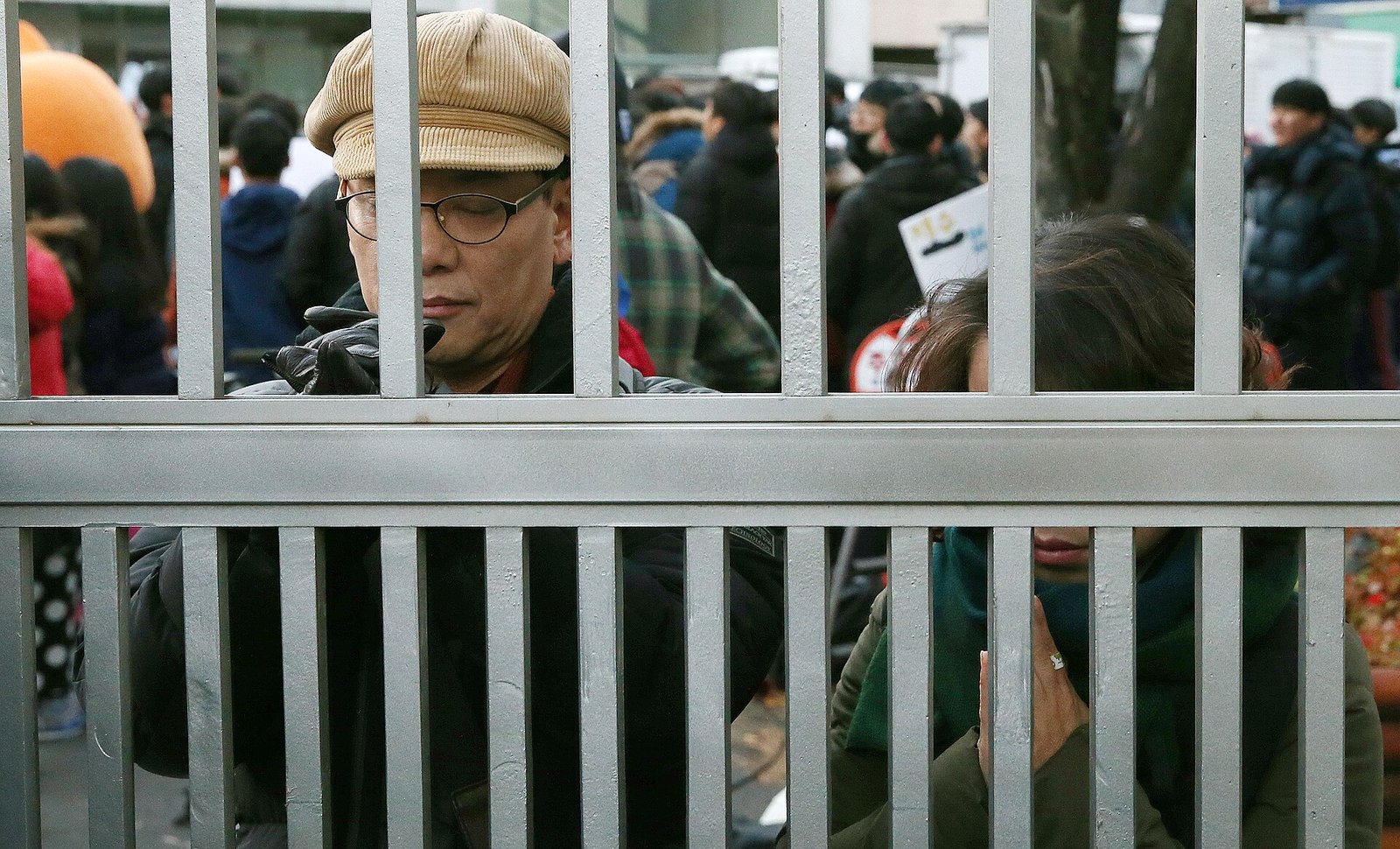
Featured photo: Parents wait outside the gate of a Suneung test site in Seoul (2014). Photo: Republic of Korea (Korea.net / Ministry of Culture, Sports and Tourism), CC BY-SA 2.0, via Wikimedia Commons.
At 8:30 a.m. on November 19, every phone in South Korea went off at once. It was an emergency alert, the kind you cannot block or silence, and it rang twice more, at 2:21 p.m. and 2:57 p.m. Inside the test sites of the College Scholastic Ability Test, the Suneung, that sound alone exposed 49 students hiding phones. Three days earlier, the YouTuber known as “Chungju-man,” Kim Seon-tae, had put on AI glasses, sat a civil service exam, scored 25 and asked, “Can you even tell?” Korea’s answer: no, so we ring everything.
The 25-point glasses
Kim Seon-tae is the civil servant who turned the city of Chungju’s YouTube channel into a national hit, and he now runs his own channel under that nickname. On November 16 he went live wearing black horn-rimmed AI glasses and a bow tie with a tiny camera in it, after screenshotting a comment that said “Chungju-cat, explain yourself” (JoongAng Ilbo, November 17). He took the 20 Korean-language questions from this year’s grade-9 local civil service exam without edits and got 5 right. The stream showed him swinging his head around so the glasses could read the long passages.
That was where the laughing stopped. At the end of the stream he said, “Can you tell this apart? You can’t, even when you look,” and “Students in horn-rims are going to get blamed for nothing” (Xportsnews, JoongAng Ilbo, November 17). What the 25 points proved was not that the AI was clumsy. It was that nobody looking at a pair of glasses and a bow tie could spot the machine.
Watch the stream on Kim Seon-tae’s YouTube channel (in Korean).
Also read: Kang Min-ho Put On the Catcher's Mask With a Cracked Rib and Got His First Ring in 23 Years
The camera that made a top scorer
The record that nobody laughed at came out the same week. On November 15, the top scorer of this year’s licensed tax accountant exam confessed that in both rounds he had photographed the questions with a hidden micro camera, sent them to a generative AI and received the answers on a smartphone. He missed one of 160 questions in the first round, for 397.5 points, and the two proctors in the room noticed nothing (MBC, November 16).
The Suneung was four days away. The government made students leave their bags in the hallway, put stickers on every button of their clothes, ordered glasses checked every period and allowed only black pencils. It added about 8,400 more proctors (Munhwa Ilbo, November 17; Busan Ilbo, November 18). And as a last resort, it chose an alarm no one could refuse.
The alert that rang three times
The first alert came as announced, at 8:30 a.m., just before first period. The second and third came without warning in the middle of the exam. By the Ministry of Education count I checked, the 8:30 alert caught 31 students, the 2:21 alert 11 and the 2:57 alert 7 (Vice Minister Choi Eun-ok’s briefing, reported by Kangwon Domin Ilbo and Seoul Economic Daily, November 19). Phones on students’ bodies and phones in bags out in the hallway rang just the same.
Beyond the alerts, Wi-Fi signal detection and other checks found 44 more students carrying electronic devices, and in 5 cases a device was actually used during the test: a phone photo of the question sheet, a phone used in a restroom, smart glasses, and a micro camera with wireless earbuds. As of 4:37 p.m., after fourth period, the total stood at 98, and the ministry ruled every one of them a cheating case (same briefing). Among students and parents, people were already saying “there must be more who didn’t get caught” (Dong-A Ilbo, November 20).
Korea is already the country that halts takeoffs and landings during the Suneung’s English listening section. This year, it added every phone in the nation.
Morning in Myeongdong
The alert sounded just as loudly outside the test sites. At 8:30, in a Myeongdong restaurant known to foreign tourists as a breakfast spot, alarms burst out from every table and customers asked, “Is this an emergency?” Only after the owner explained that it was “a text for the college entrance exam” did their faces relax. A tourist from Russia, in the shower when the alarm went off, said, “I was shocked, I thought it was an emergency… the alert was in Korean so I couldn’t read it.” A Japanese tourist on a third trip to Korea for the idols said, “I knew about the Suneung from idols cheering students on, but I didn’t know about the emergency alert” (Edaily, November 19).
The foreign press heard it too. The New York Times called it an “unusual measure,” using an alert meant for natural disasters and wartime to catch cheaters. AFP wrote that Seoul was waging an “all-out war” on AI cheating. Bloomberg described subway staff making extra announcements to calm startled passengers, and said the move showed how hard AI cheating is to stop and what confusion it can cause (Yonhap, Edaily, November 19).
Kang Sung-tae, the “god of studying” who has taken the Suneung himself every year, stayed home this time. “I think I’d just get in the way,” he said. “Every student has become a potential cheater” (Money Today, November 19).
The 25-point glasses were a joke. The camera that made a top scorer was a scandal. Because no eye could tell the two apart, Korea rang every phone in the country three times, and 49 pockets and bags answered.
Update, November 24: Three days after the exam, the education minister resigned over the Suneung chaos, five test-takers were reported to police, and the reward for a single cheating tip rose to ₩500 million (about $372,000).
Read next



Trending on Seol Notes
- Yim Si-wan's Strange Voice in Love in Disguise Was Armor All Along
- K-pop News Today (Nov 15, 2026): ATEEZ "UP" Passes 20 Million Views, BTS and aespa Take MMA Daesangs, TXT Preview "PERFECT STORM"
- There Are No Seats Left at the Online Temple Where You Can't Talk to Anyone
- BTS Just Won Artist of the Year at MMA 2026. IVE and CORTIS Took the Other Two Grand Prizes
- Once Called a "0% Actor," Park Jinyoung Took Double-Digit Ratings and a Sold-Out Concert in One Weekend
Sources
- Ministry of Education vice minister briefing (November 19), as reported by Kangwon Domin Ilbo and Seoul Economic Daily
- Dong-A Ilbo, November 20, 2026
- Edaily tourist report, November 19, 2026, Edaily on foreign press, November 19, 2026, Yonhap on foreign press, November 19, 2026
- JoongAng Ilbo, November 17, 2026 (Kim Seon-tae’s stream)
- MBC, November 16, 2026 (tax accountant exam top scorer)
- Munhwa Ilbo, November 17, 2026 (emergency alert plan), Busan Ilbo, November 18, 2026 (black pencils)
- Money Today, November 19, 2026 (Kang Sung-tae)
Discover more from Seol Notes
Subscribe to get the latest posts sent to your email.